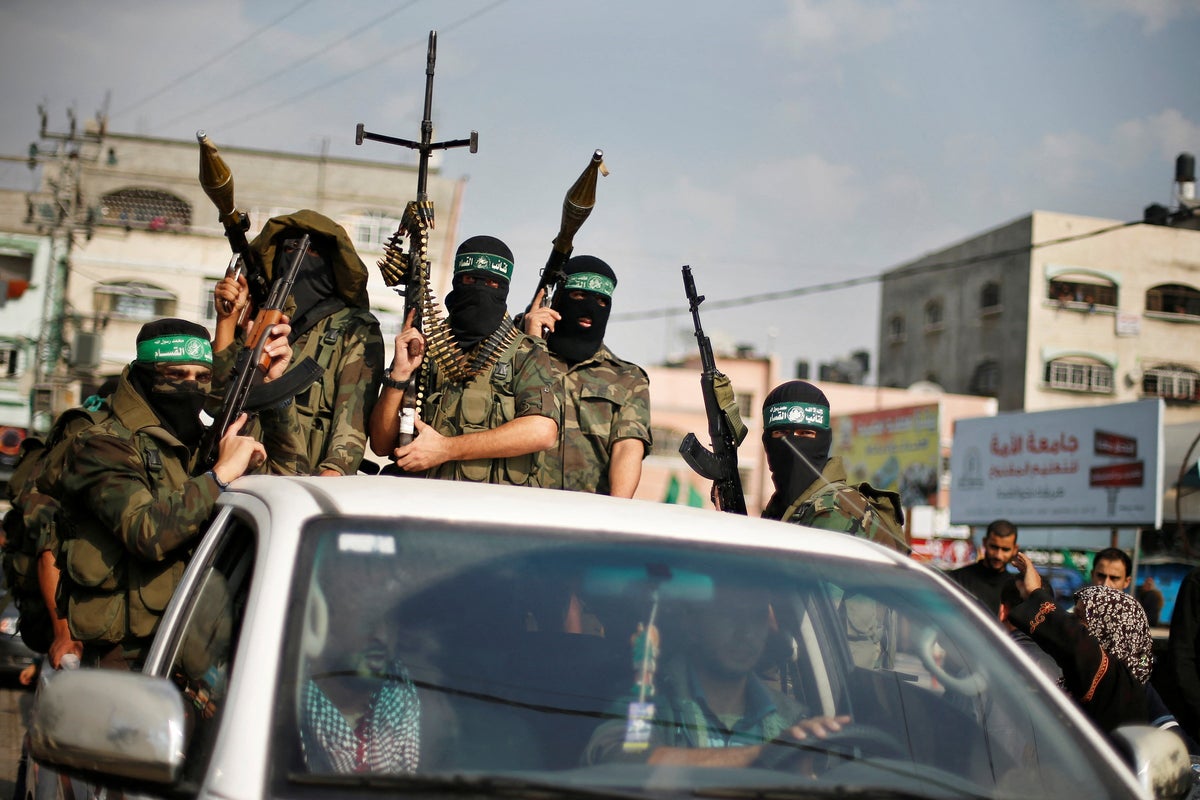
Everybody wants to talk about sequencing. Does disarmament come before withdrawal, or does withdrawal happen while militant infrastructure remains fully intact? The mainstream media loves this debate because it is clean, structured, and entirely useless. It treats a violent existential conflict like a corporate merger negotiation where both sides just need to sign a term sheet with a better sequence of closing conditions.
Stop asking the wrong question. Also making waves lately: Inside the Quetta Coal Mine Crisis Where Safety Regulations Go to Die.
The lazy consensus dominating international headlines right now assumes that peace is a mechanical problem of timing. Get the order of operations right—first the rockets go away, then the tanks roll back, or vice versa—and stability magically follows. This is diplomatic fantasy. It ignores the structural incentives of asymmetric warfare, where the actors involved do not measure success by GDP growth or territorial sovereignty, but by endurance and narrative control.
I have spent years watching diplomats and foreign policy wonks try to engineer blueprints for regions they only understand through policy briefs and sanitized intelligence summaries. They treat militant groups like rational actors in a Western economic model, expecting them to trade short-term military capability for long-term civil development. They ignore the foundational reality of the conflict: disarmament is not a concession; it is suicide for an insurgency whose entire brand is armed resistance. Further information on this are detailed by Reuters.
The Disarmament Delusion
Let us define terms accurately. When international negotiators demand disarmament from a non-state actor like Hamas, they are not asking for a weapons handover. They are demanding the complete liquidation of the group's political currency. In asymmetric conflicts, the gun is the ballot, the legislature, and the PR department combined.
Expectations that a militia will voluntarily surrender its arsenal because a foreign leader tweets about a milestone reveal a profound misunderstanding of how irregular forces survive. Imagine a scenario where a militant group hands over its last rocket launcher. Within six months, internal rivals, regional proxies, and aggrieved civilian populations carve up whatever authority that group had left. Disarmament without structural replacement equals immediate political annihilation. No leadership group signs off on its own execution, regardless of what is written on a piece of paper in Washington or Cairo.
Conversely, the demand for immediate military withdrawal while hostile tunnels, embedded rocket caches, and command nodes remain operational is equally absurd. No sovereign state with a functioning defense apparatus will pull its forces back while an active threat sits fifty yards across a border, waiting for the smoke to clear to rebuild its supply lines.
The deadlock is not a communication error. It is a collision of two incompatible survival strategies.
Dismantling The Sequencing Myth
The conventional wisdom promoted by commentators is that if Donald Trump or any other mediator can just twist enough arms, both sides will compromise on the timeline. This is where the analysis completely collapses.
Compromise requires shared goals. Here, the goals are zero-sum.
- The State Objective: Permanent neutralization of cross-border security threats and the restoration of a defensible territorial perimeter.
- The Insurgent Objective: Preservation of the capability to strike, maintain recruitment pipelines, and control the political narrative through perpetual crisis.
You cannot split the difference between neutralization and survival. Any agreement that allows a militant faction to retain dual-use infrastructure under the guise of civilian governance is merely a ceasefire masquerading as an end to war. It is a designated breathing room, a tactical pause utilized to re-arm, retrain, and reset for the next escalation.
We saw this playbook run repeatedly over the last two decades. Every single time a major milestone is celebrated, stockpiles double during the quiet phases. The international community loves the optics of a signed document because it temporarily lowers stock market volatility and keeps cable news anchors from broadcasting live sirens. But the peace it buys is synthetic. It is debt financing for future violence, with the interest paid in civilian blood.
The Cost of Professional Optimism
Diplomacy has a corruption problem, and it is entirely professional. Career negotiators, think-tank fellows, and special envoys have an institutional incentive to declare progress where none exists. If an envoy admits that a conflict is structurally intractable under current parameters, their budget gets cut, their panel invites dry up, and their memoir loses its punchy thesis.
Therefore, every incremental procedural agreement gets inflated into a historic breakthrough. A minor border corridor opening or a prisoner exchange protocol gets framed as a major milestone in the peace process. This is institutional gaslighting on a global scale.
I have watched companies and organizations blow millions chasing bad strategies because senior leadership refused to admit a project was fundamentally broken from day one. International diplomacy operates the exact same way on a trillion-dollar scale. Admitting that disarmament is impossible under current political conditions requires admitting that the entire mediation framework is obsolete. So instead, they double down on the sequencing debate. They argue over whether withdrawal precedes disarmament because arguing about mechanics prevents them from confronting reality.
The Alternative Paradigm
If the standard playbook is broken, what actually works? Let us look past the polite fiction of negotiated disarmament.
Real stabilization in deeply fractured zones does not begin with political agreements between belligerents; it begins with the absolute destruction of the military utility of violence, followed by the tedious, unglamorous imposition of alternative governance and economic dependency that makes radicalization mathematically unprofitable.
This is not a clean process. It is harsh, protracted, and completely devoid of the photogenic handshakes that politicians crave. It requires accepting that some conflicts cannot be resolved through treaties because one or both sides derive too much value from the fight itself.
When you strip away the diplomatic varnish, the choice facing regional actors is brutally simple. Either the security architecture of the region is completely rewritten to eliminate non-state military autonomy by force, or the cycle of temporary ceasefires and inevitable explosions continues ad infinitum.
There is no third option where everyone agrees to lay down their arms because a foreign president calls it a historic milestone.
Stop buying the timeline. Stop pretending that sequencing can solve a contradiction.
The next time an expert tells you that peace is just a matter of getting the order of operations right, check to see who is paying their salary. Peace does not fail because the steps were out of order. It fails because one side's existence depends on the war never ending.


