The screen glows in the predawn quiet, casting a cold blue hue across an empty desk. Somewhere in Cupertino, a server hums, holding the precise coordinates of a world built by algorithms. To a satellite orbiting hundreds of miles above the earth, water is just water. It does not care about borders, or flags, or the shifting whims of political gravity. Lake Ontario stretches across thousands of square miles of North America, an inland sea of slate and steel, indifferent to the humans who trace its shores.
Yet, digital cartography has never been an entirely objective science. Lines are drawn by human hands, or at least by human intent translated into code. Every map is an argument about ownership, history, and power.
Consider what happens when a former president decides to rewrite the physical atlas from the comfort of a digital interface.
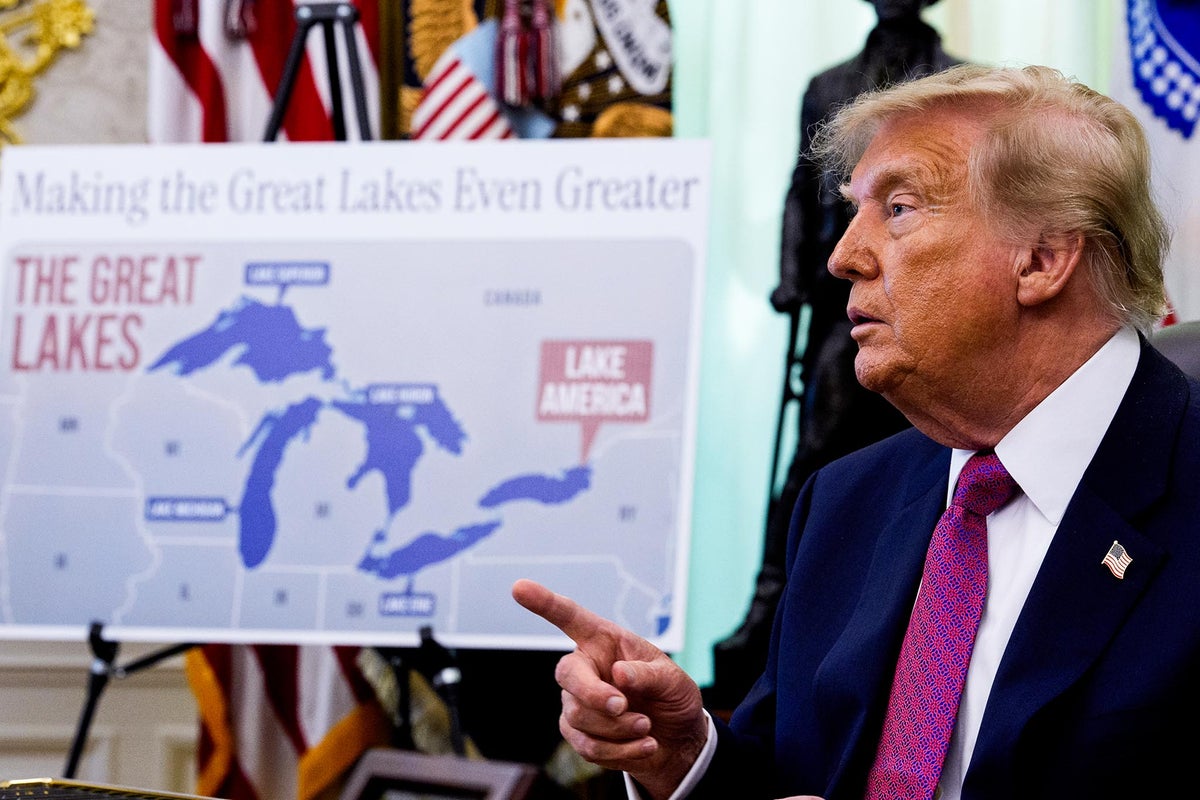
Donald Trump recently claimed that Apple Maps has quietly altered its interface to rename Lake Ontario as Lake America, declaring the change complete, ratified, and binding. It is a stunning assertion, born from the peculiar intersection of political performance and digital ubiquity. For anyone who has ever stared at a glowing smartphone screen while trying to navigate a strange city, the idea that a multi-trillion-dollar technology corporation would casually rebrand a major international body of water at the behest of a single political figure sounds absurd.
It is absurd. But it also reveals something profound about how we view truth in the modern era.
We live in a time when the boundaries between physical reality and digital representation have blurred into near-invisibility. When a map on a phone tells you a route is blocked, you turn. When a label changes on a screen, your perception of the world shifts, even if just for a fraction of a second. The map has long replaced the territory in our daily lives. Whoever controls the interface controls the narrative.
Let us step back for a moment and look at the mechanics of how maps actually change. Corporations like Apple and Google do not wake up and redraw international landmarks on a whim. Their mapping systems rely on complex aggregations of geographic data, local government inputs, and automated boundary-detection algorithms. Disputed territories and sensitive geopolitical names are handled with extreme caution, often changing dynamically based on the IP address and location settings of the user viewing them.
Sometimes, what one person sees on their screen is a reflection of customized data, localized anomalies, or algorithmic quirks. Sometimes, it is simply a joke that metastasizes into a news cycle.
Yet Trump’s claim taps into a deeper, more visceral desire. To name something is to conquer it. Throughout history, rulers have stamped their identities onto the geography of the earth, carving names into stone, renaming cities after generals, and coloring vast swathes of parchment with the hues of empire. Today, the modern empire is digital. The monuments are built in silicon and software code.
When a prominent leader claims ownership over a digital rendering of a lake, he is participating in an ancient ritual. He is trying to bend the tools of the modern world to fit an old-fashioned imperial fantasy. He looks at a screen and sees not a neutral navigational aid, but a canvas waiting for his signature.
Walk down to the actual shoreline of Lake Ontario on a bitter November morning. The wind whips off the water, smelling of damp earth and distant ice. Gulls wheel overhead through a sky the color of a wet slate shingle. Touch the water. It is freezing, ancient, and utterly unmoved by what any politician types into a social media post. The waves crash against the concrete breakwaters of Toronto and Rochester with a rhythmic, indifferent force.
Nature does not update its terms of service.
And yet, the digital echo chamber reacts instantly. Within hours of the claim, feeds are flooded with commentary, fact-checks, disbelief, and mockery. People pull out their iPhones, open Apple Maps, and zoom in frantically, searching for the phantom new name. They look at the blue expanse, find the standard, unchanged label, and let out a collective breath.
Nothing changed. Everything changed.
The episode highlights a vulnerability in how we consume information. We are primed to believe that our digital tools are malleable, subjective, and prone to manipulation. Because technology platforms have enormous power to shape public perception, almost any claim about their behavior feels plausible. If an algorithm can alter election outcomes or reshape social discourse, why couldn't it rename a lake?
This is the invisible stakes of our current technological moment. We have outsourced our sense of place to black-box systems owned by a handful of massive corporations. When those systems become objects of political posturing, the ground beneath our feet feels a little less stable. We start questioning not just the news, but the very instruments we use to navigate the physical world.
The absurdity of Lake America serves as a mirror. It reflects our collective anxiety about a reality that feels increasingly negotiable. When facts can be spun like yarn and digital interfaces can be hallucinated into existence through sheer rhetorical force, the line between satire and strategy dissolves entirely.
The screen goes dark. The blue glow fades from the desk. Outside the window, the world remains stubbornly physical, waiting for morning, untouched by the names we try to give it.