Paint dries fast in the dry heat of Tehran.
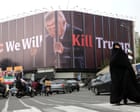
Before the sun even crests the Alborz Mountains, workers scale scaffolding erected against the concrete facades of Palestine Square, unrolling heavy vinyl stretched taut over steel frames. Down below, the morning rush begins—bakers pulling warm sangak bread from pebble ovens, commuters cramming onto buses, teenagers checking their phones for football scores and black-market currency rates. Few look up at the new mural. They have seen hundreds of them over the last four decades.
Yet this one is different. Printed in stark, unmistakable English alongside Persian script is an explicit threat aimed directly at the sitting President of the United States: We will kill Trump.
Dread.
That is the real medium painted onto that billboard, though it carries no pigment and leaves no stain on the workers' hands. For those of us who have spent years tracking the volatile fault lines between Washington and Tehran—who have sat in dimly lit newsrooms watching radar tracks over the Persian Gulf at three in the morning, smelling stale coffee and ozone—a propaganda banner is never just a piece of street art. It is a tripwire disguised as theater.
The Architecture of a Provocation
To understand why a piece of printed vinyl in downtown Tehran threatens to bring American bombers back to Iranian airspace, you have to strip away the noise of cable news panels and look at the mechanics of deterrence.
Think of international brinkmanship like two drivers speeding toward each other down a single-lane mountain road at night. Neither wants to plunge off the cliff. Both want the other to flinch first. So one driver rips off their steering wheel and throws it out the window, shouting so the other can see: I cannot turn even if I wanted to.
In geopolitical terms, that is what the Islamic Republic just did.
Since the 2020 assassination of Qasem Soleimani—the powerful commander of the Quds Force killed by a U.S. drone strike near Baghdad International Airport—revenge has been the central currency of Tehran’s domestic legitimacy. Hardliners inside the regime have spent years promising their most fervent supporters that the architects of that strike would pay with their lives. Federal indictments unsealed by the U.S. Department of Justice in recent years have detailed alleged plots backed by the Islamic Revolutionary Guard Corps (IRGC) to assassinate former and current American officials, including Donald Trump.
Now, with Trump back in the Oval Office and an explicit death threat hoisted above one of Tehran’s most symbolic public squares, the metaphor of the thrown steering wheel becomes terrifyingly literal. By broadcasting the threat in English, the regime ensured the message would bypass diplomatic channels and land directly on the desks of the Pentagon and the screens of the American press.
Why take such a reckless gamble?
Consider a hypothetical hardline strategist sitting inside an IRGC command center in northern Tehran. Let us call him Colonel Bahram. Bahram knows his country’s air defenses were severely degraded during previous exchanges of fire. He knows the Iranian rial is collapsing, inflation is choking the middle class, and public anger over domestic repression simmers just beneath the surface. If Bahram projects weakness now, the hardline base that keeps the clerical establishment in power may fracture. To survive politically at home, Bahram must project absolute defiance abroad. He orders the banner printed, betting that Washington will dismiss it as empty bluster—the same theatrical posturing Tehran has relied on since 1979.
The Man in the Oval Office
Bahram’s fatal miscalculation may be who is sitting on the other end of the wire.
Donald Trump does not read geopolitical signals through the cautious, academic lens of traditional statecraft. He reads them personally, viscerally, and through the prism of strength versus humiliation. Throughout his political life, Trump has operated on a simple, uncompromising rule: when someone punches you, you hit back ten times harder.
When Trump ordered the strike on Soleimani in January 2020, he shocked his own national security advisors by choosing the most extreme option on a menu designed to make moderate options look reasonable. Later, during his second term, when intelligence agencies warned him of credible Iranian assassination plots against his life, his public response was blunt and chilling: if Iran ever carried out such an attack, the United States would obliterate the country.
Now, imagine the scene inside the White House Situation Room.
A briefing book is slid across the mahogany table. On the top page is a high-resolution satellite and street-level photograph of Palestine Square. The English text leaps off the glossy paper. For a president who has already survived assassination attempts on American soil, seeing a foreign government publicly advertise his murder on a city block is not an abstract intelligence assessment. It is a direct personal affront.
And the military options sitting in that same briefing book are already drawn up.
For months, defense planners at U.S. Central Command have maintained updated target packages across Iran—nuclear enrichment facilities buried beneath mountains at Fordow and Natanz, ballistic missile production hubs, drone assembly plants, and IRGC naval bases along the Strait of Hormuz. Previous rounds of American and allied strikes demonstrated just how vulnerable Iranian airspace has become, with radar networks blinded and surface-to-air missile batteries neutralized in rapid succession.
The temptation to resume bombing is immense.
In Washington, hawks argue that allowing a regime to publicly threaten the life of the American president without immediate kinetic consequences destroys deterrence globally. If Tehran can hang a death threat in its capital without losing a single airfield or refinery, what stops other adversaries from testing the boundaries of American resolve?
The Invisible Casualties
Yet when you zoom out from the war rooms in Washington and the command bunkers in Tehran, the story changes shape entirely.
Let us step back down onto the pavement of Palestine Square, away from the generals and the presidents, and look at the people actually living beneath that banner.
Meet Sara—a composite character representing millions of ordinary Iranians caught between a regime they despise and a foreign military they fear. Sara is thirty-two, a graphic designer working remotely for clients in Europe through unstable virtual private networks to bypass state censorship. Every morning, she walks past the giant billboards on her way to buy groceries. She does not support the clerical regime. Two years ago, she marched in the streets chanting for basic human dignity, risking arrest and worse.
Sara knows the banner above her head is a lie. She knows she did not ask to kill the American president. Her neighbors did not ask for it. The elderly man selling pomegranates on the corner did not ask for it.
Yet if the United States resumes bombing campaigns in retaliation for the regime’s provocations, Sara is the one who will lie awake listening to the supersonic roar of stealth aircraft overhead. She is the one who will watch the electrical grid fail, plunging her apartment into freezing darkness. When sanctions tighten further and supply chains snap, her mother’s heart medication will vanish from pharmacy shelves first—long before the elite families of the Revolutionary Guard ever feel a moment of deprivation.
This is the cruelest paradox of modern conflict. The men who print the banners and the men who order the airstrikes operate in fortified worlds insulated from the immediate physical consequences of their choices. The bill is always paid by people who had no vote in the matter.
Echoes of 1979
History rarely repeats itself cleanly, but in the Persian Gulf, it rhymes with haunting precision.
In November 1979, radical students stormed the U.S. Embassy in Tehran, taking fifty-two Americans hostage for 444 days. At the time, the newly formed Islamic Republic used anti-American spectacle as a crucible to forge its revolutionary identity, burning flags and broadcasting defiance to the world. That single decision locked two nations into a state of permanent cold war that has spanned nearly half a century—a conflict punctuated by tanker wars in the 1980s, proxy battles across Lebanon, Iraq, Syria, and Yemen, covert cyberattacks, and targeted killings.
Every time a window for de-escalation appeared, a hardline faction on one side or the other slammed it shut.
I remember standing near the docks in Bahrain years ago, watching an oil tanker limp into port with a jagged, blackened hole blown into its hull just above the waterline—the result of a limpet mine planted during a previous spike in Gulf tensions. The metal smelled of scorched diesel and salt water. Nobody had died on that ship, so the incident barely registered as a footnote on the evening news back home. But the captain, a quiet Filipino mariner whose hands still trembled slightly as he held a cup of tea, told me something I have never forgotten: "They play chess with our ships, and they forget we are inside them."
That banner in Tehran is another move on that same board.
By framing the confrontation in personal, existential terms, Tehran has dramatically narrowed the off-ramps available to both governments. Diplomacy requires ambiguity; it needs quiet backchannels in Oman or Qatar where envoys can trade concessions without losing face in front of their domestic audiences. A giant billboard threatening the life of a head of state obliterates ambiguity. It turns a complex geopolitical standoff over nuclear enrichment and regional proxies into a street brawl where backing down looks like cowardice.
The Physics of a Spark
So what actually happens when a provocation crosses the threshold from rhetoric to trigger?
Military escalation does not move in a straight, predictable line. It moves like a forest fire jumping a dry riverbed—slowly at first, and then all at once.
If President Trump decides that the banner—combined with ongoing intelligence regarding Iranian plots and nuclear advancements—demands a physical response, the initial strike would likely be calibrated to send an unmistakable message without triggering an immediate ground war. Intelligence hubs linked to the Quds Force, drone factories, or hardened missile silos would be the primary targets. Precision munitions launched from standoff distances would illuminate the night sky over central Iran, reducing concrete bunkers to pulverized dust in seconds.
Washington would call it a restorative strike—a necessary measure to re-establish deterrence.
But Tehran would view it through the lens of survival. Under the doctrine of "forward defense," Iranian commanders believe that absorbing a blow without striking back invites an even larger attack aimed at regime change. Within hours, ballistic missiles could streak toward American bases in Iraq, Syria, or the Gulf states. Proxy militias could target commercial shipping in the Red Sea and the Strait of Hormuz, instantly sending global oil prices surging and triggering economic shockwaves from Tokyo to New York.
Suddenly, a piece of vinyl stretched over scaffolding in Tehran has emptied your wallet at the gas pump and placed tens of thousands of American service members in hardened bunkers waiting for incoming radar alerts.
The Silence Before the Siren
I admit that writing about this moment carries a heavy, unsettling uncertainty. Anyone who claims to know with certainty whether Washington will pull the trigger tomorrow morning is guessing. Intelligence assessments are classified, decision-making inside the White House is notoriously fluid, and the internal politics of Tehran remain opaque even to seasoned analysts.
What is certain is that the margin for error has shrunk to the width of a razor blade.
When leaders use the threat of death as a megaphone, they surrender control over how the message is received. The workers who climbed the scaffolding in Palestine Square to hang that banner were just doing a job for a meager wage. They rolled out the vinyl, secured the grommets with wire, climbed back down to the street, and went home to their families.
The banner remains suspended high above the traffic, flapping slightly in the dry wind coming off the mountains, staring out across the city in bold, uncompromising letters—waiting to see if the sky above it will stay quiet, or tear open in fire.