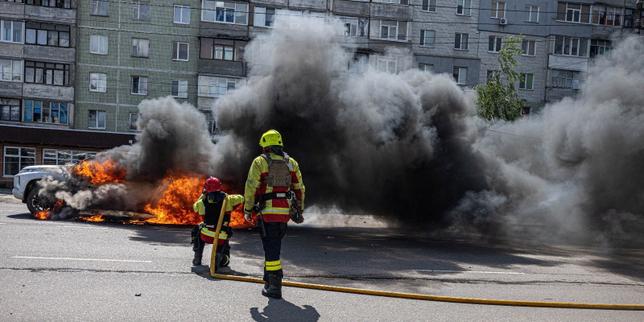
The conflict in Ukraine has shifted from a muddy war of trenches into a high-stakes air campaign threatening domestic stability deep within both nations. Ukraine has scaled up its long-range drone production, launching massive strikes against Russian energy infrastructure to induce severe domestic fuel shortages. Meanwhile, Russia has responded with heavy ballistic missile barrages targeting Ukrainian urban centers like Kyiv. This phase of the war reveals that while the ground front moves by mere square miles, the conflict is being fought through economic and industrial destruction meant to break civilian and political endurance.
The Asymmetric Chokehold on Russian Oil
Kyiv has focused its strategy on a clear target: the Russian energy sector. By targeting the economic engine that funds the Kremlin's military machine, Ukrainian forces are exploiting gaps in Russian air defense. Over the first six months of this year, Ukrainian long-range drones hit Russian refineries and fuel facilities nearly 200 times, marking an eleven-fold increase compared to the previous year.
The consequences of this campaign are visible at Russian gas stations. More than half of Russia's regions have been forced to implement strict limits on fuel sales, leading to long queues. Moscow even took the drastic step of banning diesel exports to stabilize its domestic market.
The campaign expanded significantly to the waters of the Sea of Azov and Taganrog Bay. Within a single week, Ukrainian drone units struck dozens of Russian vessels, including over twenty fuel tankers, cargo ships, and support boats. These operations aim to disrupt the shadow fleet that circumvents Western sanctions. This is not abstract strategy; it is targeted economic attrition. By forcing Russia to pull air defense systems from the front lines to protect domestic refineries, Ukraine is creating vulnerabilities in the field.
The Deadly Cost of Domestic Discretion
The Kremlin has responded to these economic shocks with intense air attacks on Ukrainian cities. Russian forces are launching thousands of drones and missiles monthly, including ballistic missiles fired from S-400 systems. These weapons hit before air raid sirens can sound, giving civilians in Kyiv and surrounding districts almost no time to seek safety.
This relentless pressure has exposed domestic vulnerabilities within Ukraine. A recent Russian strike on the town of Vyshneve, on the western outskirts of Kyiv, hit an arms warehouse belonging to the state weapons producer Ukroboronprom. The strike caused massive secondary explosions that destroyed hundreds of nearby homes and killed ten civilians.
The incident caused widespread public anger. Local residents questioned why a major weapons depot was placed in a dense residential neighborhood. President Volodymyr Zelenskyy confirmed that an internal investigation by the Ukrainian Security Service revealed the warehouse was authorized in direct violation of military directives, promising accountability for the officials involved. This tragedy highlights a difficult reality for Ukraine: balancing urgent defense production with civilian safety under constant surveillance and bombardment is becoming harder.
The Math of Attrition on the Ground
Away from the air war, the ground front remains a brutal, slow grind. Russian forces have advanced slightly in the Donbas, attempting to capture the rest of Donetsk province, but these small territorial gains have come at an immense cost.
Analysis from groups like the Center for Strategic and International Studies indicates that Russian casualties have climbed significantly, driven by Ukraine's deployment of unjamming, autonomous drones on the battlefield.
| Metric | Estimated Status |
|---|---|
| Monthly Russian Casualty Rate | 30,000 to 34,000 troops |
| Monthly Russian Recruitment Rate | Roughly 27,000 recruits |
| Net Territorial Shifts | Minor fluctuations under 35 square miles monthly |
This data shows a clear imbalance. Russia's battlefield losses are outpacing its recruitment capabilities, a deficit that complicates its long-term offensive plans. However, these losses have not shifted the Kremlin's political goals. Moscow continues to rely on mass artillery and gliding bombs, like those recently hitting Sumy, to gradually wear down Ukrainian defenses.
Ukraine faces its own personnel shortages and delayed Western military assistance, meaning neither side has the decisive advantage needed to break the stalemate. The war is no longer decided just by capturing territory, but by which society can withstand prolonged industrial and economic strain.