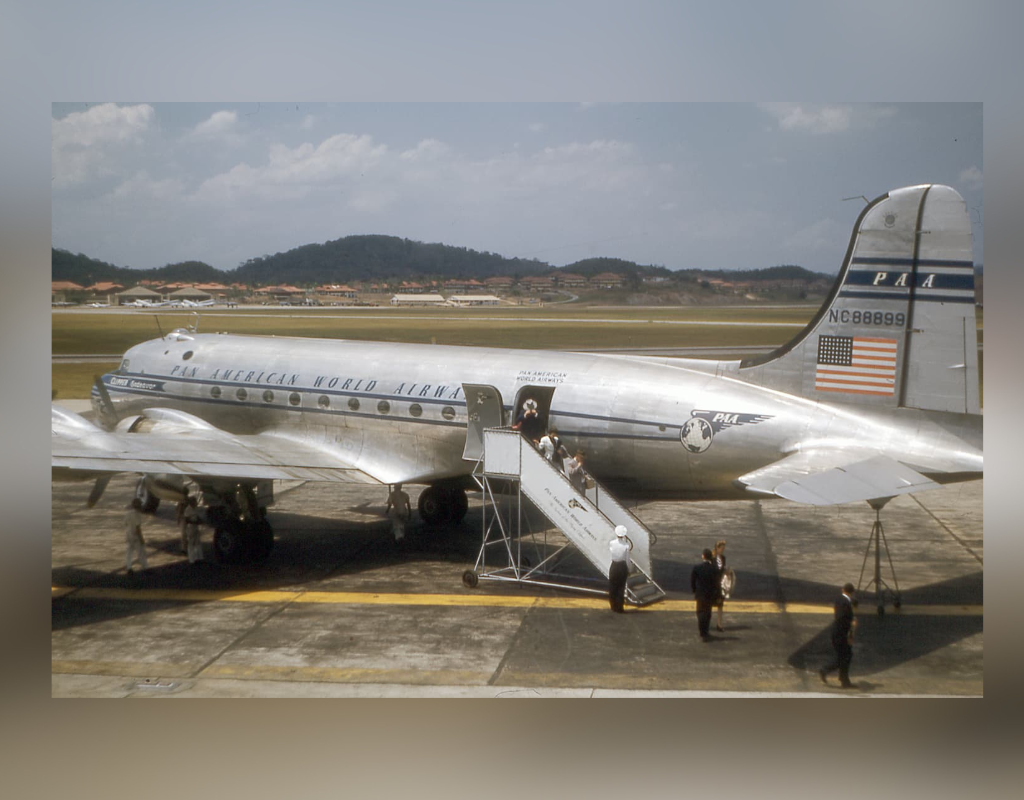
The discovery of the Pan American Airways Clipper Endeavor wreckage under 2,000 feet of water off Puerto Rico solves a 74-year-old maritime mystery, but the headlines celebrating its location miss the real story. This Douglas DC-4 did not simply vanish due to bad luck or mechanical failure. The 52 lives lost on Good Friday in 1952 were the casualties of an era that treated passenger safety as an afterthought. While modern accounts frame the find as a triumph of deep-sea exploration, the cold truth is that the Clipper Endeavor remains a monument to preventable panic, institutional complacency, and the dark cost of the aviation regulations we take for granted today.
Decades before flight attendants demonstrated how to fasten a seatbelt, the airline industry operated on a philosophy of blissful ignorance. For a more detailed analysis into similar topics, we suggest: this related article.
The Myth of the Unavoidable Tragedy
On April 11, 1952, the New York-bound Clipper Endeavor suffered catastrophic dual-engine failure minutes after departing San Juan. Captain John C. Burn executed a masterful emergency water landing, bringing the massive aircraft down intact onto heavy seas.
Every single person on board survived the initial impact. For broader details on this development, in-depth analysis can be read at The New York Times.
What followed was not a rescue, but a chaotic descent into hell. The plane remained afloat for nearly three minutes. In the post-war aviation boom, passengers were never told where the life jackets were hidden, let alone how to put them on. There were enough life rafts on board to save everyone, but the crew struggled to deploy them in pitch blackness amidst screaming, English- and Spanish-speaking passengers who could not understand one another.
As the fuselage filled with water, survival became a matter of raw strength rather than procedure. By the time the ocean swallowed the cabin, 52 people had drowned inside or immediately outside a largely undamaged aircraft. Thirty-nine bodies were never recovered, left to settle into the deep Atlantic trench along with the aluminum hull.
The industry did not lack the technology to save them. It lacked the will. Airlines feared that giving pre-flight safety briefings would terrify customers and hurt ticket sales. It took the horrific, public drowning of dozens of passengers on a holiday weekend to finally force the Civil Aeronautics Board to mandate the pre-flight safety demonstrations that are now universal.
The Tech and the Obsession
Locating the wreckage required breaking through decades of archival errors and relying on advanced undersea technology. The search, spearheaded by Russ Matthews of the Air/Sea Heritage Foundation and Tony Romeo of Deep Sea Vision, succeeded where previous attempts failed by relying on military-grade autonomous underwater vehicles (AUVs) rather than traditional towed sonar systems.
The breakthrough did not happen out in the ocean, but in dusty archives. Matthews spent years piecing together scattered clues, eventually finding a critical map drawn by U.S. Air Force pilots who happened to witness the splashdown while on a training flight. Combining this historical coordinate with historical weather data, the team mapped out a ten-square-nautical-mile grid.
Deep Sea Vision deployed an AUV equipped with high-resolution sonar. Operating independently of the surface vessel, the drone scanned the jagged seafloor on its very first pass, capturing the distinct split silhouette of the DC-4.
Subsequent photographic sweeps generated over 350,000 images, revealing the Pan Am winged logo still visible on the nose.
The Ghost in the Modern Cabin
Aviation safety expert John Cox noted that the Clipper Endeavor was the catalyst that drove the industry toward mandatory safety briefings and superior flotation gear. However, looking at the silent, deep-sea images of that intact fuselage reveals an uncomfortable parallel to modern commercial flight.
We live in an era where passengers routinely ignore the very briefings bought with the lives of those on the Clipper Endeavor. Travelers look at their phones, tune out the flight attendants, and treat safety cards as seat-back clutter. The psychological phenomenon of the "normalcy bias"—the belief that nothing bad will actually happen—remains just as potent today as it was in 1952.
The Clipper Endeavor rests under 2,000 feet of water as a graveyard. There are no plans to recover the remains or disturb the site. It serves as a stark reminder that the safety rules written in blood are only effective if the living choose to pay attention.