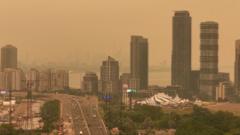
The sickly orange sky blanketing Toronto, Minneapolis, and New York is not a temporary atmospheric quirk. It is a stark warning of a continent-wide ecosystem in active collapse. Millions of citizens across the northern United States and southern Canada are currently breathing air that smells like a campfire and burns like acid. While local weather reports treat the haze as an unfortunate seasonal visitor, the reality is far more severe. Decades of aggressive fire suppression, intensifying heat, and outdated forestry policies have created an unsustainable environment.
The immediate culprit is a cluster of out-of-control blazes tearing through northwestern Ontario and Minnesota. But pointing fingers at the lightning strikes that sparked them misses the broader systemic failures that allowed these fires to turn entire cities orange. If you liked this piece, you might want to look at: this related article.
The Chemistry of the Martian Sky
Many believe the orange hue in the sky is merely a visual marker of thick smoke. The truth is rooted in atmospheric physics. Wildfire smoke is composed of microscopic particles, primarily fine particulate matter less than 2.5 micrometers in diameter, commonly known as PM2.5. These tiny particles are the perfect size to scatter shorter wavelengths of light, such as blue and violet, while allowing longer wavelengths like red, orange, and yellow to pass through.
This process, known as Rayleigh scattering, is the same mechanism that makes a sunset look red. When smoke plumes are thick enough and lofted high into the troposphere, they act as a massive filter across thousands of miles. For another angle on this development, check out the recent update from Reuters.
[Sunlight] ---> [High-Altitude Smoke Plume (PM2.5)] ---> [Scattered Blue Light]
                                                    ---> [Filtered Red/Orange Light] ---> [Observed Orange Haze]
This high-altitude filtering creates an eerie visual effect, but the real danger lies in what happens when that air mass drops. Wind patterns and low-pressure systems can easily push these elevated plumes downward, dragging dangerous concentrations of fine particles to ground level. When that happens, the hazard transitions from an aesthetic curiosity to a full-blown public health emergency.
Why Fire Suppression Backfired
For over a century, forest management in North America followed a simple, flawed rule. Every fire must be put out immediately. This policy aimed to protect timber resources and human settlements, but it ignored the natural lifecycle of the boreal forest.
Boreal forests are designed to burn. Low-intensity fires historically cleared out dead underbrush, opened pine cones to release seeds, and created a patchy, resilient mosaic across the wildlands. By putting out every single fire for decades, forest agencies inadvertently built a giant tinderbox.
Dead wood, fallen leaves, and overcrowded saplings have accumulated on the forest floor. When a fire finally escapes containment under these conditions, it no longer creeps along the ground. It climbs into the canopy, turning into a high-intensity crown fire that is virtually impossible to extinguish with standard firefighting equipment.
The Fuel Load Problem
The sheer volume of dry wood currently sitting in northern forests is unprecedented. Combined with prolonged drought conditions, this fuel has become highly flammable.
- Excessive Undergrowth: Overcrowded forests with too many trees competing for limited water.
- Dry Organic Matter: Thick layers of needles and decayed wood that burn hot and long.
- Standing Dead Trees: Millions of trees killed by pest infestations, left to dry in the sun.
This accumulated fuel means that modern fires burn hotter, spread faster, and release vastly more smoke than the historical average. The orange haze is the direct consequence of this excess fuel combusting all at once.
The Toxic Reality of PM2.5
The air quality alerts issued across major metropolitan areas are not overreactions. PM2.5 particles are so small they bypass the body's natural defense mechanisms in the nose and throat, traveling deep into the lungs and entering the bloodstream.
Emergency room visits for asthma and acute respiratory distress spike within 24 hours of a major smoke event. Research indicates that the particulate matter in wildfire smoke can be significantly more toxic than equivalent amounts of urban air pollution from vehicles or industrial factories.
The long-term effects of repeated exposure remain poorly understood. While city dwellers can retreat indoors behind sealed windows and high-efficiency particulate air filters, millions of people do not have that luxury. Outdoor workers, agricultural laborers, and delivery drivers are forced to inhale this toxic mix for hours at a time, creating a quiet health crisis that will likely show its true toll in the decades to come.
Remote Communities Bear the Brunt
While media coverage focuses heavily on major cities like Toronto and New York, the actual destruction is occurring in remote, northern regions. First Nations communities in northwestern Ontario are facing evacuations as fires burn right to their doorsteps.
Northwestern Ontario Wildfire Zones
├── Lac La Croix First Nation (Evacuated)
├── Namaygoosisagagun First Nation (Structural Damage)
├── Whitesand First Nation (Evacuated)
└── Gull Bay First Nation (Evacuated)
For these communities, the threat is not a hazy sky; it is the immediate loss of homes, cultural grounds, and critical infrastructure. Many of these settlements are accessible only by a single gravel road or by air, making evacuation incredibly hazardous when smoke reduces visibility to near zero. The destruction of local communication lines and electricity grids further complicates emergency response efforts, leaving vulnerable populations isolated in dangerous conditions.
The Broken Cross-Border Response
Air pollution does not care about national borders, yet our administrative systems do. The current smoke crisis exposes the severe limitations of international cooperation on environmental emergencies.
While the United States and Canada share resources and personnel during peak fire seasons, the administrative lag can be deadly. Coordinating air quality warnings, sharing real-time tracking data, and managing public health advisories across state, provincial, and federal lines remains a disjointed process.
Each jurisdiction uses slightly different metrics to measure air quality, leading to confusing guidance for people living just a few miles apart on opposite sides of the border. A unified, binational agency dedicated solely to transboundary smoke and fire management is desperately needed, but political inertia keeps it out of reach.
Changing the Way We Live with Smoke
We have reached a point where we can no longer expect to completely suppress these fires. The sheer scale of the blazes, coupled with increasingly severe drought and heat, means we must transition from a strategy of total elimination to one of calculated adaptation.
This shift requires a fundamental overhaul of our building codes, public infrastructure, and daily habits. Building ventilation systems must be upgraded to handle prolonged periods of heavy smoke. City planners need to design public clean-air shelters equipped with industrial-grade filtration systems, ensuring that vulnerable populations have a safe place to breathe during the worst days of summer.
Individual preparation must also evolve. Relying on paper masks or simply staying indoors with the windows closed is no longer sufficient. Homes need to be fitted with proper sealing, and families must treat high-quality air purifiers as essential safety appliances rather than luxury home goods. The orange sky is not a temporary emergency that will fade by autumn; it is the visual signature of our new climatic reality.