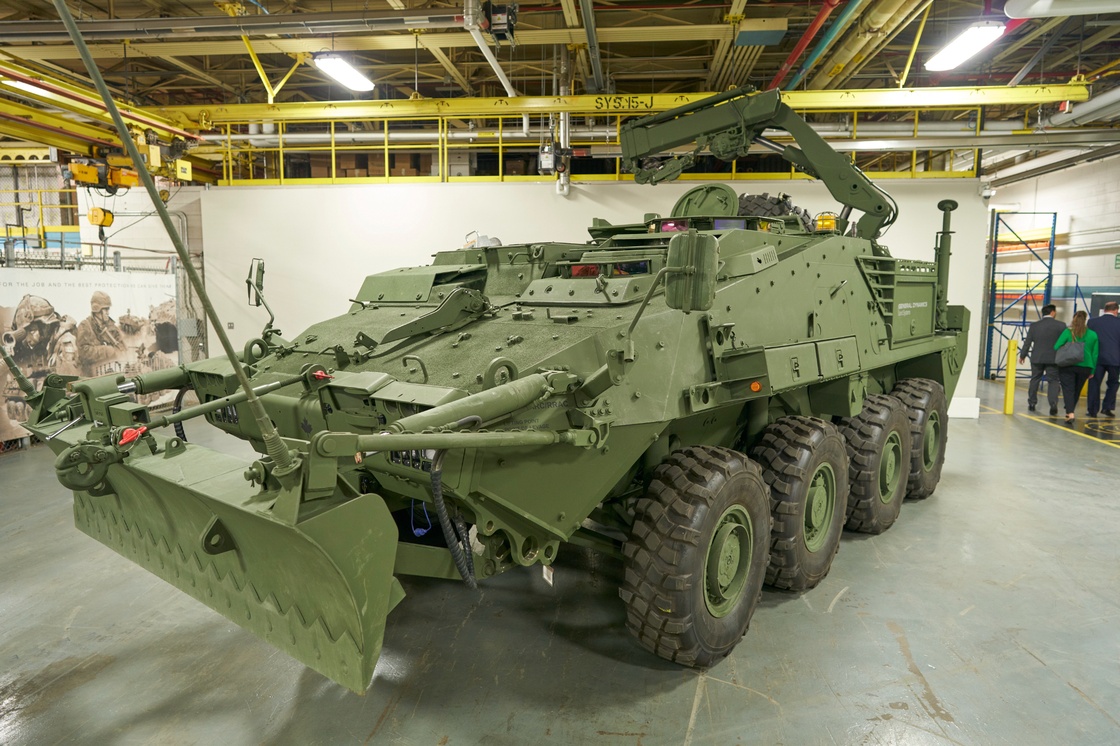
Canada will spend nearly $2 billion over the next four years to purchase 190 Armoured Combat Support Vehicles from General Dynamics Land Systems-Canada. Announcing the deal at the manufacturer's London, Ontario facility, Prime Minister Mark Carney framed the procurement as the cornerstone of Ottawa’s new "Build at Home" defence industrial strategy. The transaction will expand the military’s wheeled armoured fleet to 550 units while sending 35 new builds directly to Ukraine. On the surface, the multi-billion-dollar injection secures thousands of manufacturing jobs, establishes the federal government as a predictable "anchor customer," and aims to rapidly modernize a historically underfunded military.
Yet, stripping away the political optics reveals a more complex reality. This massive domestic cash injection acts as a structural buffer against severe geopolitical vulnerabilities, long-standing systemic procurement bottlenecks, and intense international pressure regarding Canada's defence obligations.
The Reality of Sovereign Supply Chains
Relying entirely on international defence suppliers introduces extreme strategic risk in a fractured global landscape. For years, the Canadian Armed Forces struggled with long lead times, foreign export restrictions, and supply chain disruptions that stalled critical hardware upgrades.
By committing to a domestic manufacturing framework, the federal government aims to isolate itself from international shipping blockades and foreign political shifts. The Canadian facility in London, Ontario draws from a network of more than 600 suppliers in 100 communities across the country. One critical example of this highly decentralized supply chain is Ryan Manufacturing in Richmond, British Columbia, which supplies military-grade cable and wire harness assemblies.
If a future geopolitical crisis halts manufacturing in Europe or Asia, Canada retains the baseline intellectual property, engineering personnel, and raw manufacturing infrastructure to maintain, repair, and deploy its primary ground transport platforms.
Why Buying Domestic Costs a Premium
Purchasing military hardware from specialized national suppliers is rarely the most cost-effective path in terms of pure unit cost. Economies of scale dictate that larger global production runs, such as those executed by major defense conglomerates in the United States, offer lower per-vehicle price tags.
Under the "Build at Home" doctrine, the premium Canada pays per vehicle is an indirect tax used to subsidize domestic heavy industry. High-paying jobs, domestic metallurgical research, and specialized engineering talents are expensive to cultivate and even harder to retain.
+----------------------------------------+---------------------------------------+
| Strategic Benefits of Domestic Buy     | Operational Costs and Hard Realities  |
+----------------------------------------+---------------------------------------+
| Insulates supply chain from global wars| Higher unit cost per armoured vehicle |
| Retains engineering talent in Ontario  | Slower scaling compared to US giants  |
| Direct control over modification speed | Tied to domestic labor negotiations  |
+----------------------------------------+---------------------------------------+
When Ottawa acts as an anchor customer, it guarantees a predictable baseline of demand over a four-year horizon. This predictability allows General Dynamics to fund local tooling, hire specialized workers, and maintain manufacturing lines that would otherwise sit idle between major state contracts.
Moving Beyond Procurement Paralysis
Historically, Canadian military procurement has been defined by endless bureaucratic review cycles, canceled contracts, and political flip-flops. The introduction of this strategic partnership framework attempts to bypass the traditional competitive bidding cycles that have previously delayed equipment acquisitions by decades.
Using the existing Light Armoured Vehicle (LAV) 6.0 platform as the baseline for all eight variants of the new combat support vehicles allows the military to sidestep the costly trial-and-error phases of adopting an entirely new vehicular architecture.
The strategy relies on a single, proven chassis to serve multiple battlefield roles:
- Frontline Medevac: Outfitted as armoured ambulances to stabilize and transport casualties under fire.
- Command Post Operations: Mobile command units packed with localized communications arrays.
- Electronic Warfare: Specialized units designed to jam communications and track signals.
- Mobile Repair and Recovery: Heavy-duty engineering platforms capable of repairing damaged units in active combat zones.
By standardizing the fleet on the LAV 6.0 platform, the military significantly lowers its long-term training and sustainment costs. Technicians do not need to learn entirely new engine configurations, and the supply chain for replacement parts remains uniform.
The Geopolitical Pressure Valve
The timing of this procurement is not coincidental. Ottawa has faced intense scrutiny from NATO allies to meet the alliance's defence spending target of 2% of GDP.
At the same time, Canada's military reserves have been heavily drawn down to support international efforts. Having donated dozens of older armoured units to Ukraine, the Canadian Armed Forces are facing acute equipment deficits at home. The procurement of 190 new vehicles, alongside the commitment to build 35 new units specifically for Ukraine, serves as a dual-purpose mechanism to rebuild depleted domestic stockpiles while meeting international security pledges.
This domestic spending strategy allows the federal government to simultaneously satisfy domestic economic interests and international military commitments. Every dollar spent on these vehicles stays within the country, allowing the administration to defend massive military expenditures to a domestic public that is often skeptical of foreign military investments.
Ultimately, the true test of this multi-billion-dollar initiative will not be measured by the promises made on a factory floor in Ontario. It will be determined by whether these vehicles can be delivered on schedule, within budget, and ready to survive the realities of modern combat.