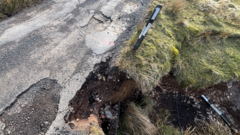
The coffee in the cupholder didn’t just spill. It launched. It was a violent, caffeinated arc that repainted the passenger seat in a shade of mocha-despair, triggered by a crater so deep it felt less like a road defect and more like a geological event. This isn't a minor inconvenience. It is a slow-motion war of attrition between a stretch of British asphalt and the people forced to navigate it every single day.
Living at the end of what might be the worst road in the UK isn't about having a "bumpy ride." It is about a fundamental shift in how you perceive the world. You stop looking at the horizon or the autumn leaves. Your gaze is permanently fixed three feet in front of your bumper, scanning for the jagged teeth of broken tarmac. You become a navigator of a wasteland.
Take a hypothetical resident—let’s call him Arthur. Arthur is seventy-two. He has lived in the same stone cottage for forty years. For the first thirty, the road was a road. Now, it is a barrier. When the ambulance service tells you they might have to "assess the approach" before sending a vehicle, the potholes stop being a punchline. They become a threat.
The facts are cold and unapologetic. Local councils across the country are facing a multibillion-pound backlog in road repairs. But "backlog" is a sterile word. It doesn't capture the sound of a coil spring snapping—a metallic crack that echoes like a gunshot in the quiet of a Tuesday morning. It doesn't describe the $500 invoice from the mechanic that eats the holiday fund.
The Economics of Neglect
We often think of infrastructure as a static thing. We build it, and then it exists. This is a lie. A road is a living system that requires constant energy to fight back against the physics of water and weight. When rain gets into a small crack and freezes, it expands. It pries the road apart from the inside out.
Ignoring a pothole is not a cost-saving measure. It is a debt with a predatory interest rate. Patching a small hole costs a fraction of the price of a full resurfacing, yet because budgets are squeezed into thimbles, authorities wait until the road is a lunar landscape. By then, the cost has quintupled. We are watching our collective wealth crumble into the dirt because we refuse to pay for the maintenance of our own lives.
Consider the sheer physics of the impact. When a two-ton SUV hits a four-inch-deep hole at thirty miles per hour, the force transferred to the suspension components is immense. It’s a localized earthquake. The tires take the brunt of it, their sidewalls bulging and tearing. Then the rims bend. Then the bearings groan.
This isn't just happening to Arthur. It’s happening to the delivery drivers who refuse to bring packages to certain postcodes. It’s happening to the social workers who have to park a mile away and walk in because their small hatchbacks can't clear the ridges of mud and stone. The road is a silent gatekeeper, deciding who gets service and who is left in isolation.
The Psychology of the Shudder
There is a specific kind of anxiety that builds when you turn off the main highway onto the "Problem Stretch." Your grip on the steering wheel tightens. Your breathing shallows. You are entering a gauntlet.
This constant low-level stress does something to a community. It breeds a sense of being forgotten. When the veins of a town—its roads—are allowed to rot, the people living there feel the rot too. They see the gleaming new developments in the city centers and then look at the muddy, jagged trench they have to drive through to get groceries.
The invisible stakes are the loss of agency. You can't just "go for a drive." You have to plan an expedition. You learn the personality of every dip. You know that the one near the oak tree is shallow but sharp, while the one by the farm gate is a deceptively soft-looking puddle that will bottom out your car.
A Failure of Responsibility
Who owns the air? Nobody. Who owns the road? Everyone, until it breaks. Then, suddenly, it belongs to no one.
The finger-pointing is a masterclass in bureaucratic dodging. Is it a private road? Is it unadopted? Does it fall under the remit of the county or the parish? While the maps are consulted and the emails are traded, the holes grow. They merge. They become "super-potholes," sprawling across the entire width of the lane, leaving no line of escape.
We are told there is no money. Yet, we see the economic drain of this neglect every day. Every hour spent waiting for a tow truck is lost productivity. Every damaged tire is a contribution to a landfill. Every delayed delivery is a friction point in the local economy.
Imagine a young mother trying to push a pram through this. The wheels catch. The pram tips. The baby wakes up screaming. This isn't a "transportation issue." It is a basic failure of the social contract. We pay our taxes, we contribute to the system, and in exchange, we expect to be able to move from point A to point B without risking life, limb, or axle.
The Breaking Point
At some point, the road ceases to be a road and becomes a monument to apathy.
I spoke to a woman who had to stop her daughter's piano lessons because the teacher's car couldn't survive the driveway anymore. Think about that. A child's education and passion were clipped because of asphalt. The "worst road in the UK" isn't a title to be proud of; it’s a symptom of a deeper, systemic exhaustion.
We have become used to things not working. We have been conditioned to expect the shudder, the bang, and the bill. We shrug and say, "That's just how it is."
But it shouldn't be.
The solution isn't another patch. It isn't a bucket of cold-lay bitumen dumped into a puddle by a tired crew at 4:00 PM on a Friday. It requires a radical reinvestment in the boring, unsexy stuff. We don't need "smart cities" if we can't have "driveable lanes." We don't need high-tech infrastructure if our basic arteries are clogged with debris and neglect.
The road home should be a welcome. It should be the place where the tension of the day begins to fade. Instead, for thousands, it is the most stressful part of the journey.
Tonight, Arthur will drive home. He will hit the brakes. He will swerve. He will pray that his tires hold out for one more week. He will hear the stones rattling against the undercarriage like hail on a tin roof. And as he pulls into his driveway, his heart still racing from the final, unavoidable jolt, he will wonder how a country that claims to be moving forward has forgotten how to simply stay on the path.
The crater outside his house is now large enough to hold a gallon of rainwater. It reflects the gray sky, a perfect, mocking mirror of the world above it—broken, stagnant, and waiting for someone to care.