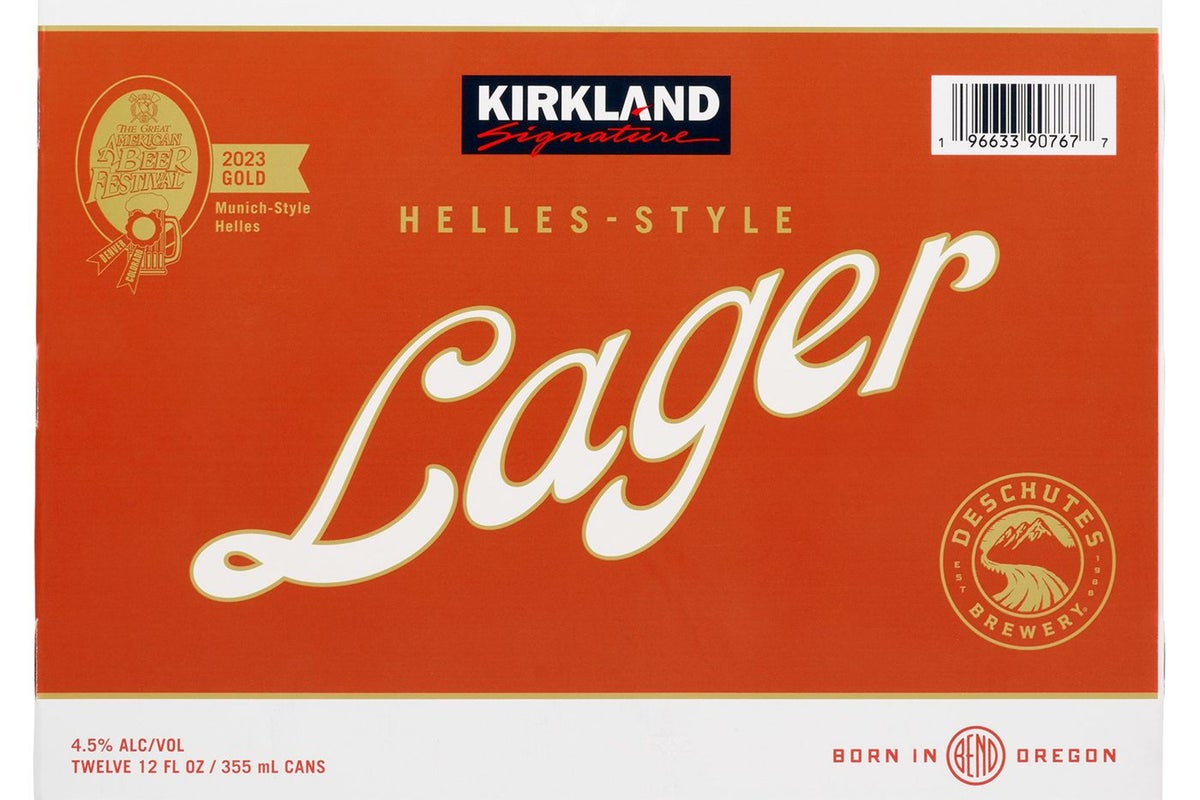
Costco is quietly pulling the plug on its critically acclaimed Kirkland Signature beer lineup, terminating its high-profile partnership with Oregon-based Deschutes Brewery less than two years after its launch. According to an internal memo sent to distributors by Deschutes CEO Peter Skrbek on July 1, 2026, production of the co-branded Kirkland Signature Helles Lager and Vintage Ale will wind down immediately, with remaining stock expected to vanish from warehouse shelves by October. The decision cuts short an experiment that defied industry expectations by delivering genuine, award-winning craft liquid at warehouse-floor prices.
The sudden termination of the deal caught the beverage world flat-footed. In an industry where private-label beers are historically maligned as cheap, watery afterthoughts, the Kirkland-Deschutes partnership was an anomaly. The Helles Lager was not just a commercial success; it earned a silver medal at the 2025 World Beer Cup and a bronze in 2026. Savvy shoppers were buying 12-packs of a world-class Munich-style Helles, brewed with imported German malts, for roughly $13.99.
But high accolades do not guarantee high margins. Beneath the surface of this fan-favorite collaboration lies a harsh reality about big-box retail distribution, shifting consumer drinking habits, and the trap of chasing volume in a stagnant craft market.
The False Promise of Big Box Volume
To understand why this partnership collapsed, one must look at the math that governs the shelves of a big-box retail warehouse.
For a regional craft brewery like Deschutes, the opportunity to secure national distribution through Costco looks like a golden ticket. In 2023, the Bend, Oregon, brewery faced an 11 percent drop in year-over-year volume sales, a symptom of a broader market contraction affecting regional craft brewers nationwide. When the Costco deal went live in late 2024, it acted as an immediate financial epinephrine shot. By the end of 2024, Deschutes saw a nine percent surge in volume, almost entirely propped up by the river of Helles Lager flowing into Costco warehouses.
The partnership wiped out traditional marketing and sales costs for the brewery. Costco handles the promotion by simply placing the bright orange cases on a pallet in the middle of a high-traffic aisle.
However, mass retail distribution is a Faustian bargain for a mid-sized brewer. To meet Costco pricing demands, a manufacturer must cut margins to the bone. When a consumer buys a 12-pack for $14, the revenue split between the retailer, the distributor, and the brewery leaves virtually no room for error. If commodity costs rise even slightly, a profitable contract can instantly transform into a liability.
Aluminum costs, freight expenses, and the price of premium imported grain have fluctuated unpredictably over the last 24 months. For a standard craft beer sold at $12 a six-pack in a grocery store, a ten-cent increase in the cost of production per can is an annoyance. For a white-label product sold at a dollar a can, that same increase wipes out the entire net profit margin.
The Ghost of Kirkland Light
Costco long memory regarding its beverage program also played a role in how this experiment was managed.
The retailer is fiercely protective of its Kirkland Signature name, which generally signals that a product matches or exceeds national brands at a fraction of the cost. Kirkland vodka, golf balls, and olive oil enjoy legendary status among bargain hunters. Beer, however, has always been the black sheep of the family.
For years, the chain sold a notorious 48-pack of Kirkland Signature Light Beer, produced by Regal Brau. It was widely derided by consumers as tasting like carbonated swamp water. The product became an internet meme for all the wrong reasons, eventually forcing Costco to discontinue it entirely in 2018. Subsequent attempts at craft variety packs failed to gain traction because beer enthusiasts remained skeptical of the Kirkland label.
Historical Trajectory of Kirkland Signature Beer:
[Pre-2018]  Kirkland Light (Regal Brau) -> Discontinued due to poor quality
[2018-2024] Craft Variety Packs (Hopfen Und Malz) -> Lacked brand identity
[2024-2026] Co-Branded Helles & Ale (Deschutes) -> Award-winning but unprofitable
The Deschutes partnership was engineered specifically to wash away that historical stain. By placing the Deschutes logo prominently on the front of the box, Costco was borrowing the brewery institutional credibility. It worked. The liquid inside the box was a re-badged version of "Prinz Crispy," a meticulous Helles lager that had previously won gold at the Great American Beer Festival.
Yet, this dual-branding strategy created an internal paradox for Costco. The company relies on its ability to command absolute control over its supply chain. By elevating Deschutes to co-headliner status, Costco limited its own flexibility. If a private-label product becomes too closely associated with a single supplier, the retailer loses the leverage to easily shop the contract around to cheaper facilities when economic conditions tighten.
The Margin Squeeze and Changing Tastes
The broader alcohol industry is enduring a structural realignment that makes low-margin beer experiments incredibly risky for big retailers.
The era of explosive craft beer growth is over. Consumers are increasingly migrating toward ready-to-drink canned cocktails, premium spirits, and non-alcoholic alternatives. When shoppers do buy beer, they are shifting toward either ultra-premium local options or ultra-cheap domestic macro-lagers. The middle tier, where regional craft breweries and premium store brands sit, is getting squeezed from both sides.
Consider the physical space inside a warehouse club. Shelf estate is zero-sum. Every square foot of concrete must generate a specific dollar amount of revenue per week to justify its existence.
While the Kirkland Helles Lager moved quickly, its low price point meant it had to move at astronomical volumes to match the profitability of the wine and spirits sections. A single pallet of Kirkland Signature French Vodka or Golden Margarita mix generates significantly higher gross profit dollars than a pallet of craft lager that requires cold storage and heavy freight handling.
"With beer, there is a more personal connection to brands," notes Dave Williams, president of Bump Williams Consulting. Private-label programs work beautifully for commodities like sugar or paper towels, but beer is an emotional, identity-driven purchase.
When economic pressures mount, a retailer like Costco will always favor the product that yields the highest return per square inch of floor space. The Helles Lager was a critical darling, but it was fighting a losing battle against the high-margin efficiency of hard seltzers and spirits.
The Operational Fallout for Craft Brewing
For Deschutes, the end of this contract is a sobering lesson in the dangers of relying on a single retail giant to inflate production volume.
On paper, the brewery looks healthy. Recent data from market research firm Circana shows Deschutes sitting comfortably within the top 25 grocery beer vendors, with dollar sales up 8.3 percent. The brewery currently ranks as the tenth-largest craft brewery in the United States.
But filling a massive production pipeline for a white-label client creates a dangerous operational dependency. When a brewery allocates a significant portion of its fermentation tanks to a low-margin, high-volume product, it must often neglect its own proprietary brands. The tanks holding Kirkland Lager were tanks that could not be used to brew higher-margin flagship beers like Fresh Squeezed IPA or Black Butte Porter.
Now that the Costco train is leaving the station, Deschutes faces the task of backfilling that sudden void in production volume. Scaling down brewing operations is not as simple as turning off a switch. Ingredients have been forward-contracted, packaging materials have been ordered in bulk, and labor schedules have been optimized for high-throughput manufacturing.
While Skrbek has assured distributors that the brewery is experiencing strong independent growth, the sudden removal of a national retail partner inevitably forces an operation to scramble.
The Search for the Next Supplier
The exit of Deschutes does not necessarily mean Costco is abandoning the beer category forever. The company past behavior suggests this is a recalibration rather than an outright surrender.
The warehouse giant still wants a piece of the beer market, but it wants it on its own terms. Industry insiders speculate that Costco may look to replicate the model used by other major grocery chains, quietly partnering with smaller regional contract packagers that are desperate for volume and willing to accept microscopic margins just to keep their lines running.
This strategy carries immense risk. If Costco returns to anonymous, low-tier contract brewers to chase a lower price point, it risks resurrecting the negative consumer perceptions that doomed Kirkland Light. The modern beer consumer is educated. They read labels, they check review apps, and they can tell the difference between a meticulously crafted Munich Helles and a rushed, corner-cutting industrial lager.
The brief, brilliant run of the Kirkland-Deschutes partnership proved that private-label beer doesn't have to be garbage. It proved that a major retailer could deliver competition-crushing quality at a price that made standard craft packaging look like a rip-off. But it also proved that in the unforgiving world of corporate retail, taste buds will always lose the argument to the balance sheet.
The cases remaining on the floor right now are the last of their kind. Once they are gone, the dream of the one-dollar world-class craft lager goes with them, leaving beer enthusiasts to pay full price elsewhere while Costco reallocates the floor space to more profitable pallets of tequila.