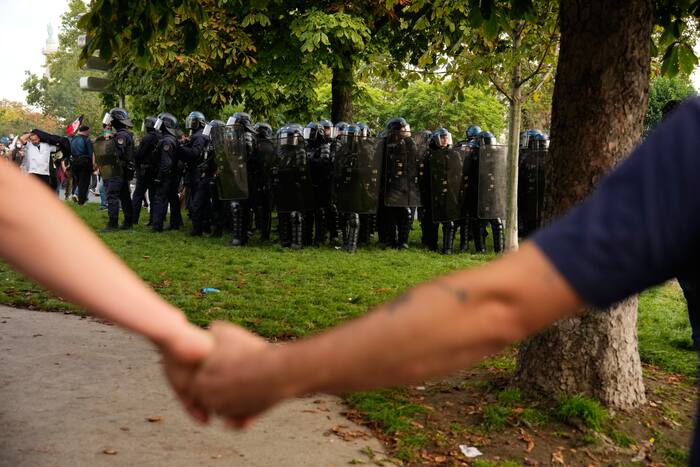
The smoke clears over the Place de la Bastille, leaving behind the acrid stench of tear gas and the chilling reality of a fractured social contract. When high school students across France took to the streets to protest educational reforms and mounting living costs, they expected friction with authorities. What they encountered instead was a heavy-handed security apparatus more accustomed to quelling urban riots than managing teenage demonstrators. The resulting injuries—ranging from fractured jaws to severe trauma inflicted by explosive munitions—have thrust the French state's policing doctrine into an uncomfortable national spotlight.
For decades, the French model of public order maintenance has relied on deterrence, overwhelming force, and specialized kinetic tools. This methodology assumes that maintaining state authority requires a show of unyielding strength. Yet, applying kinetic crowd-control equipment designed for high-intensity rioters against minors blockading academic institutions exposes a dangerous escalation in tactical doctrine. The fundamental question is no longer whether public order can be preserved, but at what human price that order is exacted. Recently making headlines lately: Why French High School Students Keep Shutting Down Their Schools.
The Arsenal of Escalation
At the heart of the controversy lie the specific tools deployed by security forces. French law enforcement utilizes intermediate-force weapons, including the LBD 40 impact-projectile launcher and various types of explosive tear gas and stun grenades. These instruments are classified as defensive, yet their deployment in dense crowds involving teenagers frequently yields catastrophic outcomes.
Consider the operational reality on the ground during a typical high school blockade. Officers face restless youths, scattered opportunists, and the generalized volatility of street demonstrations. When commanders order the deployment of explosive deterrents to clear an area, the trajectory of a grenade or the path of a foam projectile is rarely predictable in a chaotic environment. A 14-year-old standing near a perimeter wall or an uninvolved bystander checking a mobile phone can suddenly become a casualty of war-grade crowd control. Additional information regarding the matter are detailed by Al Jazeera.
Legal experts and human rights organizations have repeatedly flagged the inherent danger of utilizing military-derived hardware in domestic policing scenarios. When a minor sustains a facial fracture from a kinetic projectile or loses a hand to an unexploded canister on the pavement, the incident ceases to be a mere tactical misstep. It becomes a profound institutional failure that poisons relations between the state and its youngest citizens for a generation.
The Doctrine of Preemptive Containment
Beyond the hardware, the strategic philosophy underpinning these operations warrants scrutiny. Law enforcement agencies increasingly rely on aggressive containment strategies, commonly known as kettling, alongside mass preemptive arrests. Thousands of individuals, a significant percentage of whom are minors, have been swept into custody during periods of peak civil unrest.
Defenders of these methods argue that preemptive containment neutralizes violent actors before property destruction can occur. They point to the presence of radical elements or opportunistic groups who latch onto student movements to inflict maximum damage on urban infrastructure. From the perspective of the Ministry of the Interior, allowing a protest to spiral out of control is an abdication of governing responsibility.
Yet, this logic creates a toxic feedback loop. When peaceful student demonstrators are caught in sweeping police cordons, subjected to aggressive physical restraint, or exposed to indiscriminate chemical agents, the line separating a rioter from a schoolchild vanishes. Trust evaporates. Rather than diffusing tension, heavy-handed intervention validates the grievances of protesters, turning a localized dispute over school resources into a generalized rebellion against institutional legitimacy.
Structural Impasse
The political fallout reveals a deep fissure in French society. Executive leadership condemns the violence perpetrated against public property while defending the operational necessity of security forces. Conversely, civil liberties advocates, trade unions, and legal collectives argue that the state is effectively criminalizing dissent.
This impasse leaves little room for institutional reform. Accountability mechanisms, such as internal police oversight bodies, face chronic skepticism regarding their impartiality and transparency when investigating serious injuries. Without verifiable metrics, independent oversight, and clear identification protocols on tactical gear, allegations of misconduct are met with defensive institutional silence.
The streets of French cities remain a barometer of broader European anxieties over economic precarity, governance, and civil liberties. Until the state reevaluates the proportionality of its security architecture, every barricaded school entrance will remain a potential flashpoint for tragedy.
The sirens fade, but the silence left in the wake of institutional violence speaks louder than any political decree.
View a detailed report on the French high school protests and police tactics on YouTube
This video provides an on-the-ground look at the high school blockades and the immediate aftermath of police interventions in French cities.
