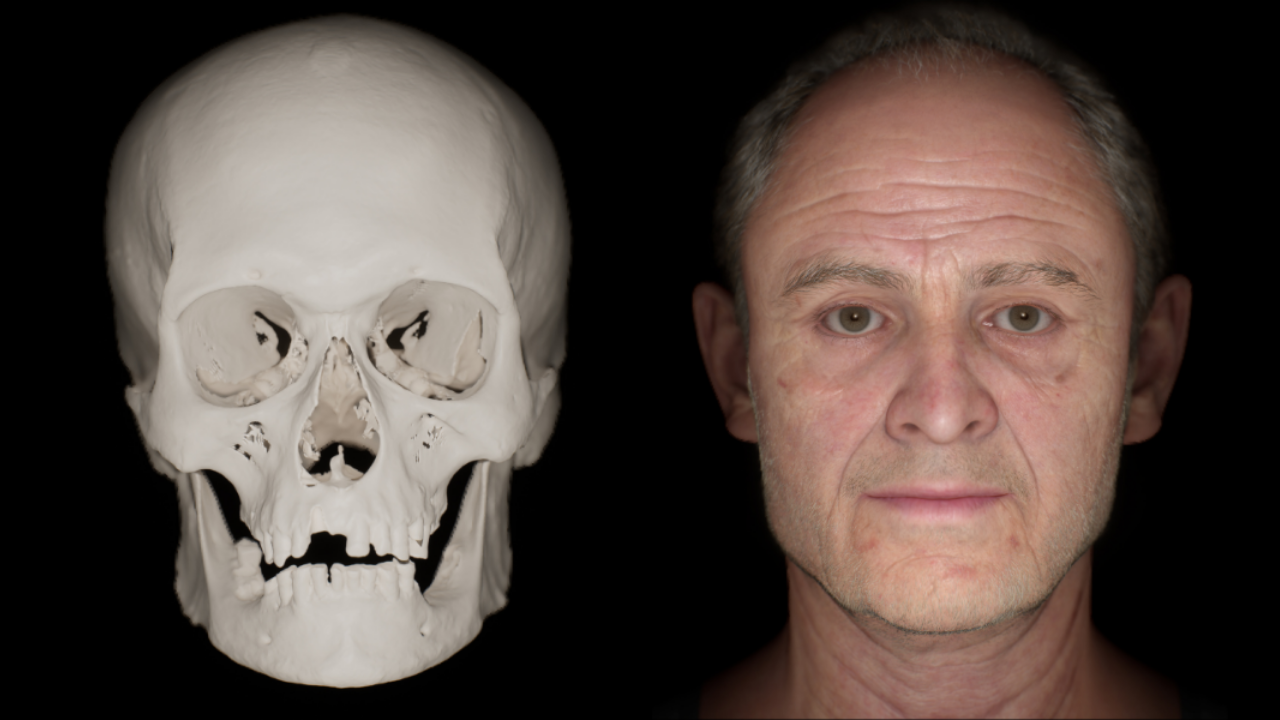
History loves a clean narrative. Textbooks thrive on neat dividing lines, presenting 1066 as a hard meteorological boundary where Anglo-Saxon England ended and Norman England began. Yet bones do not care about political epochs. A collaborative team spanning English Heritage, Historic England, the Francis Crick Institute, and Face Lab at Liverpool John Moores University has unveiled the digital facial reconstruction of an individual dubbed the "Conquest Man," unearthing a physical reality that completely upends the tidy binary of victor and vanquished.
Buried around 1079 at St Peter's Church in Barton-upon-Humber, Lincolnshire—just thirteen years after William the Conqueror secured his crown at Hastings—this individual was no king or chronicled baron. He was a working-class survivor. Standing just over five feet tall, the man was stocky, muscular, and aged between fifty and sixty at the time of his death. His skeleton bears the unmistakable physical toll of a brutal existence: multiple healed fractures that trace a life of heavy physical labor and frequent trauma.
When researchers peeled back the layers of dust and time using osteological analysis, ancient DNA extraction, isotope testing, and advanced digital facial reconstruction, they found a man whose very biology defies geographic pigeonholing. His DNA points to substantial continental European ancestry, while oxygen isotope levels extracted from his teeth suggest his adolescent years were spent in a noticeably colder climate. Yet, strontium isotope tests align more closely with the local Lincolnshire soil where he spent his final years. He was a transient soul or part of an already mobile European network long before the ink dried on the Domesday Book.
Even his burial tells a story of cultural syncretism that bureaucratic medieval clerks failed to record. Placed in an oak coffin fashioned from a tree felled around 1079, his arms were folded carefully, his head propped on a grass pillow, and stabilized with two blocks of local chalk. Most telling of all, three applewood staffs—grave goods deeply rooted in Scandinavian tradition—lay by his side. This amalgamation of Christian interment and pagan-adjacent northern ritual occurred right outside a pre-Conquest church that had fallen under the ownership of one of William the Conqueror’s knights.
This man occupied a strange, gray space in a changing world. He lived through the reign of Viking King Cnut, watched an invading Norman army redraw the geopolitical map, and ultimately found rest in a landscape dominated by the new ruling elite. He was neither a pure Anglo-Saxon nor an immigrant invader in the simple terms often deployed by chroniclers. By the eleventh century, populations across the North Sea world, Scandinavia, Normandy, and Britain were already deeply intertwined.
The digital rendering created by Face Lab brings an unsettling immediacy to these scientific datasets. Staring into the face of a man with graying hair, receding follicles, and stubborn facial stubble strips away the clinical abstraction of archaeology. He looks like someone you might pass on a modern street, weathered by wind and harsh winters.
Archaeology often chases gold hoards and royal tombs because they photograph well for museum brochures. But the true architecture of the past is built by people like the Conquest Man—individuals who absorbed the shockwaves of political earthquakes, stitched together conflicting cultural traditions to bury their dead, and kept walking despite broken bones. History is rarely about the generals who command the field; it is about the resilient bodies that manage to survive the aftermath.


