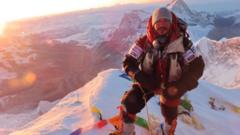
An avalanche on Pakistan's Broad Peak changed the global mountaineering conversation overnight. A ten-member international expedition, led by legendary high-altitude mountaineer Nirmal "Nimsdai" Purja, went completely out of contact after a massive wall of snow swept the upper slopes.
When elite professionals disappear in the Karakoram range, it forces everyone to look past the social media gloss of modern mountaineering and confront the raw danger of the world's highest peaks.
The Reality of Broad Peak
Broad Peak stands at 8,047 meters, making it the twelfth-highest mountain on Earth. It sits right next to K2 on the China-Pakistan border. While climbers often view it as a slightly more approachable giant compared to its ferocious neighbor, the mountain demands absolute respect.
Around midday on a Thursday, conditions turned instantly lethal. An avalanche struck the upper section of the peak just as the expedition was pushing toward higher camps or the summit zone. Communication lines dropped dead immediately.
The Alpine Club of Pakistan, alongside local expedition leaders like Mingma David Sherpa, scrambled to coordinate ground searches and helicopter support. Yet, weather windows in the Karakoram dictate everything. Helicopters cannot fly into blind whiteout conditions or active storm tracks. Ground teams face extreme altitude sickness risks, bitter cold, and unstable snowpacks just trying to reach the site.
Who Was on the Mountain
The expedition team reflects the truly global nature of modern high-end mountaineering. The group included five Nepali climbers anchored by Purja's elite climbing infrastructure, alongside international figures like American climber Mallory Geis, Omani mountaineer Nadhira, Chinese climber Wang, and Pakistani climber Sohail Sakhi from Hunza.
These aren't novices stumbling onto a tourist trail. These are experienced expedition members operating at the absolute limit of human endurance. Purja himself had just summited Gasherbrum II without supplemental oxygen days prior, ticking off another milestone in his massive "Hat-Trick Project"—an ambitious endeavor to climb every eight-thousander three times over.
Why High Altitude Risks Remain Unforgiving
People look at modern gear, satellite weather forecasting, and commercial logistics and assume high-altitude climbing has become safe. It hasn't.
Gravity, shifting climate patterns, and sudden slope failures care nothing about a mountaineer's resume. Purja earned global fame by shattering speed records across all fourteen eight-thousanders in 2019, later leading the historic first winter ascent of K2. Yet, statistics prove that legendary status provides zero immunity against falling ice and cascading snow.
Avalanches remain the single most volatile hazard in the Karakoram and the Himalayas. A single thermal shift or wind-slab fracture can wipe out an entire team in seconds, regardless of how many oxygen bottles they carry or how many times they have stood on a summit.
The Waiting Game and Rescue Logistics
When communication cuts out at eight thousand meters, rescue operations turn into a logistical nightmare. Ground rescuers cannot simply charge up a mountain at those elevations; the thin air makes physical exertion agonizingly slow and dangerous.
Agencies rely heavily on military helicopter pilots willing to push aircraft to their absolute technical ceilings. Even then, mechanical lift capabilities drop drastically in high-altitude, thin-air environments.
As search and rescue coordinators monitor conditions for the next weather break, the entire climbing community holds its breath. Incidents like this strip away the glamour of extreme sports and expose the grim baseline truth of mountaineering: the mountain always gets the final vote.