Click. Twist. Scrape.
Anyone who has ever held a Rubik's Cube knows the sound before they even see the colors. It is a dry, insistent percussion—plastic sliding against plastic, a tiny internal spring groaning under the pressure of a thumb trying to force red next to red when the math stubbornly refuses to cooperate. I still remember the first one I ever gripped on a rainy afternoon in my grandfather's study. The stickers were peeling at the corners, exposing pale white plastic underneath, and the center mechanism felt loose, almost wobbly, like a well-worn bicycle chain. I spent forty minutes turning faces at random until my wrists ached and the colors looked more chaotic than when I started.
Forty-three quintillion possible configurations. That is the famous number mathematicians throw around when they want to make a three-inch block of colored squares sound like a cosmic riddle. Yet for decades, the most surprising twist in the cube's story had nothing to do with algorithms or speedcubing records. It had to do with geography. A puzzle born in Budapest, shaped by Hungarian engineering and Cold War scarcity, spent most of its global boom being stamped out in factories thousands of miles away. Now, as production of the Rubik's Cube returns to Hungary, the shift carries a weight that goes far beyond supply chains, shipping containers, or quarterly earnings.
It feels like a prodigal invention walking back up the cobblestones of home.
A Wooden Prototype and a Quiet Revolution
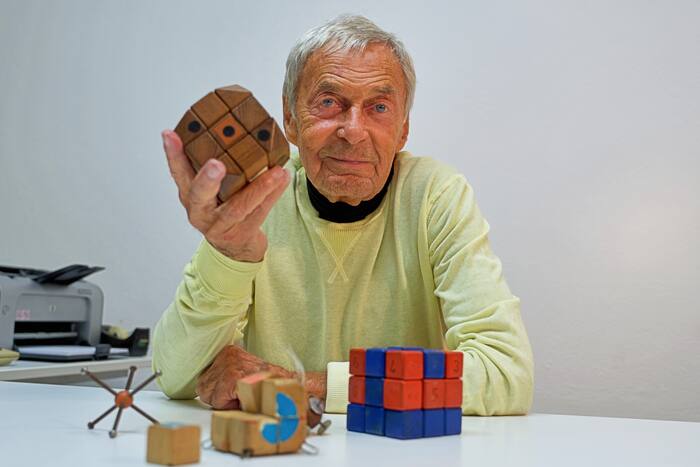
To understand what it means for manufacturing to return to Hungary, you have to look back to 1974 in Budapest. Ernő Rubik was not trying to conquer toy aisles across the globe when he carved twenty-six wooden blocks and tried to figure out how to move rows independently without the whole structure collapsing into a pile of loose parts. He was an architecture professor teaching spatial geometry, looking for a tactile way to help students visualize three-dimensional movement.
When he scrambled the faces and tried to put them back, it took him a month. A whole month. Think about that for a second. The creator of the puzzle got stuck inside his own creation.
That detail matters because it strips away the myth of effortless genius. Ernő Rubik did not pull a finished toy out of thin air. He wrestled with wood, glue, elastic bands, and geometry behind the Iron Curtain, in a country where consumer goods were tightly controlled and raw materials were rarely abundant. When the puzzle—originally called the Magic Cube, or Bűvös kocka—slowly began appearing in Hungarian toy shops in the late 1970s, it was a small miracle of ingenuity born under constraint.
Then came the explosion. By the early 1980s, the cube had escaped Hungary's borders and swept across the world with a speed few toys have ever matched. Millions of people bought them, dropped them, peeled off the stickers with butter knives, or threw them into desk drawers in defeat. Millions more became obsessed, memorizing sequences of turns until their fingers moved faster than their conscious thoughts.
In a world increasingly defined by flat glass screens, bringing a physical object with real friction and mechanical resistance back to its birthplace hits a nerve. Screens are smooth and weightless. A Rubik's Cube demands grip. It pushes back.
The Long Detour of Global Manufacturing
If you ask why a Hungarian invention eventually ended up being mass-produced elsewhere—chiefly in Asian manufacturing hubs—the answer is neither mysterious nor scandalous. It is the story of modern global trade. As demand skyrocketed in the 1980s and continued across decades of waves and revivals, companies looked for scale, lower unit costs, established tooling networks, and factories built to churn out tens of millions of units without blinking.
For a global toy brand, outsourcing makes cold, tidy sense. You get efficiency. You get predictability. You shave fractions of a penny off each unit, and when you are talking about millions of cubes, those fractions add up fast.
Yet there is always a trade-off when a cultural icon leaves its place of origin, even if nobody talks about it on an earnings call. (Note: What follows is a hypothetical scenario created to illustrate the human side of industrial shifts.) Picture a hypothetical machinist named Gábor working near Győr or Budapest in his late forties. For years, he has watched foreign factories assemble toys that carry a Hungarian name on the box, while domestic industry in his region leaned heavily on automotive parts, electronics assembly, or precision components for other nations' brands. To Gábor, seeing the cube return is not an abstract economic headline. It is the sight of something unmistakably Hungarian being built on Hungarian soil once again, with local hands setting the tolerances and testing the turn feel.
I have to admit, I used to view reshoring and localized manufacturing through a purely cynical lens. Whenever companies announce they are bringing production closer to home, my first instinct is to ask whether it is a publicity move, a tariff hedge, or a temporary pivot that will reverse the moment costs shift again. Skepticism protects you from marketing spin. Sometimes, though, skepticism can make you miss genuine emotional and strategic meaning. When a product is tied so closely to a single creator and a single national identity, geography is part of its DNA.
Why Geography Changes the Feel of a Classic
People often ask whether a Rubik's Cube made in one country actually feels different from one made in another. Fair question. At the end of the day, an injection mold is an injection mold, and ABS plastic behaves according to chemistry and physics, not sentiment.
Still, anyone who has ever tuned a speedcube—adjusting tension screws, wiping away factory lubricant, testing corner-cutting angles—knows that micro-differences in tolerances change everything. A fraction of a millimeter decides whether a layer glides or catches. A slightly stiffer spring changes the rhythm of a solve from a whisper to a clack.
Bringing production back to Hungary is not merely about nostalgia; it is also a signal about how modern manufacturing works when automation, precision tooling, and regional supply chains mature. You do not bring a complex multi-part mechanical puzzle back home successfully unless the local engineering ecosystem can support quality control, consistent molding, and modern logistics. If the tolerances are sloppy, people notice within ten turns. A bad cube feels gritty and cheap. A well-made cube feels inevitable.
Consider what happens next when a company pairs heritage with modern industrial discipline. Suddenly, the story stops being "a famous old toy is back in its homeland" and becomes proof that high-precision consumer goods can be manufactured closer to home without sacrificing scale or durability.
The Invisible Stakes Behind Six Colors
Why does any of this matter to someone who has not touched a puzzle cube since middle school?
Because objects carry stories, and the places where we make things shape what we believe we are capable of making. For decades, a dominant narrative in global business went like this: ideas can come from anywhere, design can happen in one studio, branding can happen in another, and physical production simply goes wherever labor and scale are cheapest. That model built the modern world, lowered prices on countless goods, and connected distant economies.
It also hollowed out plenty of towns and severed physical craft from cultural memory.
When a Rubik's Cube is produced in Hungary again, it quietly challenges that purely transactional view of making things. It reminds us that heritage is not a museum piece behind velvet rope. It can be active. It can be industrial. It can hum on a factory floor.
And on a personal level, the cube has always been a mirror for how we handle frustration. Most people do not solve it on their first try. Most people stall out on the second layer, or stare at a yellow cross that refuses to align, wondering if they broke something inside. You have to learn patience. You have to accept that moving a piece away from where it belongs is often the only way to guide it home.
That metaphor—moving backward to move forward—is obvious, maybe even a little worn smooth like an old corner piece. (I should be clear here: comparing industrial reshoring or personal problem-solving to rotating layers of a puzzle is a metaphor, not a literal rule of economics or psychology.) Even so, it rings true because real problems rarely yield to brute force. Twisting harder does not line up the colors. Understanding the system does.
What Stays in Your Hands After the Twist
Memory plays funny tricks with sensory details. When I close my eyes and think of that first cube in my grandfather's study, I do not remember the exact date or the brand licensing history. I remember the cool smell of old paperbacks on the shelves around me, the bright glare of orange and blue squares under a desk lamp, and the quiet determination of a kid refusing to give up on a square block that seemed smarter than he was.
That is the real reason a story about factory lines and Hungarian production matters. Beneath the business logistics sits a universal human impulse: the urge to take something tangled, confusing, and scattered, hold it in both hands, and bring order to it one deliberate turn at a time.
As production returns to Hungary, the six colors are lining up a little closer to where they began—not frozen in 1974, not trapped in amber, but spinning forward into a new chapter.
Watch a solver's hands sometime when the final face clicks into place—no fanfare, no speech, just a sudden stillness as six solid walls of color lock together and the noise stops.