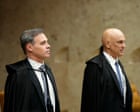
When the highest arbiters of justice start screaming at each other on live television, democracy usually takes a direct hit. Brazil's Supreme Federal Court recently descended into an ugly, public brawl right on the eve of a razor-thin presidential election. Instead of acting as a stabilizing anchor for the country, the judiciary became the main attraction in a political circus, leaving voters to wonder who is actually running the nation.
If you have been watching Brazilian politics, you know the stakes could not be higher. Incumbent President Luiz Inácio Lula da Silva and the conservative opposition have been locked in a brutal, dead-heat battle. Then came an explosive scandal involving leaked messages, a failed bank called Banco Master, and alleged connections reaching the highest levels of power. Rather than quietly handling the judicial fallout, the justices chose open warfare.
When Robes Come Off and Accusations Fly
The courtroom drama reached a boiling point during a plenary session in Brasília. Justice André Mendonça and Justice Alexandre de Moraes locked horns over investigations and leaked records, trading furious accusations. When Mendonça presented a report tied to the controversy, shouting matches erupted.
“It is a lie!” Mendonça fired back when challenged.
Things deteriorated even faster when veteran Justice Gilmar Mendes jumped into the fray, accusing Mendonça of weaponizing the court's administrative duties to trigger political chaos and tilt the upcoming vote. Fingers were pointed, warnings were issued, and basic judicial decorum evaporated. “Don't point your finger at me! You're not talking to any old person!” Mendonça snapped, drawing a sharp reminder from Mendes that respect is earned, not given.
This was not just professional disagreement. It was a raw display of institutional breakdown that spilled directly into the presidential campaign trails.
How the Courtroom Crisis Fueled the Campaign Trail
Politicians don't waste crises like this. Right-wing challengers immediately seized on the Supreme Court infighting to galvanize their base. Figures aligned with the Bolsonaro camp argued that the chaos inside the judiciary proved the system was rotten to its core. Rallies featured fierce attacks on individual justices, with candidates claiming that a vote for the left was basically a vote for judicial overreach.
On the other side, defenders of the court argued that the public bickering was a symptom of transparent, albeit messy, accountability. They claimed that airing these grievances showed the court was strong enough to police itself, even when the internal pressure cooker blew its lid.
Most everyday Brazilians didn't buy that spin. Public trust in the Supreme Court had already been sliding for years. When the men and women in black robes start acting like rival street fighters, ordinary citizens lose faith in the rule of law. Political analysts noted that the spectacle accelerated the campaign's descent into pure mudslinging. Instead of debating inflation, healthcare, or social programs, the national conversation became consumed by institutional paranoia.
The Broader Damage to Democratic Norms
You have to look at the structural damage here. Brazil's Supreme Court holds immense, sometimes controversial power. Justices routinely block legislation, oversee high-stakes corruption trials, and police digital speech and election integrity. When that power appears compromised or fractured by internal factionalism, the entire democratic apparatus wobbles.
Voters went to the polls carrying deep skepticism. A staggering percentage of the population felt the high court had simply grown too powerful and unaccountable. This institutional fracture contributed to an election so polarized that the margin of victory razor-thin, leaving the country deeply split and vulnerable to foreign commentary and domestic unrest.
Fixing an institution like Brazil's high court requires more than a temporary ceasefire between warring judges. Experts have long argued for structural reforms, such as fixed terms for justices, decisions requiring the full bench rather than solitary rulings, and strict timelines for investigating judicial misconduct. Without those changes, personality clashes at the top will continue to threaten political stability every single time a presidential election rolls around.
The robes might stay on, but the stains of this political brawl will take years to wash out.