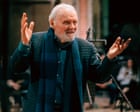
The room is quiet. It is the kind of silence that only accumulates over decades, heavy with the dust of old scripts, stage lights, and the echoes of applause that belong to someone else. An old man sits on a wooden bench. His fingers, thickened by time and mapped with the blue veins of eighty-plus years, hover over a row of ivory keys. To the world, those hands belong to Hannibal Lecter. They belong to King Lear. They belong to an titan of the silver screen who spent half a century commanding the attention of millions with nothing more than a chilling, unblinking stare.
But the man at the piano is not thinking about Hollywood. He is not thinking about the Oscars resting on his mantle or the knighthood bestowed by a queen. He is thinking about a cold, grey afternoon in Wales, more than seventy years ago, when a lonely boy sat in a front room and realized that the only language he ever truly wanted to speak was written in crotchets and quavers. You might also find this similar article insightful: The Price of Staying Alive.
Anthony Hopkins has just released his debut single.
To the casual observer scrolling through a newsfeed, it looks like a vanity project. We live in an era where celebrities routinely cross lanes, where actors try their hand at pop music and musicians try their hand at prestige television. It is easy to dismiss it. It is easy to write it off as the late-career whim of a restless artist who has run out of things to conquer. As extensively documented in latest coverage by E! News, the results are worth noting.
That assumption is entirely wrong.
The truth is far more fragile. The truth is that acting was the detour. The silver screen, with all its glory and terrifying brilliance, was the beautiful accident that kept a musician away from his instrument for a lifetime. When Anthony Hopkins announced that music was his first desire, he was not starting something new. He was finally coming home.
The Weight of the Detour
Consider the mechanics of a life redirected. In the 1940s, in the industrial grit of Port Talbot, Wales, young Anthony was not a golden child. He was considered a slow learner. He was isolated, deeply insecure, and utterly detached from the structured world of academics. He found his sanctuary in the keys of a secondhand piano. The instrument did not demand that he spell words correctly or memorize historical dates. It only asked for his hands.
He practiced with a fierce, quiet desperation. He dreamed of the concert hall. He imagined the swell of strings rising up to meet his melodies. But life possesses a strange, unpredictable gravity. A chance meeting with Richard Burton ignited a spark of curiosity about the stage. A scholarship to a drama college followed. The theater claimed him. Then the cameras found him.
The rest is a matter of cinematic history. He became a master of the human psyche, a chameleon who could terrify an audience with a whisper or break their hearts with a slumped shoulder. He became a global icon.
But icons carry secrets.
For decades, while the world watched him inhabit other people’s souls, Hopkins kept his own soul locked inside a piano. He composed in secret. He wrote melodies on hotel pianos between takes on movie sets. He scribbled musical notations on the backs of script pages. It was a private communion, a shadow life lived in the margins of a legendary career. Imagine carrying a symphony in your head for fifty years while the world constantly asks you to recite Shakespeare. The invisible stakes of this artistic confinement are immense. It is the quiet ache of knowing you have excelled at a craft you stumbled into, while the craft you chose remains waiting in the dark.
Breaking the Silence
The transition from a private passion to a public offering is terrifying. It requires a vulnerability that no acting role can ever demand. When an actor steps onto a stage, they are protected by the armor of a character. They wear another man's clothes. They speak another man's words. If the performance fails, the character takes the blame.
Music offers no such shelter.
When you release a piece of music, you are exposing the raw architecture of your internal world. There are no dialogue coaches to smooth over the rough edges. There are no editors to cut away the mistakes. It is just you, bare and unprotected, floating on a wave of sound.
The debut single is not a commercial play. It is an act of profound courage. It is an old man looking back at the boy in Port Talbot and saying, "I did not forget you."
The piece itself breathes with the cinematic scope you might expect from a life spent in front of the lens, yet it remains intensely intimate. It does not chase modern trends. It does not attempt to be hip or relevant. It is a classical, sweeping endeavor that feels as though it was pulled directly from the mid-century soil of his youth. The melodies rise like the Welsh hills, heavy with melancholy, yet shot through with a stubborn, enduring light.
The Illusion of Time
We are conditioned to believe that life is a linear progression. We think we start at point A, climb to the peak of our careers at point B, and then quietly fade away in the twilight. We view age as a process of closing doors.
Hopkins shatters that framework.
His foray into the musical world at this stage of his life reminds us that creativity does not possess an expiration date. The human heart remains hungry long after the body slows down. This single is a rebellion against the tyranny of the clock. It is a declaration that it is never too late to claim the identity you left behind in the rush of youth.
Think of the courage it takes to be a beginner again when you are already a master. Hopkins could spend his remaining years resting on his laurels, painting in his studio, or accepting lifetime achievement awards. Instead, he chose to enter the arena as a debut artist. He chose the vulnerability of the novice.
The Final Chord
The music plays on.
In houses around the world, people will listen to this track. Some will listen out of curiosity, eager to see what the famous actor sounds like when he isn't speaking. Others will listen with a critical ear, searching for flaws in the composition.
But the true value of the music lies beyond the critiques and the streaming numbers. It exists in the space between the notes, where a lifelong dream finally found its breath. It is the sound of a circle closing.
The old man on the bench hits the final note. The sound rings out, vibrating through the wood, filling the quiet room before slowly dissolving into the air. He smiles. The boy from Port Talbot is finally listening.