The coffee in the mug is cold. It has been cold for an hour, forgotten beside a stack of invoices that look more like casualty reports with every passing sunrise.
Mark doesn't look at the map anymore. He doesn't need to. He can draw the invisible line dividing two nations from memory, tracing it right through the middle of his warehouse floor where four thousand steel components sit stacked on wooden pallets, going nowhere. They were supposed to cross south by dawn. Instead, they are prisoners of a bureaucratic ceasefire that feels remarkably like a slow-motion war.
When trade wars make the evening news, they arrive as tidy percentages on a glowing screen. Economists speak in clipped tones about tariffs, retaliatory measures, gross domestic product adjustments, and executive signatures. The language is sterile. It smells of dry-erase markers and mahogany boardrooms.
It smells nothing like grease, diesel, and sweat.
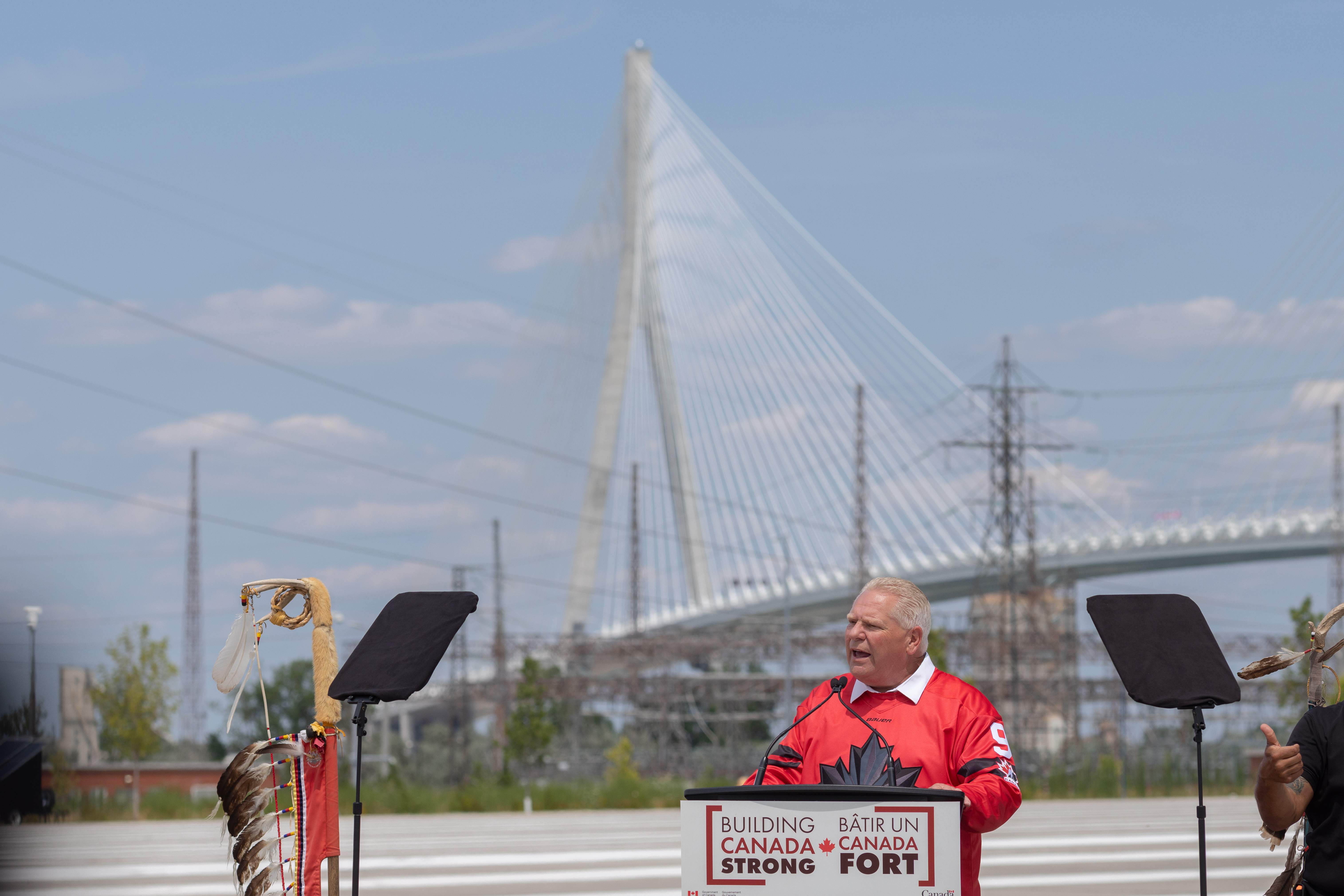
Consider what happens next when the political temperature spikes thousands of miles away in Washington and echoes down into the limestone halls of Queen's Park in Toronto. Ontario Premier Doug Ford steps up to a microphone. The cameras flash. The reporters lean in, notebooks snapping open like mouse traps. He is scheduled to speak, and everyone in the province knows the weight of the air he is about to breathe into. It is a defense of the shield. It is a warning to the south.
(Note: While Ford’s speeches are real-time political reactions, the anxiety rippling through shop floors is a lived, daily reality for thousands of independent operators.)
For months, the friction has built up grain by grain. What started as whispers of protectionism has curdled into actual policy—duties slapped on aluminum, sudden quotas on manufactured goods, and the slow, agonizing tightening of economic tourniquets. To a politician, a tariff is a bargaining chip. To Mark, who employs forty-two people in a manufacturing plant just outside of Windsor, a tariff is a sledgehammer swung directly at his payroll.
"We aren't asking for favors," Mark says, wiping a smudge of hydraulic fluid from his thumb. "We just want the rules we built our businesses on to stop changing every time an election cycle stumbles."
This is the hidden cost of geopolitical posturing. We treat trade like a giant game of Risk, moving blue and red armies across an oceanic board. We forget about the people living under the game pieces.
To understand why a speech by a provincial premier matters, you have to look past the political theater and into the anatomy of cross-border supply chains. Modern manufacturing is not a relay race where one country hands a baton to another at a clean boundary line. It is a finely woven sweater. Pull a thread in Detroit, and a sleeve unravels in Oshawa. An automotive part will cross the border seven times before a vehicle ever rolls off an assembly line. When sudden trade barriers drop, you aren't just taxing a foreign nation; you are taxing yourself. You are throwing sand into your own engine.
Ford knows this. His political survival, and the economic pulse of Canada's industrial heartland, depends on projecting absolute unyielding resolve. When he stands at that podium to address the escalating U.S.-Canada trade war, his words are aimed squarely at cross-border protectionism. He has to balance the defiance of a trade combatant with the pragmatism of a man holding an economy together with duct tape and hope.
History tells us this dance is dangerously old. Protectionism is an intoxicating drug for politicians looking for a quick fix to domestic discontent. It promises local salvation while quietly strangling the very regional partnerships that made both economies global powerhouses. We saw it in the steel towns of the past. We see it now in the battery plants, the tech corridors, and the family-owned machine shops.
Down the road from Mark’s facility, Sarah runs a logistics firm that coordinates cross-border freight. Her whiteboard is a chaotic mosaic of color-coded sticky notes, half of them crossed out in red marker.
"Drivers are sitting at the crossing for six hours instead of forty-five minutes," she explains, her voice tight with exhaustion. "Every delay is money burned. Every new regulation is a puzzle piece designed to make us fail. And for what? So a politician can sound tough on a Tuesday night broadcast?"
She isn't talking about abstract theory. She is talking about diesel costs, driver retention, and the frantic phone calls from American clients who love her work but hate the new price tag forced upon them by legislative crossfire.
This is where the narrative of trade wars breaks down. We talk about nations as monolithic blocks, as if Canada and the United States are two monolithic titans glaring across a fence. In reality, they are a patchwork of deeply intertwined communities. A factory in Ontario relies on steel from Pennsylvania, which relies on software from Waterloo, which relies on microchips from California.
When you introduce sudden trade hostility, you aren't fighting a rival. You are punching your reflection in a cracked mirror and wondering why your hand hurts.
Back at the podium, the premier speaks. He talks about jobs, about fairness, about the unbreakable bond of neighbors who share the longest undefended border in the world. The rhetoric is strong. It has to be. In the theater of international trade, showing weakness invites a worse beating.
Yet, out in the provinces, away from the microphones and the tailored suits, the real battle is fought in silence. It is fought in the quiet cancellations of expansion plans. It is fought in the hesitant handshakes of business owners who decide to wait another year before hiring new apprentices. It is fought in the slow erosion of trust.
Mark looks back at his cold coffee. He picks it up, realizes it is undrinkable, and sets it down again. Outside, a transport truck pulls out of his loading bay, its trailer half-empty because the client south of the border decided to source locally just to be safe.
Safe. That is the word everyone is chasing. But in a trade war, safety is an illusion. The longer the barriers stay up, the more both sides discover how much pain they can inflict on themselves in the name of winning. And long after the speeches are given, the cameras are packed away, and the headlines fade into yesterday's digital dust, the invoice sits on the desk, waiting to be paid.


