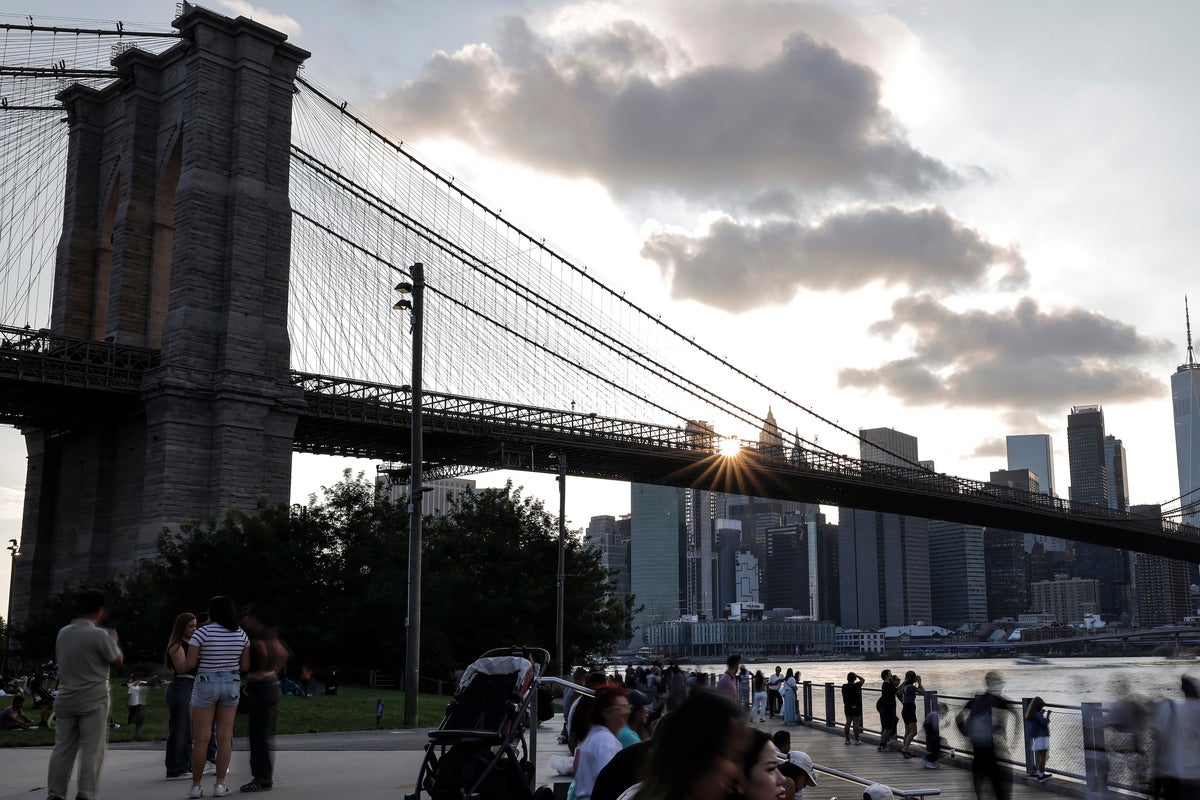
The headlines following the fatal shooting of a man on the Brooklyn Bridge cables write themselves. They always do. Another tragic standoff, another life ended on public infrastructure, another round of institutional hand-wringing about use-of-force protocols and urban crisis response. The standard narrative treats the incident as a localized breakdown of de-escalation, a tragic puzzle where officers simply failed to talk someone down from a steel arch high above the East River.
That perspective is dangerously lazy. It reduces a systemic urban pathology to a binary moral struggle between a desperate individual and the officers pulling the trigger.
When a man scales the suspension cables of one of the busiest choke points in America, armed, defiant, and entirely non-compliant with repeated police directives, the event is no longer an isolated policing failure. It is the final, noisy failure of a public health apparatus that abandoned its post long before the first squad car blocked the span. Focusing solely on the tactical decisions made on those cables is a comfortable distraction. It lets every municipal agency off the hook for the months and years of institutional neglect that put a man in a position to force a lethal confrontation in front of thousands of commuters.
The Geography of Desperation
Scale a bridge in New York City, and you are not just making a statement; you are hijacking the city's nervous system. The Brooklyn Bridge is a vital artery carrying over one hundred thousand vehicles and pedestrians daily. When it shuts down, the economic and logistical shockwaves ripple across boroughs within minutes.
Yet the public debate routinely ignores the operational reality of policing a vertical choke point. Critics sitting behind keyboards demand infinite patience, treating a high-wire standoff like a mediation session in a quiet conference room. They forget gravity, wind shear, limited cover, and the staggering impossibility of rapid extraction on a narrow pedestrian walkway suspended 135 feet in the air.
Imagine a scenario where officers are expected to indefinitely negotiate with an armed individual on a structural span while thousands of commuters remain trapped in the gridlock below, vulnerable to whatever impulsive escalation comes next. The police do not create the crisis on the bridge. They inherit it at its absolute worst, compressed into a few panic-filled minutes where every single option carries a catastrophic downside.
Blaming the frontline officers for the fatal outcome is equivalent to blaming the ER surgeon for losing a patient who arrived with a rotting, untreated infection. It ignores the upstream failures that made a lethal collision inevitable.
The Myth of Infinite De-escalation
Every time a headline features a fatal police intervention involving a weapon-wielding subject, a chorus emerges demanding more de-escalation training. The assumption is that officers possess a secret verbal formula that, if deployed correctly, will always induce a rational surrender from someone in the throes of a psychological crisis or acute distress.
This is a fantasy born from complete unfamiliarity with high-stress human behavior.
De-escalation requires a baseline of shared reality and rational processing. When an individual is heavily intoxicated, experiencing severe psychosis, or determined to achieve suicide by cop, standard verbal containment hits a hard brick wall. Officers are not mental health clinicians, nor are they miracle workers. They are armed municipal workers tasked with public safety in environments where seconds matter and mistakes are fatal.
Insisting that officers absorb infinite risk to protect someone who refuses to drop a weapon turns the social contract upside down. The primary duty of the state in a public space is to protect the innocent bystanders, the commuters, and the officers themselves. When an individual crosses the line from self-harm to threatening the public safety infrastructure, the calculus shifts. Pretending that every standoff can be resolved with a cup of coffee and a sympathetic ear is a lethal delusion that costs lives on both sides of the badge.
The Upstream Abandonment
The real scandal of the Brooklyn Bridge shooting is not what happened on the cables. It is how that man got onto them in the first place.
New York City’s emergency psychiatric and social safety nets are fractured beyond recognition. Hospitals discharge vulnerable individuals into unstable housing or total homelessness with alarming regularity. Outpatient mental health clinics are perpetually underfunded, understaffed, and bureaucratic nightmares to navigate. When families try to secure involuntary commitment for a loved one spiraling toward violence or self-destruction, they run into a wall of legal red tape and locked doors.
Society waits until someone climbs a bridge, grabs a weapon, and forces a violent intervention. Only then do the cameras roll, the politicians issue statements of concern, and the pundits debate tactical nuances.
It is a grotesque diversion. We underfund care, gut our institutional support systems, and then act surprised when the raw edges of human misery spill out onto our most visible public landmarks. The police become the default social workers of last resort, armed with firearms because no one else is left to answer the call.
Shifting the Target
If we genuinely want to stop fatal incidents on our bridges and thoroughfares, we have to stop treating policing as the root cause of urban violence and start treating it as the symptom.
Stop pretending that better crisis intervention training for cops can substitute for functional mental healthcare facilities. Stop treating public infrastructure as a makeshift stage for untreated psychological distress. And stop blaming the officers who are forced to make life-and-death choices in fractions of a second while politicians wash their hands of the systemic decay below.
The tragedy on the Brooklyn Bridge was written months before anyone ever climbed those cables. Until we fix the rot at the foundation, we are simply waiting for the next headline on the span.

