History often reduces political spouses to decorative footnotes, walking quietly two paces behind the throne while prime ministers draft the chapters of a nation. But Hasmah Mohamad Ali, who passed away at the age of one hundred at the National Heart Institute in Kuala Lumpur, was never merely a shadow. For seven decades alongside Malaysia's longest-serving leader, Mahathir Mohamad, she carved out an independent identity that outlasted administrations, weathered monumental crises, and fundamentally shifted public health policy in Southeast Asia. Her death closes a remarkable chapter defined by quiet resilience, medical pioneering, and an unshakeable adherence to a strict personal code of public service.
Long before she became the spouse of a deputy prime minister and subsequently a two-term prime minister, Hasmah was a trailblazer in her own right. Born in Klang, Selangor, in 1926, she broke profound barriers by training as a physician at the King Edward VII College of Medicine in Singapore. In an era when higher education was overwhelmingly male-dominated, particularly in British Malaya, she earned her MBBS degree and entered the public health sector. She did not treat medicine as a temporary stepping stone. Instead, she labored extensively as a government medical officer, focusing intently on rural health, maternal care, and family planning long before those initiatives gained institutional backing from the federal government.
When she married Mahathir in 1956, she understood the delicate friction between marital partnership and political exposure. She maintained a strict boundary, noting later in life that as a civil servant, active political partisanship was forbidden, and she consciously chose to keep her professional integrity distinct from her husband's ascending political ambitions. That boundary-setting became her trademark. While her husband shaped the economic trajectory and authoritarian contours of modern Malaysia across his initial twenty-two-year tenure from 1981 to 2003, Hasmah channelled her influence into civic advocacy.
She assumed leadership roles across major societal organizations, serving as president of the Malaysian Girl Guides Association, championing adult literacy, and spearheading national campaigns against drug abuse. Her medical background gave her an authoritative voice that politicians lacked. When she spoke about infant mortality, malnutrition, or reproductive health, she did so not as a political surrogate, but as a clinician who had witnessed the stark disparities in rural clinics.
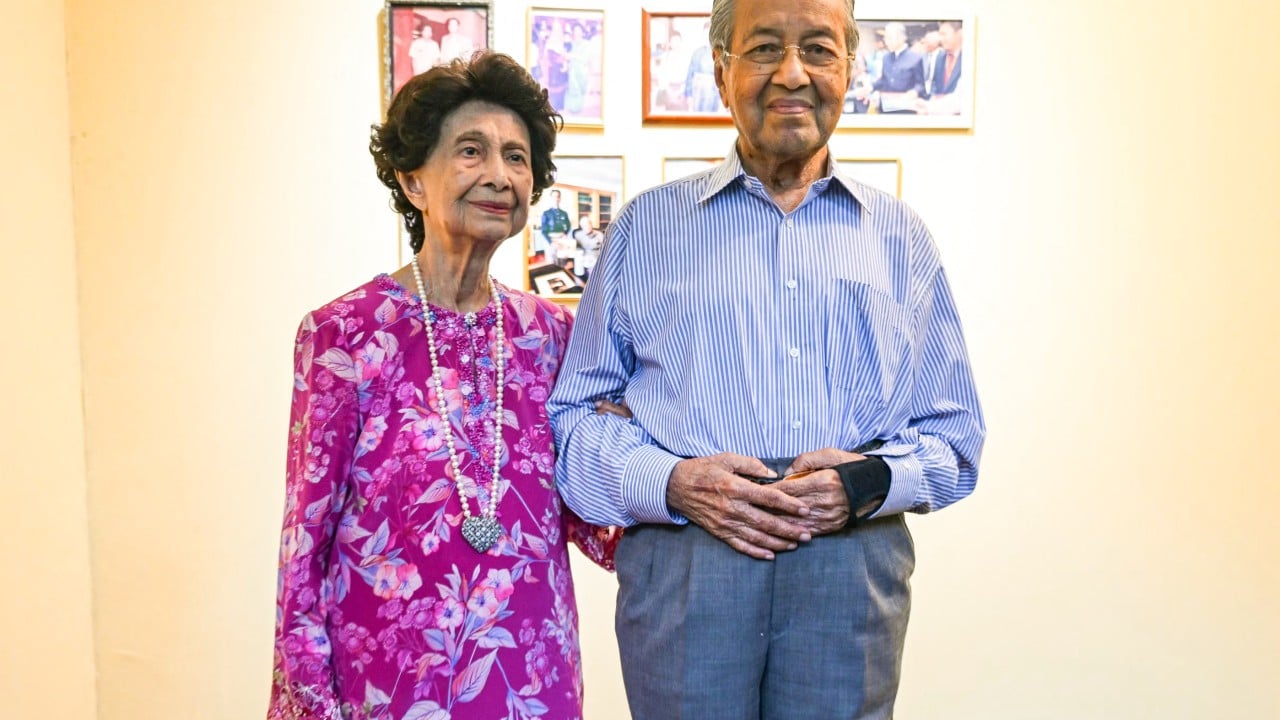
Her public profile was defined by an astute paradox. She was unfailingly soft-spoken, yet possessed an iron spine. During the tumultuous political upheavals that marked her husband's return to power in 2018 at the head of an uneasy coalition, Hasmah was frequently seen holding hands with Mahathir at massive political rallies, serving as a stabilizing human anchor for a leader known for his unyielding sternness. The public affectionate display contrasted sharply with the cutthroat realities of Malaysian political intrigue, endearing her across ethnic and partisan divides.
Later in life, she actively worked to correct how the public perceived her identity. In a 2024 podcast interview, she clarified a minor yet telling detail that underscored her fierce independence: the honorific "Siti" was never part of her given birth certificate, but rather a moniker bestowed by the affectionate public. She requested to be known simply as Hasmah. Yet, the title "Ibu Negara"—Mother of the Nation—bestowed upon her by the Asian Strategy and Leadership Institute, stuck because it captured the maternal gravity she held in the national consciousness.
The milestones of her life mirrored the developmental arc of modern Malaysia itself. She witnessed the Japanese occupation during World War II, the turbulent birth of independence in 1957, the racial riots of 1969, the rapid economic modernization of the late twentieth century, and the dramatic political realignments of the twenty-first century. Through every seismic shift, she remained a constant, embodying a bridge between the colonial era and a digitally connected contemporary state.
Her final years were marked by public displays of remarkable longevity. Just weeks before her passing, she and her husband marked their seventieth wedding anniversary, an astonishing milestone recognized by regional record organizations as the longest union of a former head of government and spouse. Days before her hospitalization, she was still public-facing, appearing on stage at Multimedia University and maintaining an active social calendar that baffled observers half her age.
When she passed away at the National Heart Institute, the outpouring of grief transcended political lines. Current Prime Minister Anwar Ibrahim—historically a fierce political rival of her husband before their brief, complicated alignment—praised her steadfast spirit and maternal warmth. The state funeral at the National Mausoleum in Putrajaya was a solemn acknowledgment of a life dedicated to public service.
Yet the most enduring image of her departure was not the military procession or the condolences of kings and prime ministers. It was the sight of Mahathir, aged 101, sitting in a wheelchair beside her grave, having lost the companion who had walked beside him through seven decades of triumph, controversy, and history. Hasmah leaves behind an institutional legacy of health advocacy and moral steadiness that will outlive the shifting tides of Malaysian politics.
Wife of Malaysia's former PM Mahathir Mohammad dies at age 100
This video provides coverage of the life, legacy, and state funeral proceedings of Hasmah Mohamad Ali.