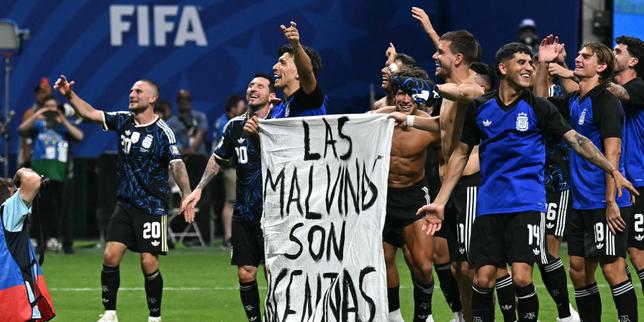
The air in Buenos Aires does not merely circulate; it weighs on you. It carries the scent of charred meat from neighborhood parrillas, the exhaust of ancient buses, and, on certain nights, the collective, suffocating tension of forty-seven million people holding their breath.
To watch football in Argentina is not a pastime. It is a psychological condition.
There is a phrase you hear muttered in the dim light of neighborhood clubs, shouted at glowing television screens in crowded apartments, and whispered like a mantra on the concrete steps of the El Monumental stadium: "Si no se sufre, no vale." If you don’t suffer, it doesn’t count. Or, more simply: if you don’t suffer, it isn’t Argentina.
This is the story of a semifinal that should have been simple, but was instead a masterclass in national masochism. It is the story of how a game of football becomes a mirror for an entire culture’s relationship with struggle, joy, and the terrifying beauty of the cliff's edge.
The Anatomy of the Self-Inflicted Wound
Consider a hypothetical fan named Mateo. He is fifty-two, has a bad heart, and wears a faded Diego Maradona jersey that has seen more tears than detergent. Mateo does not watch the match; he endures it.
On this particular night, Argentina was cruising. They possessed the ball with the lazy elegance of a tango dancer in the late hours of a San Telmo milonga. The passes were crisp. The opposition was chasing shadows. The scoreboard reflected a comfortable lead, the kind of margin that, in any other corner of the globe, would invite the fans to open a beer, lean back, and begin planning for the final.
But Mateo was sweating. His knee bounced a frantic rhythm against the legs of his plastic barstool.
"We are playing too well," he muttered to no one. "This is dangerous."
To outsiders, this looks like paranoia. To an Argentine, it is basic mathematics. The national psyche is built on the profound understanding that peace is an illusion, a brief and suspicious intermission between crises. Whether it is the economy, history, or a football match, the moment things begin to feel secure is the exact moment you must brace for impact.
And then, right on cue, the shift happened.
A misplaced pass in the midfield. A sudden, vertical burst from the opposition. A deflection that seemed to defy the laws of physics, looping agonizingly over the goalkeeper’s outstretched fingers.
Just like that, the comfortable lead vanished into the humid night. The stadium, previously a roaring furnace of song, fell into a silence so sudden you could hear the flags fluttering against their poles.
The Metaphysics of the Tightrope
Why does this happen? Why does a team blessed with some of the most sublime talents in human history consistently choose the path of maximum resistance?
It is not a lack of tactical discipline or physical preparation. It is something far deeper, woven into the very fabric of the country’s sporting identity. Argentine football was born in the potreros—the dusty, uneven vacant lots of Buenos Aires where space was tight, tackles were brutal, and survival required a mix of cunning, improvisation, and sheer defiance.
In the potrero, you do not win by being clinical. You win by outlasting the chaos.
When the opposition scored their second goal, pushing the match into a frantic, chaotic scramble, the narrative arc of the Argentine experience reached its familiar peak. The tactical charts drawn up by the managers in their expensive suits became utterly irrelevant. The match descended into a test of raw, emotional endurance.
"This is who we are," Mateo whispered, his hand pressed firmly against his chest as if to keep his heart from escaping. "We cannot just walk through the front door. We have to burn the house down and climb out through the chimney."
This is the invisible stake of Argentine football. It is never just about a trophy. It is a weekly validation of a shared national truth: that life is hard, unfair, and chaotic, but if you fight hard enough through the mud, the salvation at the end will taste sweeter than anything else on earth.
The Release and the Scar
The final minutes of the match did not resemble sport so much as a collective exorcism.
Every tackle was greeted with a primal scream from the stands. The referee's whistle seemed to blow in slow motion. When the opposing striker found himself free in the penalty box in the ninety-fourth minute, time stopped entirely. Millions of people across a vast, beautiful, troubled country lived a lifetime in the three seconds it took for the ball to leave his foot.
The ball hit the post. The rebound was cleared.
The referee blew the final whistle.
Argentina had won. They were in the final.
But there were no immediate celebrations, no wild outbursts of unadulterated joy. Instead, there was a collective, national exhale. It was the sound of a people realizing they had survived yet another brush with catastrophe.
In the plaza outside the stadium, young men and women wept openly, embracing strangers with a desperation that looked more like relief after a natural disaster than sporting triumph. Mateo sat back down on his stool, his hands shaking slightly as he finally took a sip of his lukewarm beer. His face looked five years older than it had ninety minutes ago.
"We suffered," he said, a slow, exhausted smile finally breaking through his weathered face. "But my god, did we live."
They will do it all over again in the final. They will demand the suffering, they will invite the chaos, and they will march right back to the edge of the cliff, because to do anything less would feel like an empty victory. In Argentina, the scar is not something to be hidden; it is the ultimate proof that you were brave enough to enter the fight.