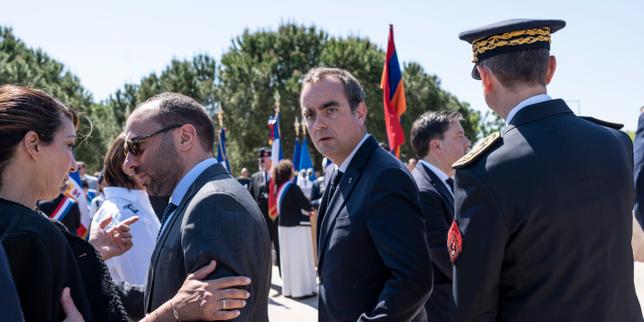
Sébastien Lecornu sat before the microphones, not as a soldier, but as a man defending a different kind of front line. Outside the glass-walled rooms of government, the air in France hummed with a specific kind of tension—the kind that arises when the price of a liter of petrol begins to dictate the contents of a family’s dinner plate. On one side stood the critics, their voices sharp and rhythmic, demanding that the state reach into the deep pockets of TotalEnergies and claw back the "superprofits" gathered during a global energy crisis. On the other stood the Minister of the Armed Forces, making a case that was less about accounting and more about the invisible architecture of national strength.
Money, in this context, is never just numbers on a screen. It is a proxy for power. Also making headlines in related news: The Desert and the Drumbeat.
Imagine a small-town bakery owner, let’s call him Jean. For years, Jean has watched the prices of flour and electricity dance a frantic tango. When he hears that a multinational corporation has cleared billions in profit while he struggles to keep his ovens hot, his reaction is visceral. It feels like a betrayal of the social contract. This is the emotional spark that the French left-wing parties have fanned into a political wildfire. They see those profits as an unearned windfall, a harvest reaped from the soil of a global catastrophe. To them, taxing these gains isn't just policy; it’s a moral imperative.
Lecornu, however, sees a different map. Further insights on this are detailed by CNBC.
His argument doesn't start with the individual at the pump, but with the sovereignty of the flag. He looks at TotalEnergies and sees a strategic asset, a private entity that functions as a pillar of French influence in a world where energy is the primary weapon of diplomacy. To weaken the company's financial reserves through exceptional taxation is, in his view, akin to chipping away at the hull of a ship while it’s still in stormy waters.
The numbers are staggering, but they require context to breathe. TotalEnergies reported a net profit of roughly $20.5 billion in 2022. That is a figure so large it becomes abstract. It ceases to be money and becomes a mountain. But the debate isn't about whether the mountain exists; it's about who gets to mine it.
The left-wing coalition, led by figures who view the corporate world with inherent skepticism, argues that this wealth is "captured" rather than "created." They suggest that the war in Ukraine and the resulting spike in energy prices acted as a massive, unintended subsidy for oil and gas giants. If the public pays the price at the station, they argue, the public should share in the bounty. It’s a compelling narrative of redistribution. It speaks to the French value of égalité.
But the counter-argument, the one Lecornu is spearheading, is rooted in a colder reality.
Consider the transition to green energy. Moving a civilization from oil to electricity is not a simple flick of a switch. It is a massive, multi-decade engineering project that requires capital on a scale that most governments cannot provide alone. TotalEnergies has redirected a significant portion of those "superprofits" into renewable energy projects, attempting to pivot its entire identity. If the state takes that capital today to plug a short-term budget hole or provide a temporary rebate, it might be sacrificing the energy independence of 2040.
Lecornu’s defense is also a defense of French jobs and the "Made in France" label. TotalEnergies isn't just an oil company; it’s an ecosystem. Thousands of subcontractors, engineers, and service workers are tied to its health. In the Minister's eyes, the company is a champion on the global stage. If you hamstring your champion because they are winning too much, you shouldn't be surprised when they start losing to rivals from the United States or China who face no such domestic pressure.
The tension lies in the gap between the immediate and the eternal.
A mother in Marseille doesn't care about a "strategic pivot" to offshore wind farms in 2035 when her heating bill has doubled this month. Her reality is immediate. Her struggle is tangible. When the government refuses to tax the "superprofits," she sees a leadership that is more concerned with the boardroom than the breakroom. This is the "human element" that often gets lost in the dry transcripts of parliamentary debates. It’s a clash of two different, equally valid fears: the fear of poverty today versus the fear of irrelevance tomorrow.
Lecornu knows this. He isn't a man who ignores the public mood, but he is a man whose job is to think about threats that haven't happened yet. He views the energy giant as a buffer. In a world where Russia can turn off the gas or tensions in the Middle East can spike shipping costs, having a "national champion" with deep pockets provides a layer of security that a government tax receipt cannot replicate.
The debate over "superprofits" is actually a debate about the soul of the French economy. Is it a system designed to protect its citizens from the volatility of the world, or is it a system designed to compete and win within that volatility?
The critics point to the fact that while profits soared, the company also engaged in massive share buybacks. This, they claim, is proof that the money isn't going to "the future" or "the workers," but to wealthy shareholders. It is a potent point. It turns the argument from one of national strategy into one of corporate greed. When a company buys back its own shares, it is essentially saying it has nothing better to do with its money than to inflate its own value.
Lecornu’s task is to convince the public that the truth is more nuanced. He argues that a strong stock price is what allows the company to borrow the billions needed for those massive infrastructure projects. It’s a cycle. Strength begets strength.
But the optics remain difficult.
The narrative of the "little guy" versus the "giant" is the oldest story in the world. It is David and Goliath, but in this version, the government is being accused of holding Goliath’s shield. Lecornu’s defense is an attempt to rewrite the roles. He wants the public to see TotalEnergies not as Goliath, but as the fortress that keeps the community safe from the elements.
The debate will continue because both sides are right in their own way. The left is right that the current inequality feels unsustainable. Lecornu is right that weakening a national pillar during a global crisis is a gamble with the country's future.
As the winter sun sets over the Palais Bourbon, the spreadsheets are put away, but the questions remain. The ledger is never truly balanced. For every euro taken in tax, a project is potentially delayed. For every euro left in the corporate vault, a family feels the pinch of an unfair world.
The struggle isn't over a percentage point. It's over who we trust to build the future: the state with its mandate of fairness, or the corporation with its mandate of survival. In the end, the French citizen is left standing in the middle, looking at the price on the pump and wondering if anyone truly has their back.
The ink on the ledger is still wet. The story of the French economy is being written in real-time, one heated debate at a time, while the ovens in Jean's bakery continue to hum, waiting for a stability that seems further away than ever.