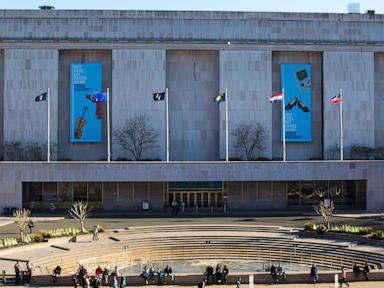
Walk through the heavy bronze doors of the National Museum of American History on a humid July afternoon, and you will hear a specific sound. It is the collective murmur of families trying to explain themselves to their children. A mother points to a scarred lunch counter from Greensboro. A grandfather stops before a tattered wool uniform from Valley Forge. These objects are not just brass and fabric. They are the physical manifestations of a secular faith, a quiet contract between the past and the present.
Now, that contract is being torn to shreds by two different groups of lawyers, politicians, and academics, all fighting over who owns the right to tell you who you are.
The latest explosive volley landed on Independence Day, packaged as a 162-page document compiled by the White House Domestic Policy Council. The report does not read like a standard bureaucratic assessment. It is a declaration of war. It accuses the leadership of the Smithsonian Institution, the keeper of the nation’s collective memory, of practicing "extreme political activism" and enforcing an ideological capture that turns a proud national inheritance into a weapon of division and shame.
Consider a hypothetical visitor. Let’s call him Arthur. Arthur brought his teenage granddaughter to Washington to see the history he lived through and the history he inherited. He expects to see the triumphs of George Washington and Abraham Lincoln. Instead, according to the White House report, he finds Benjamin Franklin introduced primarily through his connection to slavery, while the monumental achievement of the American Revolution is treated with academic skepticism. The report explicitly details how wall texts and displays focus on "anti-White activism," "illegal alien activism," and "transgender activism," highlighting exhibits like "Girlhood," which features LGBTQ+ advocate Jazz Jennings.
To the authors of the report, this is not history. It is a targeted demolition of national pride.
But step behind the curatorial curtain, and the view changes entirely. For the scholars who spend their lives in the dusty basements of the Smithsonian, the stakes are completely different. To them, history is not a static monument to be worshiped; it is a living, breathing argument.
Anthea Hartig, the museum's director, has long maintained that history is a vital instrument for social justice. Lonnie Bunch III, the Secretary of the Smithsonian and the first Black American to lead the institution, views the museum’s mission through a lens of profound responsibility. In his eyes, America's true strength does not come from running away from the dark, jagged corners of its past. It comes from staring directly into them, understanding how those fractures formed us, and figuring out how they still shape the ground we walk on today.
But the real problem lies elsewhere. The conflict is not actually about the accuracy of the footnotes or the number of American flags on display. It is about a fundamental, irreconcilable disagreement over the purpose of a national museum.
Should the Smithsonian be a temple or a forum?
A temple requires reverence. It demands that we look up at the statues of the Founders with uncritical awe, celebrating a singular narrative of American exceptionalism, ingenuity, and triumph. This is the vision driving the administration's "Restoring Truth and Sanity to American History" initiative, an effort to purge what it deems "improper ideology" from federal cultural institutions.
A forum, by contrast, requires argument. It invites the marginalized, the forgotten, and the messy contradictions of a nation that explicitly promised equality while practicing human bondage. It asks uncomfortable questions on its wall panels: Was the American Revolution an unfinished movement for liberty? How do we define the ideal character of our citizenry?
For Arthur and his granddaughter, the tension is palpable. When they stand before an exhibit on immigration, they are caught between two opposing forces. One side insists that framing restrictive immigration laws as tools of white supremacy is a slander against the nation's heritage. The other side argues that ignoring the explicitly racial motivations of the 1882 Chinese Exclusion Act is an act of historical cowardice.
This is the invisible crisis unfolding on the National Mall. It is a quiet, desperate struggle for the soul of American memory. When funding is threatened and leadership overhauls are signaled from the highest office in the land, the independence of scholarship itself begins to erode.
History is a heavy thing to carry. If you strip away the pain, the tragedy, and the long, agonizing struggle for civil rights, you are left with a fairy tale that can sustain no one in times of genuine hardship. Yet, if you strip away the genuine nobility of the founding ideals—the radical, breathtaking notion that a people could govern themselves based on natural rights—you are left with a story of pure cynicism, an inheritance that offers no hope for the future.
The bronze doors remain open for now, and the crowds still shuffle through the cool exhibition halls. They look at the ruby slippers, the battle flags, and the portraits of deeply flawed men who built a spectacular republic. The visitors are looking for a reflection of themselves. What they find will depend entirely on who wins the right to design the mirrors.