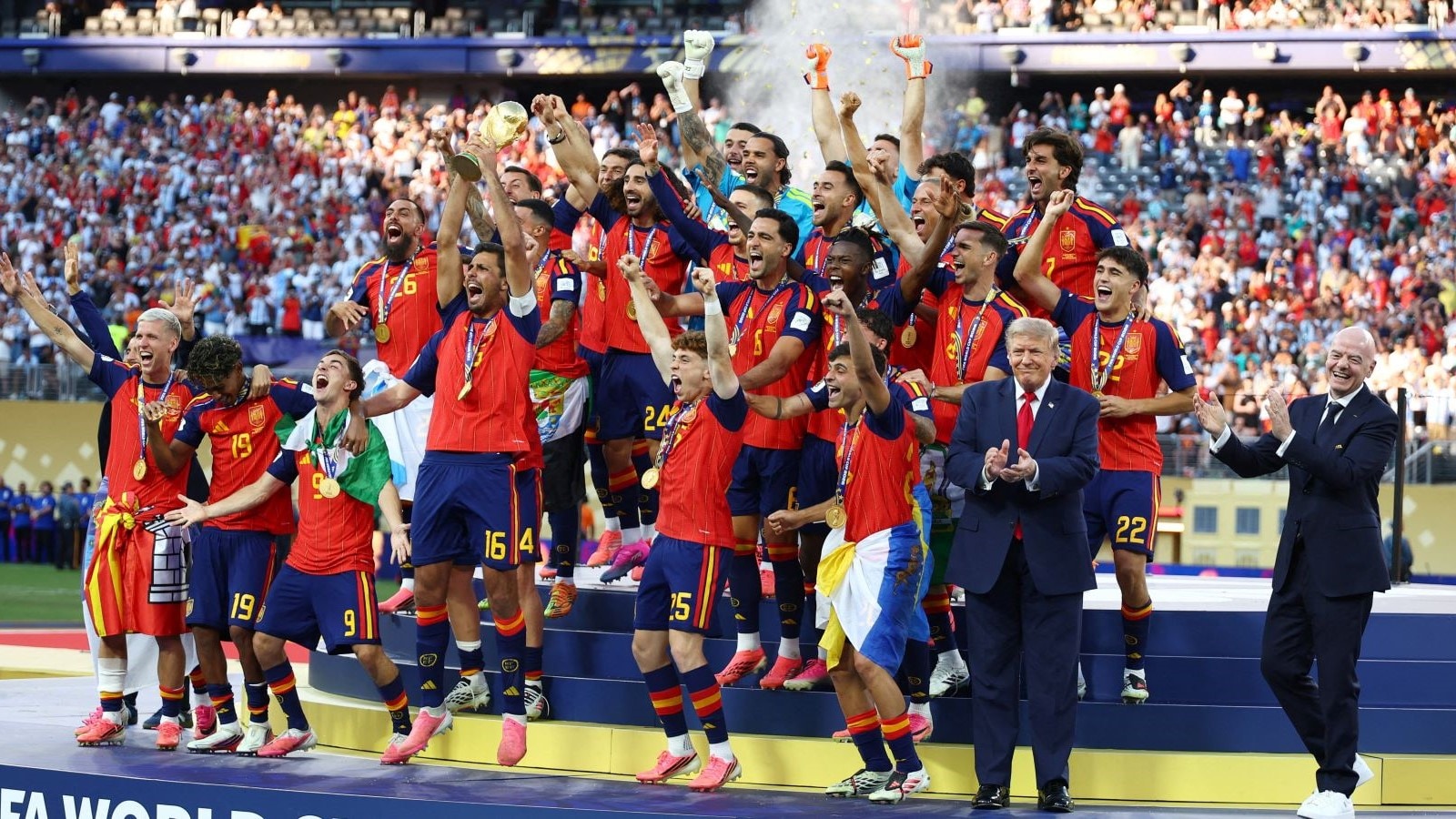
The air inside the stadium crackles with ninety minutes of built-up noise, sweat, and collective hysteria. Golden confetti hangs suspended in the humid evening air like glitter trapped in amber. On the dais, twenty-two young athletes are screaming, crying, and reaching for the one object that has consumed every waking second of their lives since childhood: the solid-gold FIFA World Cup trophy.
Then comes the moment of exchange. You might also find this similar article interesting: The Royal World Cup Photo Op Is a Distraction From Spain's Broken Football System.
The trophy passes from politician to champion. Duty fulfilled. Protocols executed. The choreography of international sport dictates what happens next: the dignity of office steps back, dissolving into the shadow of the stage, leaving the stage entirely to the victors.
Donald Trump did not step back. As discussed in latest reports by Yahoo Sports, the implications are notable.
Instead, he stood. He hovered at the margin of the victory cluster, hands loosely clasped, eyes drifting across the stadium tiering, soaking in the blinding glare of ten thousand camera flashes. The Spanish team danced around him, jumping in synchronized ecstasy, trying to claim the physical space that their sweat had earned. Yet there he remained, an unscripted center of gravity in a moment designed exclusively for someone else.
It was a study in human inertia.
Watching the broadcast, you could almost hear the silent panic in the production control room. Television directors thrive on clean visual narratives. They want the hero shot: the captain lifting six kilograms of gold into the heavens while teammates erupt behind him. They do not want a former head of state hovering two feet to the left, casually taking in the atmosphere as if waiting for a delayed commuter train.
Every major public event operates on an implicit social contract. Protocol dictates that organizers, presentation officials, and political figures are merely conduits. They are the white space on a printed page, designed to draw attention to the text, not to themselves. When the white space decides to stick around, the entire composition breaks down.
Consider the human mechanics of being trapped on a stage. Imagine standing on a platform raised above eighty thousand roaring fans. You have finished your singular assigned task. The exit stairs are ten paces behind you. Every instinct of ordinary social grace tells a person to quietly slip into the wings.
Yet power operates under a different set of instincts. For figures accustomed to being the sun around which every room orbits, stepping out of the light requires a conscious effort of self-effacement. It demands an acknowledgment that, for this specific minute, you are not the main character.
The Spanish players hardly seemed to notice, swallowed whole by the euphoria of a world championship. They hugged. They cheered. They raised the trophy repeatedly, sending fresh cascades of gold foil into the air. But around the periphery of the frame, the visual tension remained unresolved. A stark reminder of how political power constantly seeks to anchor itself to cultural glory.
When the cameras finally cut away to a wide shot of the glittering stadium, the moment dissolved into the historical archive. The trophy belonged to Spain. The night belonged to football. But for a few agonizing, hilarious, and deeply human seconds, the biggest stage in global sports belonged to a man who simply refused to walk off.