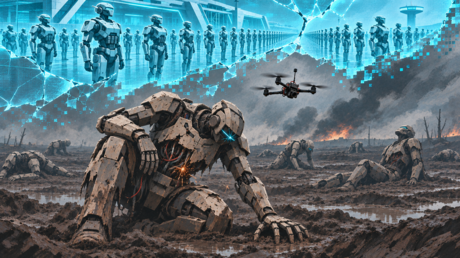
Defense contractors love selling the idea of a bloodless, automated war. You see it in glossy concept videos from Silicon Valley startups and legacy defense giants alike: swarms of autonomous drones clearing trenches, robotic dogs kicking down doors, and AI algorithms calling the shots from a bunker miles away. The pitch sounds clean. Remove the human, save a life, win the war.
Except anyone who has actually studied modern ground combat knows that pitch falls apart the second boots hit mud.
Even with global military spending pushing past $2.4 trillion annually and billions funneled into autonomous weapons programs like the Pentagon's Replicator initiative, machines still can't replace human soldiers. Not in 2026, and likely not for decades. The reason isn't just a lack of battery life or better microchips. War is fundamentally a human collision of wills, politics, and chaos—and machines are terrible at all three.
The Moravec Paradox Eats Military AI Alive
In the 1980s, roboticist Hans Moravec pointed out something that still haunts defense engineers today. High-level reasoning requires very little computational power, while basic sensorimotor skills require massive amounts of it.
A modern military algorithm can process millions of satellite images in seconds or beat a seasoned fighter pilot in a simulated dogfight, as DARPA's AlphaDogfight trials famously demonstrated. Put that same system in a collapsed concrete building in Eastern Europe or a dense jungle, and it struggles to walk up a pile of wet rubble without tipping over.
I've watched robotics engineers test quadruped robots—the kind modeled after Boston Dynamics' Spot—in basic outdoor obstacle courses. On flat asphalt, they look terrifyingly capable. Throw in ankle-deep mud, tangled concertina wire, or a sudden downpour that blinds optical sensors, and a $100,000 machine turns into an expensive paperweight.
Human infantrymen do things every second that robotics still can't replicate reliably:
- Shifting weight instinctively on loose gravel while carrying 70 pounds of gear
- Reading micro-expressions on a civilian's face at a checkpoint to tell fear apart from hostile intent
- Improvising a splint, a shelter, or a radio antenna out of literal trash when equipment fails
Computers calculate probabilities. Humans improvise under pressure. Those two skills aren't even in the same ballpark.
Electronic Warfare Turns Smart Machines Into Bricks
Tech executives often design autonomous weapons in clean laboratories with reliable Wi-Fi and clear GPS signals. Real battlefields are electromagnetic nightmares.
Look at what's happened in Ukraine over the last few years. Both Russian and Ukrainian forces have deployed massive electronic warfare (EW) networks that jam GPS, spoof navigation signals, and sever radio links within seconds. When a drone loses its connection to an operator, it either falls out of the sky, flies off course, or relies on onboard terminal guidance that can easily be fooled by cheap decoys.
In 2023 and 2024, several high-profile Western precision-guided munitions—weapons costing hundreds of thousands of dollars per round—saw their accuracy plummet in Ukraine because Russian jamming degraded their GPS guidance. Now imagine scaling that vulnerability up to an entire mechanized infantry battalion made of robots.
If your "soldier" depends on cloud connectivity, satellite links, or unjammed sensors to know where it is and who it's shooting at, a $5,000 jamming unit mounted on the back of a pickup truck can neutralize an entire platoon. A human soldier with a paper map, a magnetic compass, and basic training doesn't stop functioning when the electromagnetic spectrum goes dark.
The Battery and Logistics Trap
Let's talk about fuel, because amateurs talk tactics while professionals talk logistics.
Right now, an infantry squad can operate behind enemy lines for days with whatever food, water, and ammunition they carry on their backs. They eat cold rations, drink filtered ditch water, and sleep in two-hour shifts in the dirt.
Try doing that with autonomous ground vehicles. High-compute AI chips and electric actuators burn through lithium-ion batteries at an alarming rate, especially in sub-zero temperatures where battery capacity drops by 30 to 50 percent. A squad of humanoid or quadruped combat robots doesn't just need ammunition—it needs heavy mobile generators, thousands of gallons of diesel fuel to run those generators, and specialized technicians to fix stripped gears and fried circuit boards.
You haven't eliminated humans from the battlefield. You've just traded riflemen for an army of mechanics and fuel truck drivers who are way easier to ambush.
War Isn't a Video Game It's Politics With Violence
The biggest blind spot in the "robot army" fantasy has nothing to do with hardware. It's about what war actually is.
Prussian military theorist Carl von Clausewitz wrote nearly two centuries ago that war is a continuation of politics by other means. You don't fight just to destroy targets. You fight to compel an adversary to accept your political terms, to hold territory, and to stabilize populations after the shooting stops.
Machines can't hold ground. Not really.
A drone can hover over a city block and blow up anything that moves, sure. Can that drone kick down a door, clear a basement full of terrified noncombatants without causing a massacre, hand out medical supplies, and negotiate a local ceasefire with a village elder? Obviously not.
Counterinsurgency and urban warfare require restraint just as much as lethality. Every time a machine misidentifies a water pipe as a rocket launcher—a classic computer vision failure mode known as adversarial brittleness—it creates a strategic disaster. When a human soldier makes a mistake, there is a chain of command, a uniform code of military justice, and moral accountability. When an algorithm kills the wrong people, who goes to court? The programmer? The general who bought the software? Nobody?
Under international humanitarian law, specifically the Geneva Conventions, combatants must distinguish between civilians and fighters and ensure that civilian harm isn't disproportionate to the military advantage gained. Those aren't math equations. They're moral judgments made in split seconds under extreme stress.
The Human Element Deterrence and Sacrifice
There's also a psychological reality that defense analysts rarely admit out loud. Deploying human soldiers signals commitment in a way machines never can.
When a nation sends troops into a contested region, it puts its own citizens' lives on the line. Adversaries see that and understand the political cost involved. If war becomes a clash of disposable robots built in automated factories, two things happen—and neither makes the world safer.
First, the threshold for starting a war drops dramatically. Politicians hesitate to deploy troops when body bags might come home to voters. If the only casualties are balance-sheet write-offs, military intervention becomes far too easy to justify.
Second, a wealthy nation might think it can fight a risk-free war with robots, right up until an adversary realizes they can't beat the machines—so they target the cities, power grids, or human operators back home instead. War never stays neatly confined to the arena one side prefers.
Why Machines Will Stay Assistants Not Replacements
None of this means military robotics is useless. Far from it. The militaries winning the adaptation race right now treat autonomous systems as force multipliers for human troops, not substitutes.
Think of how modern armed forces actually use these tools:
- Expendable scouting: Sending a $1,000 quadcopter into a contested alleyway before a squad enters saves lives immediately.
- Mule logistics: Uncrewed ground vehicles hauling 1,000 pounds of water and mortar rounds up a mountain trail keep human soldiers fresh for the actual fight.
- Counter-drone defense: Automated turrets and radar-linked interceptors react faster than human reflexes when incoming munitions travel at hundreds of miles per hour.
- Medical evacuation: Robotic stretchers can pull wounded troops out of exposed kill zones without risking two more medics.
Notice the pattern here. In every single case, the machine handles the dull, dirty, or hyper-fast mechanical task so the human soldier can focus on judgment, leadership, and survival.
The Pentagon's own doctrine on autonomy—specifically DoD Directive 3000.09—explicitly requires "appropriate levels of human judgment over the use of force." Military commanders aren't clinging to human troops out of nostalgia. They're keeping humans in the loop because removing them breaks the link between military force and strategic purpose.
If you're evaluating defense tech trends, tracking military budgets, or trying to separate real battlefield capability from venture-capital hype, use a simple filter whenever someone promises an autonomous replacement for infantry. Ask three questions: How does it operate without GPS or radio links? How is it powered and repaired three weeks into a muddy campaign? And who takes responsibility when it makes a fatal mistake in a crowded street? Until an engineer can answer all three without hand-waving, the human soldier isn't going anywhere.


