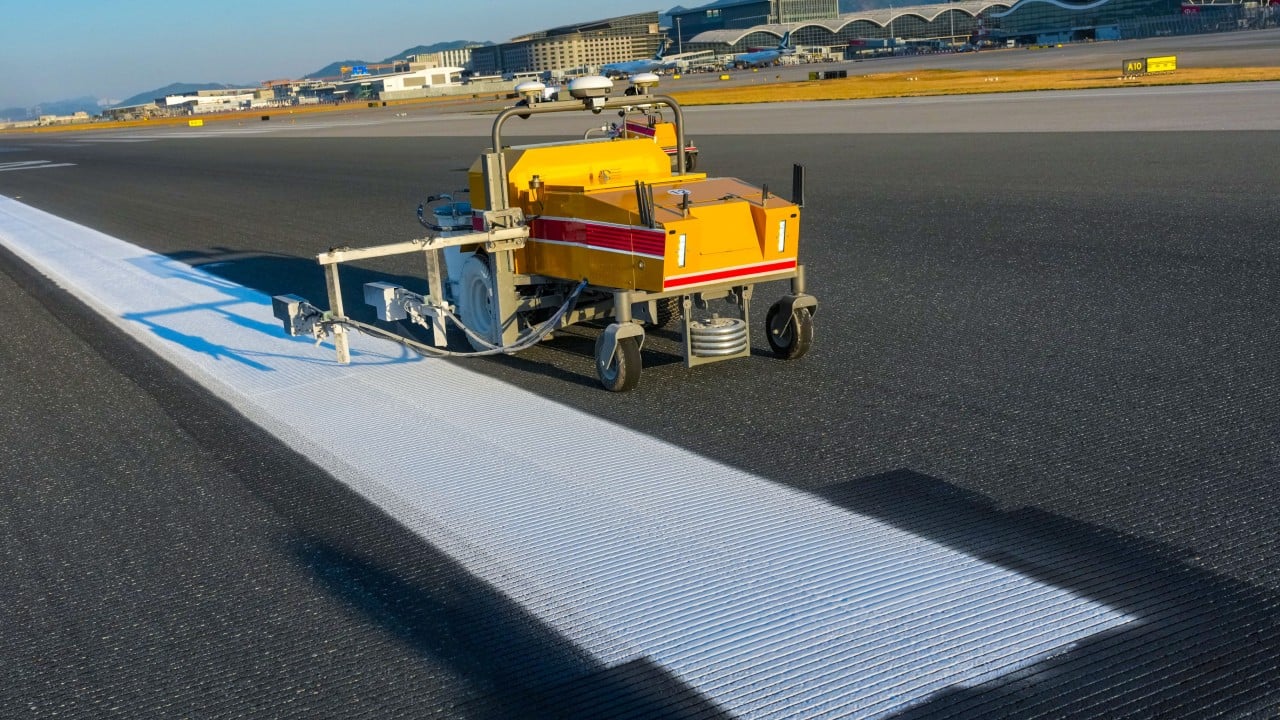
Deploying autonomous line-painting robotics at Hong Kong International Airport (HKIA) solves a severe operational bottleneck rather than simply reducing manual labor. In high-capacity aviation hubs operating near peak slot saturation, airside pavement marking is governed by strict temporal constraints, millimeter-level regulatory tolerances, and acute occupational health hazards. By shifting surface marking from manual crews to automated guided vehicles, the Airport Authority Hong Kong (AAHK) restructures the cost function of airfield maintenance, trading high variable labor risk and runway closure penalties for predictable capital depreciation and algorithmic precision.
The Structural Economics of Airside Maintenance
To understand why an international hub invests in specialized surface robotics, one must examine the operational constraints of airfield pavement management. Runway and taxiway markings—comprising thresholds, touchdown zones, centerlines, and hold-short bars—degrade rapidly under the mechanical shear of aircraft tire rubber deposits, jet blast thermal cycling, and tropical weather patterns. Meanwhile, you can find other stories here: Why SpaceX Caught a 20-Story Rocket in Mid-Air and What It Actually Costs the Competition.
Under International Civil Aviation Organization (ICAO) Annex 14 standards, degraded retroreflectivity or faded contrast ratios constitute a direct safety non-compliance, triggering mandatory remediation. Historically, executing this remediation created a trilemma between runway availability, marking precision, and worker safety.
The Opportunity Cost of Runway Closures
At a major international transit hub, runway capacity is the primary revenue-generating asset. Maintenance windows are compressed into narrow nocturnal intervals—often lasting fewer than four hours—when flight movements drop below single-runway capacity thresholds. To understand the full picture, we recommend the detailed report by Ars Technica.
Manual painting workflows introduce high variance into these fixed maintenance windows. A traditional crew requires physical chalk-lining, stencil placement, manual spray application, and glass-bead broadcasting for retroreflectivity. Any delay in setup, equipment calibration, or crew mobilization eats directly into the drying and curing time required before the surface can accept aircraft landings. If a maintenance window overruns due to human error or slow execution, the resulting slot delays cascade across global flight networks, imposing massive financial penalties on airlines and the airport operator.
The Ergonomic and Regulatory Penalty
Airside painting exposes ground crews to three compounding hazards:
- Chemical Toxicity: High-durability aviation paints—typically solvent-borne acrylics or two-component epoxies—emit volatile organic compounds (VOCs) and isocyanate vapors during atomized spraying.
- Thermal and Acoustic Stress: Crews operate in high-humidity tarmac environments alongside active auxiliary power units (APUs) and adjacent runway traffic, requiring heavy personal protective equipment (PPE) that accelerates heat exhaustion.
- Incursion Risk: Every human operator and support vehicle introduced onto the maneuvering area increases the statistical probability of a runway incursion, necessitating complex air traffic control (ATC) coordination and escort protocols.
Mechanical Architecture and Control Systems
Automated airfield marking systems replace human motor control with closed-loop mechatronic execution. Rather than relying on physical ground strings or manual visual alignment, these robotic units operate as autonomous mobile platforms integrated with high-precision spatial positioning.
Positioning and Path Execution
A runway painting robot must maintain lateral deviations within narrow millimeter tolerances over distances exceeding 3,800 meters. Achieving this requires dual-redundant localization:
- Real-Time Kinematic Global Navigation Satellite Systems (RTK-GNSS): Base stations fixed to known airport survey benchmarks transmit phase-correction data to the rover, reducing standard GPS meter-level error down to centimeter-level accuracy.
- Inertial Measurement Units (IMUs) and Odometry: Wheel encoders and fiber-optic gyroscopes bridge signal gaps and smooth high-frequency trajectory adjustments, ensuring crisp line edges without sinusoidal wandering.
Before deployment, airfield CAD blueprints are converted into machine-readable path vectors. The robot's onboard computer maps these digital coordinates directly onto the physical asphalt or concrete substrate, eliminating the pre-marking survey phase entirely.
Fluid Dynamics and Material Application
Consistency in paint film thickness determines both the lifespan of the marking and its retroreflective performance. Manual operators vary their walking speed and spray-gun height, creating uneven wet-film thickness. Too thin, and the marking delaminates under tire friction; too thick, and the paint fails to cure before runway reopening, leading to immediate tire pickup and smearing.
Automated units synchronize pump pressure and nozzle actuation directly with wheel speed. If the chassis decelerates to navigate a taxiway curve, flow rates modulate proportionally to maintain a constant micron thickness. Simultaneously, a synchronized pressurized dispenser injects glass beads into the wet paint film at a calibrated embedment depth—typically 50% to 60% of the bead diameter—maximizing incident light return from aircraft landing lights.
Operational Trade-offs and System Limitations
Autonomous robotics do not eliminate maintenance complexity; they shift the operational burden from manual execution to digital preparation and mechatronic upkeep. Relying on automated systems introduces distinct failure modes that airport engineering teams must manage.
The Digital Twin Dependency
An autonomous painter executes its programmed coordinates blindly. If the airport's Geographic Information System (GIS) database contains outdated survey data or unrecorded pavement resurfacing shifts, the robot will paint precise lines in the wrong physical location. Correcting a misaligned epoxy runway threshold requires water-blasting or shot-blasting the concrete—a destructive, time-consuming process that destroys the exact schedule efficiency the robot was purchased to create. Therefore, continuous geospatial auditing becomes a prerequisite for robotic operation.
Environmental and Substrate Constraints
Mechatronic precision degrades when environmental variables exceed sensor thresholds:
- Surface Moisture: Automated optical sensors cannot reliably detect microscopic dew points on porous asphalt. Applying paint over invisible surface moisture traps vapor, causing blistering and premature delamination once solar radiation heats the tarmac.
- Wind Shear: While mechanical shrouds protect spray nozzles from crosswinds, high gusts on open airfields still disrupt atomization patterns and scatter retroreflective glass beads, requiring human supervisors to abort or adjust parameters dynamically.
- Multipath Interference: Large metallic structures—such as nearby maintenance hangars or parked wide-body aircraft—can reflect satellite signals, inducing RTK-GNSS multipath errors that require manual intervention or local total-station tracking overrides.
Workforce Skill Reallocation
Introducing autonomous systems rarely yields immediate net headcount reductions; instead, it forces a structural shift in labor requirements. The airport trades lower-cost manual spray operators for higher-cost robotics technicians, CAD specialists, and field engineers capable of troubleshooting hydraulic valves, ultrasonic sensors, and telemetry links at 3:00 AM under strict time pressure.
Strategic Framework for Airside Automation
For airport operators evaluating the transition from manual to robotic pavement maintenance, capital allocation should follow a staged validation protocol rather than a wholesale fleet replacement.
- Isolate High-Variance Assets First: Deploy autonomous units initially on straight, high-wear geometries—specifically runway centerlines, edge stripes, and touchdown zones—where RTK-GNSS sky-view is unobstructed and continuous linear speed maximizes return on investment. Retain manual crews for complex apron markings and tight gate box geometries where frequent turns and terminal proximity degrade satellite lock.
- Establish Closed-Loop Retroreflectivity Auditing: Pair robotic painting with vehicle-mounted mobile retroreflectometers. By logging baseline retroreflectivity immediately post-application and tracking degradation curves over subsequent months, engineering teams can transition from fixed-calendar repainting to predictive, condition-based maintenance.
- Standardize Digital Airfield Models: Mandate that all civil engineering contractors update the central airport CAD/GIS repository immediately following any slab replacement or overlay work. Automated maintenance hardware is only as reliable as the spatial data governing its path planning.
Airport infrastructure management is fundamentally an exercise in risk and capacity optimization. By automating surface marking, Hong Kong International Airport removes human operators from hazardous zones while compressing maintenance variability, converting a chaotic manual chore into a deterministic engineering process.