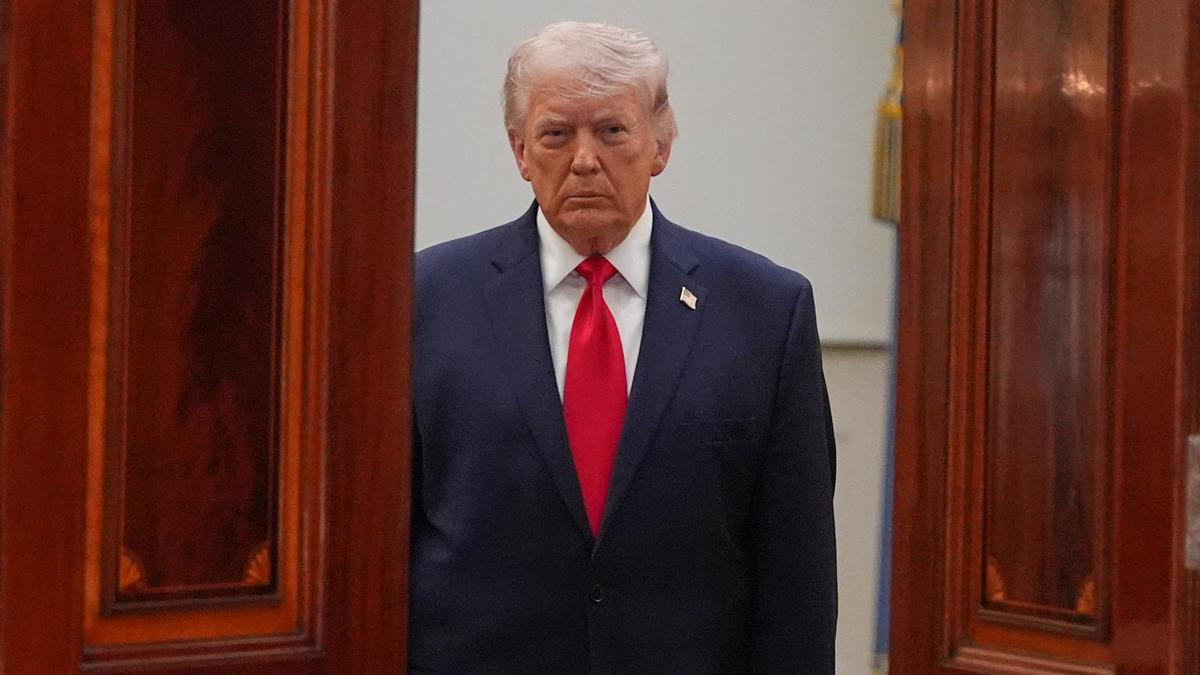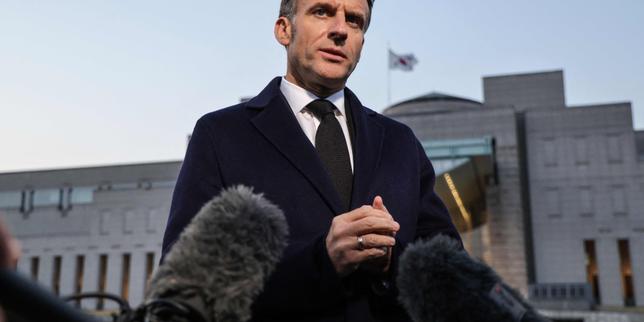
The North Atlantic Treaty Organization (NATO) functions not as a physical shield, but as a psychological contract based on the certainty of mutual destruction. Emmanuel Macron’s recent accusations against Donald Trump regarding the "substance" of the alliance highlight a critical failure in the mechanism of deterrence: the transition from absolute commitment to conditional participation. When a primary security guarantor introduces ambiguity into the execution of Article 5, the alliance shifts from a monolithic defense block to a fragmented collection of bilateral interests. This erosion is not merely rhetorical; it is a structural realignment of European security architecture.
The Logic of Credibility as Currency
Security alliances operate on a currency of credibility. In game theory, the effectiveness of a deterrent is calculated by the product of capability and resolve. If either variable approaches zero, the deterrent fails. By questioning the automaticity of U.S. intervention, Trump effectively devalues the resolve variable, forcing European states to recalculate their security investments under a "Solo-Actor Framework."
Macron’s critique identifies three distinct layers of institutional decay triggered by this rhetoric:
- The Perceptual Gap: Adversaries no longer view the alliance as a unified response unit but as a series of individual thresholds that can be tested independently.
- The Budgetary Divergence: States that previously relied on the U.S. nuclear umbrella are forced into rapid, uncoordinated rearmament, creating inefficiencies in procurement and interoperability.
- The Diplomatic Hollow-Out: International agreements lose their weight when the underlying enforcement mechanism—U.S. military hegemony—is signaled as optional or transactional.
The Transactional Fallacy in Geopolitics
The current tension stems from a fundamental disagreement on the nature of NATO. The "Transactional Model," championed by Trump, views the alliance as a service-for-hire arrangement where protection is exchanged for direct financial contributions (the 2% GDP threshold). Conversely, the "Structural Model," favored by Macron and traditional Atlanticists, views NATO as a long-term investment in global stability that prevents the emergence of a hegemonic rival in Eurasia.
The Transactional Model fails to account for the "Externalities of Instability." If the U.S. reduces its commitment based on short-term balance sheets, the resulting vacuum is filled by regional powers whose interests directly conflict with long-term U.S. economic and maritime dominance. The cost of a failed deterrent in Ukraine or the Baltics exceeds the cumulative defense spending of all European members combined.
The Math of Strategic Autonomy
Macron’s push for "European Strategic Autonomy" is a hedge against this instability. However, the logistical reality reveals a significant capability gap. For Europe to achieve a defense posture independent of U.S. intelligence, surveillance, target acquisition, and reconnaissance (ISTAR) assets, the continent would require:
- Integrated Command Structures: Moving beyond the current patchwork of 27 different military procurement systems.
- Deep-Strike Capabilities: Developing indigenous long-range missile systems that currently rely heavily on American technology.
- Satellite Constellations: Establishing a sovereign European space-based intelligence network to replace reliance on the Pentagon’s data streams.
The Ukrainian Variable and the Proxy Stress Test
The war in Ukraine serves as the stress test for these competing philosophies. Macron’s rhetoric emphasizes that Russia is not just a territorial threat to Ukraine but a systemic threat to the European project. When the U.S. signals a potential retreat from the conflict, it creates a "Time-Inconsistency Problem." European leaders must decide whether to escalate their own support to fill the gap or seek a negotiated settlement that inevitably favors the aggressor and sets a precedent for further territorial revisionism.
The "Doubt" Macron refers to acts as a catalyst for Russian escalation. In military strategy, an adversary is most likely to strike when they perceive a window of hesitation. By publicizing the possibility of non-intervention, the U.S. inadvertently expands this window, raising the probability of a direct kinetic confrontation on NATO’s eastern flank.
The Bottleneck of Industrial Mobilization
Beyond the rhetoric, the "substance" of NATO is bound by industrial capacity. The alliance is currently facing a production bottleneck that underscores the fragility of its current state. The transition from a peacetime "just-in-time" supply chain to a "just-in-case" wartime footing has been sluggish.
- Artillery Disparity: Russia’s transition to a war economy allows for shell production volumes that currently dwarf the combined output of the EU and U.S.
- Technological Atrophy: Dependence on globalized supply chains for microchips and specialized components makes European defense systems vulnerable to economic coercion from non-aligned third parties.
This industrial deficit means that even if political will were restored tomorrow, the physical ability to sustain a high-intensity conflict is years away from being fully realized. Macron’s alarmism is targeted at this specific lag time.
Redefining the Threshold of Engagement
The core of the Macron-Trump friction is the definition of "Automaticity." Under the traditional reading of NATO’s founding treaty, an attack on one is an attack on all. Trump’s rhetoric suggests a "Conditional Article 5," where the U.S. first audits a member’s financial standing before responding to a crisis.
This creates a tiered membership system. Frontline states like Poland and the Baltics, who meet or exceed the 2% threshold, remain technically protected, while states like Germany or Italy would exist in a grey zone. This fragmentation is the "emptying of substance" Macron fears. A defensive alliance that is only 70% certain is 100% ineffective at preventing war.
The Strategic Playbook for European Sovereignty
To counter the decay of the Atlanticist consensus, European policy must shift from reactive diplomacy to structural reinforcement. This requires a three-pronged tactical approach:
- Direct Defense Indexing: Decoupling defense spending from GDP and instead indexing it to "Combat Readiness and Interoperability." This forces members to prove their value through usable military units rather than inflated budget lines.
- The European Defense Fund Expansion: Centralizing procurement for high-cost assets (missile defense, stealth aviation) to eliminate the redundancy of 27 separate national industries.
- Nuclear Sharing Realignment: Discussions regarding a pan-European nuclear deterrent, potentially backed by French capabilities, to mitigate the risk of a U.S. "Nuclear Retreat."
The era of the "Security Free-Rider" is over. Whether through Trump’s withdrawal or Macron’s autonomy, Europe is being forced into a period of self-reliance. The risk is that this transition is occurring during an active conflict, leaving no room for the typical decade-long cycles of military transformation. The immediate requirement is the rapid scaling of the "European Pillar" within NATO, ensuring that even if the U.S. executive branch wavers, the infrastructure of the alliance remains functional enough to deter a total collapse of the continental order.