Salt dries white on dark skin within twenty minutes of leaving the spray. You do not notice it at first because your hands are shaking too violently to feel the tightness across your cheekbones.
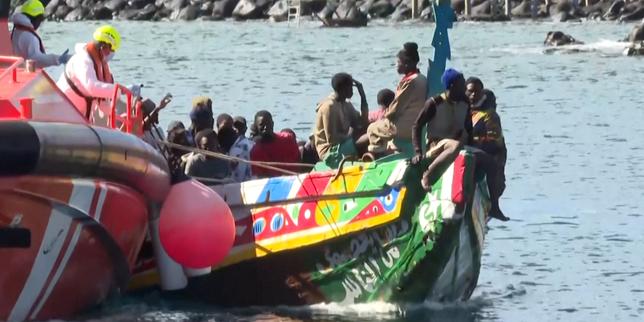
In the quiet hours before dawn, when the Atlantic off the coast of El Hierro looks less like an ocean and more like hammered pewter, the first hulls appear on the radar screens of Spain’s maritime rescue service. By noon, the radios are crackling without pause. By dusk, nearly 1,500 people have stepped—or been carried—onto the volcanic rock of the Canary Islands in a single twenty-four-hour span.
Numbers like that are designed to numb you.
Read in a morning briefing, "1,500 arrivals in one day" sounds like an accounting ledger, a logistical spike on a spreadsheet in Madrid or Brussels. It feels abstract. Clean. Distant. You skim the headline over coffee, register a vague sense of crisis, and move on to the weather forecast.
Wait. Stop scrolling for a moment.
Behind every single digit in that tally is a set of lungs that spent a week breathing diesel fumes and salt mist, praying that a wooden hull nailed together on a beach in Senegal or Mauritania would not split apart over three thousand meters of black water. When we reduce an arrival surge to a statistic, we miss the actual story unfolding on the edge of Europe—a story about desperation, geography, bureaucracy, and the quiet breaking point of small islands left to carry the weight of a continent.
The Anatomy of a Single Day
To understand what happens when fifteen hundred human beings make landfall between sunrise and midnight, you have to picture the geography first. El Hierro is the smallest and westernmost of the main Canary Islands. It is a volcanic teardrop rising sharply out of the sea, home to roughly eleven thousand permanent residents. There are no sprawling metropolises here. There are winding mountain roads, terraced vineyards, quiet fishing ports like La Restinga, and a local hospital built to serve a town the size of a modest European suburb.
Now, imagine a hypothetical figure—let us call him Moussa, a twenty-four-year-old mechanic from Saint-Louis—stepping off a rescue vessel onto the pier at La Restinga at four in the morning.
Moussa has been at sea for six days. He left the West African coast in a cayuco, an open wooden fishing pirogue originally built to hug coastal waters, never meant to cross hundreds of miles of open Atlantic swell. Along with more than a hundred others packed knee-to-chest on wooden planks, he watched the coastline vanish until there was nothing left in any direction except a flat, indifferent horizon. By day four, the fresh water ran low. By day five, two men at the bow stopped speaking altogether, their bodies shutting down from hypothermia and dehydration.
When the orange hull of a Salvamento Marítimo vessel finally cut through the swell, Moussa could not stand on his own. Rescue crews had to lift him under the arms, wrapping him in a silver foil thermal blanket that crinkles like dry leaves in the Atlantic wind.
Multiply Moussa by fifteen hundred.
Not over a month. Not over a season. In one rotation of the Earth.
Between midnight and the following night, rescue boats towed and escorted vessel after vessel into El Hierro, Tenerife, Gran Canaria, and Lanzarote. Some boats carried eighty people; others carried nearly two hundred. Among them were women clutching toddlers wrapped in damp sweaters, teenagers traveling completely alone, and men whose feet were swollen twice their normal size from sitting motionless in bilge water mixed with spilled gasoline—a chemical burn known grimly among coastal doctors as "patera foot."
On the docks, the rhythm becomes mechanical out of sheer necessity. Red Cross volunteers in red vests move from person to person with bottles of water, energy biscuits, and dry tracksuits. Police officers assign wrist numbers, taking names and nationalities for initial processing. Ambulances idle with their engines rumbling, doors open, waiting for the ones who cannot walk.
Why the Atlantic Route Is Surging
If you have been following European migration news, you might wonder why this particular stretch of ocean has become the busiest and deadliest gateway into the European Union. The answer lies in a simple, brutal law of physics: when you squeeze one end of a balloon, the air rushes to the other.
For years, European governments poured billions of euros into fortifying land borders and patrolling the central and eastern Mediterranean. Fences rose higher around Ceuta and Melilla. Coast guards tightened their grip along the North African littoral. Smuggling networks adapted, just as water always finds the lowest crack in a foundation. They pushed south and west, turning the Atlantic route from West Africa to the Canary Islands into the primary corridor.
Think of the Atlantic crossing not as a ferry ride, but as walking a tightrope over a canyon in a hurricane.
The shortest distance from the Moroccan coast to Fuerteventura is roughly one hundred kilometers. Yet most boats no longer leave from there. Tighter patrols have forced departures further south—from Mauritania, Senegal, and even The Gambia. That stretches the voyage to anywhere between eight hundred and sixteen hundred kilometers across open ocean. There are no shipping lanes to rescue you if your outboard motor dies. There is no land to sight if your cheap handheld GPS loses battery. If the Canary Current pushes your boat slightly too far west, you miss the islands entirely and drift out into the empty central Atlantic, where no one will ever find you.
Yet people still board those boats. Why?
Because on land, the math has stopped working. Across parts of the Sahel and West Africa, converging crises have hollowed out daily survival. Political instability and coups have choked foreign investment and local commerce. Climate shifts have scorched farmland and disrupted traditional fishing grounds—ironically, industrial trawlers from Europe and Asia have depleted the very coastal waters that once sustained Senegalese fishermen, leaving wooden pirogues idle on the sand until smugglers realized those same boats could carry human cargo north. Add soaring food inflation to the mix, and staying put begins to feel like a slow, guaranteed defeat.
When staying means watching your family go hungry and leaving means a seventy percent chance of reaching Europe, human beings will take the gamble every single time. We would do the exact same thing in their shoes.
The Invisible Strain on the Islands
Walk away from the port of La Restinga two hours after a rescue operation, and you will see the other side of this story—the side that rarely makes the evening news outside Spain.
In the harbor cafés, fishermen drink their morning cortados while watching National Police vans ferry new arrivals up the steep switchbacks toward temporary holding facilities. The mood on the islands is rarely hostile, yet it is undeniably exhausted.
Canary Islanders know migration in their bones. For centuries, poverty forced their own grandparents onto ships bound for Venezuela, Cuba, and Argentina. When a boat washes ashore carrying starving teenagers, the instinctive reaction among locals has overwhelmingly been one of compassion. Neighbors have brought out warm soup, spare blankets, and children's shoes.
Still, compassion does not expand hospital beds.
When fifteen hundred people arrive in twenty-four hours, every system on a small island groans under the weight. Temporary reception tents fill past capacity before sunset. Police stations run out of holding space. Most critically, the island authorities become legally responsible for hundreds of unaccompanied minors who arrive without parents or guardians. Under Spanish law, regional governments must house, feed, educate, and care for every single child until they turn eighteen.
Canary Islands officials have repeatedly warned Madrid and Brussels that their child protection centers are overflowing—housing thousands of teenagers in facilities built for a fraction of that number. Meanwhile, political deadlock on the Spanish mainland has stalled agreements to relocate these young people to other regions across the country.
It is an absurd, quiet standoff. An archipelago of two million people—and tiny islands like El Hierro with barely eleven thousand—is left acting as the sole reception room for an entire continent of four hundred and fifty million.
What the Numbers Hide—and What They Reveal
I will admit something that anyone writing honestly about migration eventually confronts: there is no clean, painless villain here, and no magic policy lever waiting to be pulled.
If you listen to hardline politicians, the solution is deterrence—more patrol boats, faster deportations, tougher rhetoric. Yet history shows that deterrence on the high seas rarely stops desperate people; it merely forces them onto longer, deadlier routes where more bodies disappear beneath the waves. Conversely, if you pretend that small island communities can absorb thousands of arrivals week after week without massive financial and logistical backing, you breed resentment and watch basic humanitarian standards collapse.
Look closely at what actually happens when the spotlight fades after a record-breaking day.
Once medical triage finishes and initial police registration wraps up, adults are transferred to larger macro-camps on Tenerife or Gran Canaria, where NGOs step in to provide legal aid, language classes, and psychological support. Many of those arriving from conflict zones like Mali qualify for international protection. Others, driven purely by economic collapse, face months of legal limbo, caught between deportation orders that cannot be executed due to lack of diplomatic agreements with home countries, and a labor market they cannot legally enter.
To understand this bottleneck, picture an hourglass whose top bulb is widening every year while the glass neck in the middle stays frozen at the exact same width.
Every grain of sand passing through that narrow neck is a person suspended between two worlds. They cannot go back to the debts their families took on to pay smugglers—often between one thousand and three thousand euros per seat, a fortune pooled together by an entire village. Nor can they easily move forward into a stable life in Europe without years of legal struggle.
The Morning After the Surge
By the following morning, the harbor at La Restinga is quiet again.
Municipal workers hose down the concrete pier, washing away salt residue, discarded foil blankets, and empty water bottles. Fishing boats untie their lines and motor out past the breakwater toward the open sea, passing the very spot where rescue vessels stood lit up like floating hospitals just hours earlier.
Up the hill, inside a converted sports hall smelling faintly of disinfectant and damp wool, Moussa sits on the edge of a folding cot. Someone has given him a gray fleece sweatshirt two sizes too big and a pair of plastic sandals. His skin is still flaking from the salt. His ears are still ringing from the roar of the outboard engine that hammered against his skull for six straight days.
He borrows a volunteer's phone to send a thirty-second voice note to his mother back in Saint-Louis. He tells her only four words: I am alive. Here.
Three thousand kilometers away, in a courtyard with packed-earth floors, a woman presses that phone against her ear and weeps until her knees give out. On the news broadcasts in Europe that evening, anchors will read out the updated total—nearly fifteen hundred arrivals in a single day—before cutting to a commercial break.
The ocean, meanwhile, keeps rolling in against the black volcanic rock, indifferent to borders, treaties, and headlines, waiting for the next wooden hull to appear on the horizon.