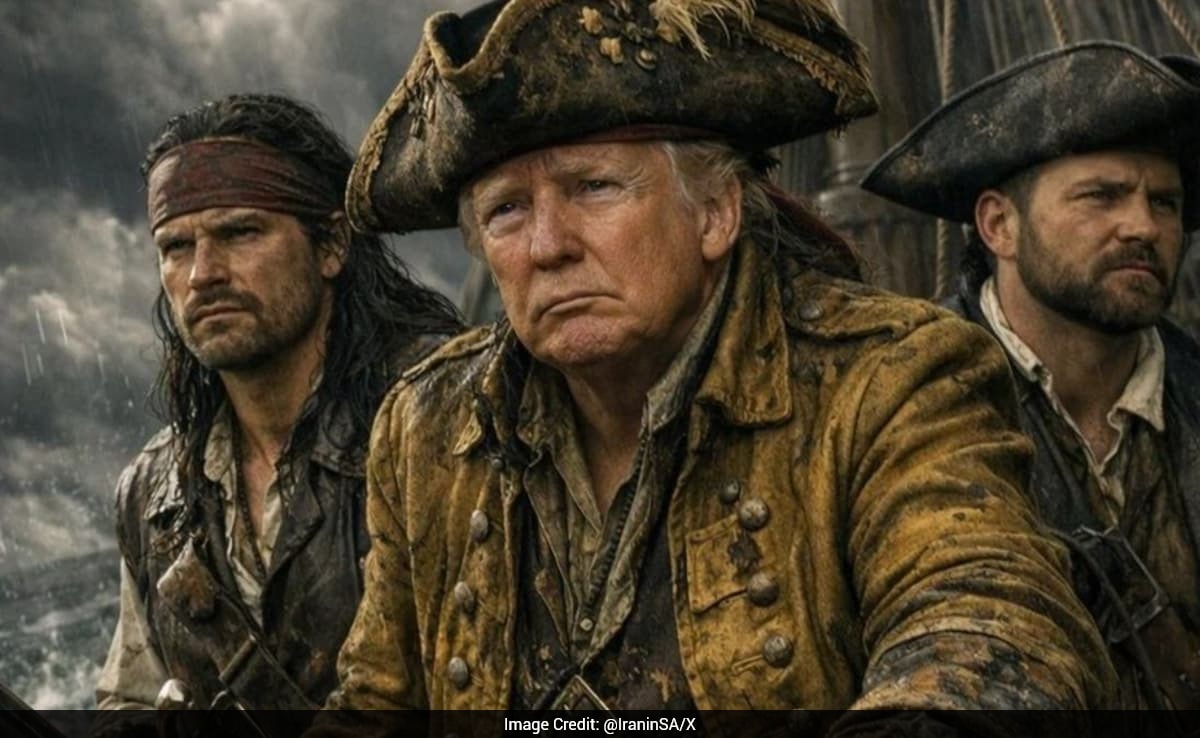
The Iranian state's recent escalation in digital hostility against Donald Trump—specifically the branding of the former president as a "miserable pirate of the Persian Gulf"—represents a shift from traditional state-run propaganda toward Asymmetric Semantic Warfare. While the rhetoric appears superficial or juvenile to Western audiences, it functions as a calculated deployment of cultural capital designed to achieve three specific strategic ends: domestic consolidation, regional signaling, and the exploitation of Western digital echo chambers.
The effectiveness of these campaigns is not measured by their humor or viral reach in the United States, but by their ability to lower the cost of state-aligned narrative dominance within specific geographic and ideological sectors.
The Tri-Pillar Framework of Iranian Digital Aggression
To analyze the "Miserable Pirate" campaign, one must look past the linguistic oddity and evaluate the underlying operational logic. This strategy rests on three distinct pillars of engagement.
1. Linguistic De-escalation through Ridicule
By pivoting from threats of kinetic retaliation (missiles, drones) to memetic ridicule, the Iranian state media apparatus creates a "pressure valve" for domestic consumption. This allows the regime to maintain a posture of defiance without triggering the immediate military escalations associated with formal diplomatic threats. Ridicule serves as a low-cost tool to signal strength to a domestic base while remaining below the threshold of a casus belli.
2. Semantic Re-anchoring of the Persian Gulf
The specific choice of the "pirate" moniker is a deliberate attempt to flip the narrative of maritime security. By labeling a U.S. head of state as a "pirate," Iran seeks to delegitimize the presence of the U.S. Navy in the Strait of Hormuz. In this framework, the United States is cast as the lawless actor, while Iran positions itself as the rightful "constable" of the waterway. This is a classic exercise in Normative Inversion, where the state attempts to rewrite international legal perceptions through repetitive, high-visibility branding.
3. Exploitation of the Algorithmic Friction
State actors have identified that Western social media algorithms prioritize high-arousal, divisive content. The "Miserable Pirate" campaign is engineered to be "outrage-ready." It provides fodder for both supporters and detractors of Donald Trump, ensuring that the Iranian state message is amplified for free by the very platforms it seeks to undermine.
The Cost Function of Memetic Insurgency
Traditional propaganda requires expensive infrastructure: television stations, radio towers, and international press offices. In contrast, the cost function of a meme-based campaign approaches zero while its potential for penetration increases exponentially.
- Production Cost: Minimal. Requires a graphic designer and a social media manager.
- Distribution Cost: Subsidized by the platform (X, Telegram, Instagram).
- Resilience: High. Decentralized memes are difficult to "fact-check" because they rely on metaphor and insult rather than falsifiable data.
The "Miserable Pirate" trope functions as a Minimum Viable Narrative (MVN). It is simple enough to be translated across languages, visually distinct enough to be recognized in a scrolling feed, and provocative enough to generate news cycles.
Mechanics of the "Pirate" Metaphor in Regional Diplomacy
The use of the term "pirate" is not accidental. It targets specific historical and legal anxieties in the Middle East. Under international law, piracy is a "crime against all" (hostis humani generis). By applying this specific label, Iran is attempting to build a subconscious association between U.S. economic sanctions and the illegal seizure of goods at sea.
This creates a bottleneck for U.S. diplomatic messaging. If the U.S. ignores the meme, the narrative goes unchallenged in non-Western information spaces (Global South). If the U.S. responds, it dignifies the insult and grants the Iranian state a seat at the table of viral relevance. This is a Strategic Double-Bind, where every possible reaction from the target provides some form of utility to the aggressor.
Quantifying the Impact of Asymmetric Branding
Standard metrics for digital success—likes, retweets, and impressions—are largely irrelevant in state-sponsored semantic warfare. A more accurate measurement of Iranian success is the Narrative Seepage Rate. This is the frequency with which state-originated metaphors (like "Miserable Pirate") are adopted by independent third-party actors, including Western news outlets and anti-establishment influencers.
When a mainstream Western outlet carries the headline "Iran Calls Trump a Pirate," the Iranian state has succeeded in its primary objective: forcing its specific framing of the conflict into the global consciousness. The "pirate" label becomes a permanent entry in the digital archive of the individual, regardless of whether the reader agrees with the sentiment.
The Cognitive Infrastructure of State Ridicule
State-sponsored memes function differently than grassroots memes. They are designed for Cognitive Persistence.
- Selection: A high-profile target (Donald Trump) ensures maximum visibility.
- Simplification: Complex geopolitical grievances are reduced to a single, evocative image or phrase.
- Iteration: The "Pirate" theme is repeated across different formats—videos, posters, and social posts—to build a cohesive brand identity for the adversary.
- Distribution: Utilizing "bot-nets" and state-aligned influencers to achieve initial velocity.
This process bypasses the logical centers of the brain and targets the emotive centers. Once a target is successfully "memed," any subsequent serious policy discussion regarding that person is tainted by the ridiculous imagery previously consumed.
Limitations and Systemic Vulnerabilities
The Iranian strategy is not without significant flaws. The primary limitation is the Cultural Translation Gap. A meme that resonates in Tehran may appear absurd or incomprehensible in Des Moines or London.
The "Miserable Pirate" phrase, for instance, lacks the visceral "bite" of Western political insults. It feels archaic, perhaps even theatrical. This creates a disconnect where the Iranian state believes it is projecting strength, while the Western audience perceives it as a sign of desperation or a lack of modern cultural literacy.
A second limitation is the Saturation Point. Constant repetition of high-decibel insults leads to audience fatigue. Over time, the "shock value" of a state-sponsored meme diminishes, requiring the actor to become increasingly radical or bizarre to maintain the same level of engagement. This leads to a "race to the bottom" in diplomatic discourse, which can eventually alienate potential neutral allies who value professional statecraft.
Strategic Realignment: Countering the Semantic Insurgency
Western response strategies must move beyond simple debunking or ignoring the content. To counter asymmetric semantic warfare, the following logic must be applied:
- Narrative Sterilization: Refusing to repeat the specific monikers used by state actors in official briefings. Repeating the "Pirate" label, even to mock it, aids in its cognitive persistence.
- Infrastructure Targeting: Focus on the distribution networks (IP addresses, hosting services, and platform-specific accounts) rather than the content itself.
- Counter-Branding: Instead of defensive posturing, the focus should shift to highlighting the internal inconsistencies and domestic failures of the regime in a way that resonates with their own domestic audience.
The Iranian "Miserable Pirate" campaign is a symptom of a larger evolution in conflict. Kinetic warfare is being supplemented, and in some cases replaced, by a battle over the Semiosphere. In this environment, the ability to define an opponent through a viral image is as critical as the ability to track them via satellite.
The shift toward memetic warfare suggests that the Iranian state is increasingly aware of its inability to win a conventional PR battle on Western terms. By embracing the "absurd," they are attempting to break the rules of engagement entirely. The goal is no longer to be liked or respected, but to be inescapable. This is the hallmark of modern digital authoritarianism: the weaponization of the trivial to achieve the monumental.
Strategic actors must recognize that these memes are not "distractions"—they are the frontline of a new, low-intensity conflict designed to erode the perceived legitimacy of Western leadership over years, not days. The battle is for the "default association" that pops into a user's mind when a name or a region is mentioned. If Iran can successfully associate "U.S. Policy" with "Piracy" in the minds of the next generation of global citizens, they will have achieved a geopolitical victory that no amount of naval hardware can easily undo.