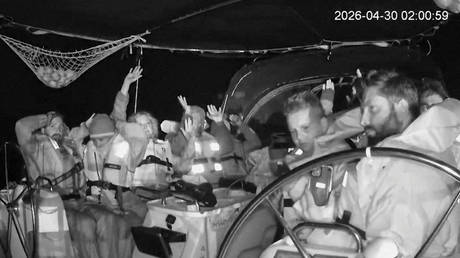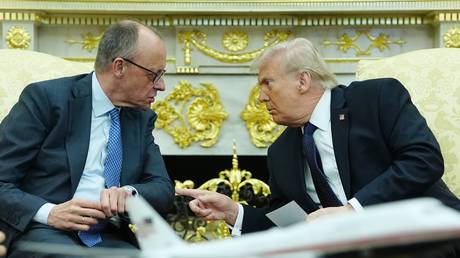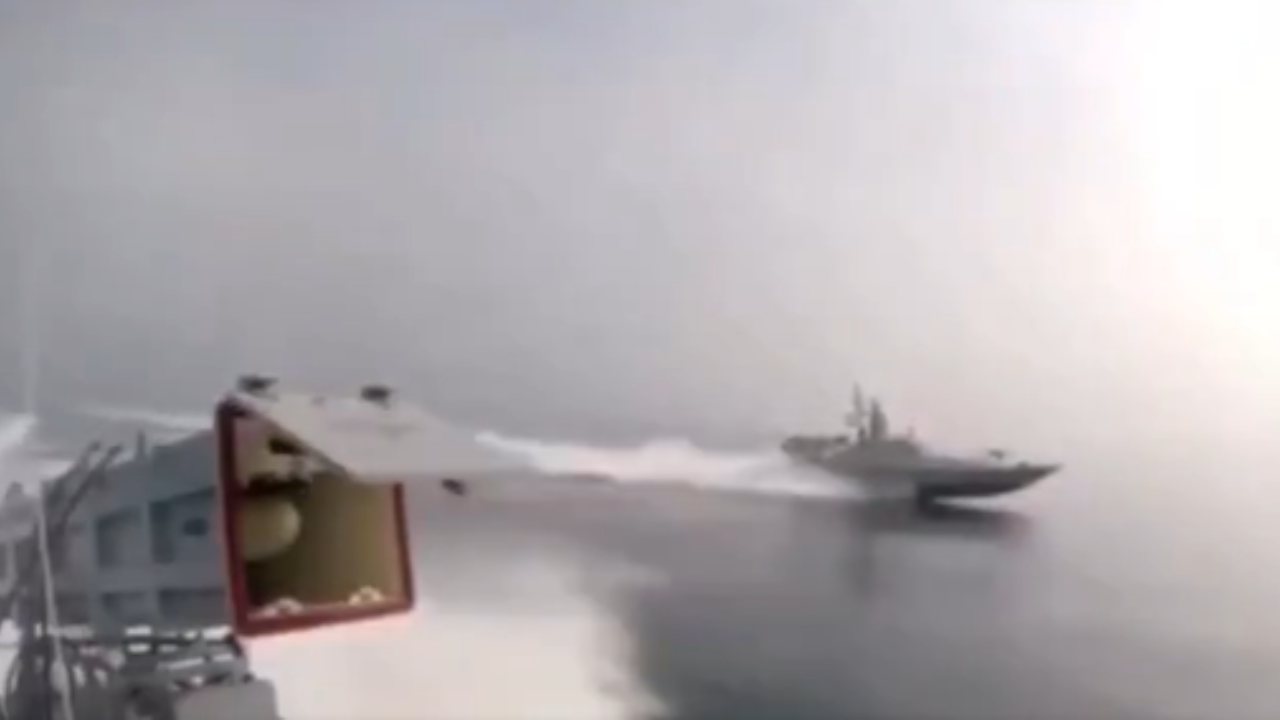
The convergence of cultural signaling and naval brinkmanship in the Strait of Hormuz represents a calculated departure from traditional deterrence. When Tehran utilizes cinematic metaphors to address American executive leadership, it is not merely engaging in rhetoric; it is signaling an alignment between internal ideological mobilization and external kinetic readiness. The current friction point centers on the "Picture abhi baaki hai" (The film isn't over yet) narrative—a deliberate appropriation of soft power to underscore a hard-power ultimatum. This strategy serves to broadcast a specific operational reality: the Iranian Revolutionary Guard Corps Navy (IRGCN) has transitioned from a posture of passive observation to one of active "warm-up" protocols for its fast-attack craft and missile batteries.
Understanding this escalation requires a decomposition of the tactical environment within the Persian Gulf, the psychological mechanics of the Bollywood-inspired messaging, and the economic variables that dictate the global cost of a Hormuz blockade.
The IRGCN Doctrine of Swarm Dynamics
Iran’s naval strategy does not seek parity with the U.S. Fifth Fleet. Instead, it optimizes for Asymmetric Denial, a framework designed to exploit the geographical constraints of the Strait of Hormuz. The "warming up" of missile boats refers to a specific shift in readiness levels (Condition of Readiness II or higher), where propulsion systems are engaged and fire-control radars are intermittently active to complicate the adversary's Electronic Support Measures (ESM).
The operational effectiveness of these boats relies on three distinct variables:
- Saturation Volume: By deploying dozens of high-speed, missile-armed small craft simultaneously, the IRGCN aims to overwhelm the Close-In Weapon Systems (CIWS) of larger surface combatants. The logic is mathematical: every defensive system has a maximum target-engagement track. If the number of incoming vectors exceeds this track limit $N+1$, the probability of a successful hull strike reaches near-certainty.
- Geographic Narrowness: The Strait of Hormuz is approximately 21 miles wide at its narrowest point, with shipping lanes restricted to two-mile-wide channels. This lack of maneuverable "sea room" turns the Persian Gulf into a "kill box" where the speed and agility of Iranian fast-attack craft (FACs) negate the long-range standoff advantages of traditional destroyers.
- Low-Signature Integration: Modern Iranian missile boats often utilize civilian hull profiles or low-observable composite materials, making it difficult for automated radar systems to distinguish between a commercial dhow and a combatant until the terminal phase of an engagement.
Cultural Semiotics as a Tool of Psychological Warfare
The use of the phrase "Picture abhi baaki hai" is a sophisticated application of Cross-Cultural Signaling. By quoting a iconic line from Indian cinema to address a Western leader (Donald Trump), Tehran is performing for three distinct audiences simultaneously.
- The Domestic Front: It projects a sense of cool-headed defiance. Using "pop culture" framing suggests that the threat of conflict is not a source of panic, but a controlled narrative that the Iranian state is currently "directing."
- The Regional Proxy Network: It simplifies the complexity of geopolitical tension into a digestible slogan of resistance, reinforcing the "Axis of Resistance" identity.
- The Global Market: It introduces a "Wild Card" variable. To an oil trader, a state leader talking about "the next act" in a movie is a signal of high unpredictability, which immediately inflates the "war premium" on Brent Crude futures.
This is not a "jab" in the sense of a playground insult; it is Perception Management. It seeks to frame the U.S. administration's "Maximum Pressure" campaign as an incomplete script, asserting that the final resolution of the conflict remains under Iranian control.
The Economic Cost Function of a Hormuz Closure
The threat of a blockade is often more effective than the blockade itself. The global economy operates on a "Just-In-Time" energy delivery model, where the Strait of Hormuz acts as the primary carotid artery for 20-30% of total global liquefied natural gas (LNG) and oil consumption.
If the IRGCN moves from "warming up" to active kinetic denial, the cost function shifts from linear to exponential.
Phase 1: The Insurance Spike
Before a single shot is fired, the mere presence of "warmed up" missile boats triggers a reclassification of the Gulf by Lloyd’s Market Association Joint War Committee. This leads to:
- Hull War Risk Premiums: Increases in insurance costs that can reach hundreds of thousands of dollars per transit.
- Demurrage Costs: Ships loitering outside the Gulf to avoid the risk zone, leading to supply chain bottlenecks.
Phase 2: The Physical Blockade
A physical closure involves the deployment of bottom-moored mines and land-based anti-ship cruise missiles (ASCMs) like the Noor or Ghadir systems. Unlike the "Tanker War" of the 1980s, modern ASCMs possess sophisticated seekers capable of discriminating between targets. This allows Iran to selectively target vessels based on the flag state, creating a tiered economic penalty system for nations supporting U.S. sanctions.
Phase 3: The Global Inflationary Feedback Loop
A sustained disruption of 15-20 million barrels per day would cause an immediate price decoupling. The Brent-WTI spread would widen, but more importantly, the "Shadow Price" of oil—the price at which industrial production becomes net-negative—would be breached in several emerging markets.
The Logic of the "Warm Up" Protocol
When Iranian officials state that their boats are "warming up," they are communicating a transition in the Escalation Ladder. In game theory, this is a move from a "Stochastic Game" (where outcomes are probabilistic) to a "Signaling Game" (where actions reveal hidden information about intent).
The "Warm Up" serves three tactical purposes:
- Testing Response Times: By moving craft into a state of readiness, the IRGCN forces the U.S. Navy and regional allies to increase their own alert levels. Monitoring the time it takes for a carrier strike group to cycle its CAP (Combat Air Patrol) provides Iran with critical intelligence on "readiness fatigue."
- Normalizing Deviation: If the IRGCN frequently "warms up" its fleet without attacking, the adversary may eventually view these movements as routine. This creates an opportunity for a "Bolt from the Blue" attack, where the actual offensive strike is masked by what appears to be another routine drill.
- Political Leverage: The timing of these warnings often coincides with diplomatic windows—specifically, periods when the U.S. administration is facing internal political pressure or when international bodies are debating sanction renewals.
Structural Vulnerabilities in Global Energy Transit
The reliance on the Strait of Hormuz highlights a critical failure in global energy infrastructure redundancy. While pipelines like the Habshan–Fujairah line in the UAE or the East-West Pipeline in Saudi Arabia exist, their combined capacity cannot absorb the total volume handled by the Strait.
The "bottleneck" is not just physical, but systemic. The global tanker fleet is optimized for specific routes; rerouting entails massive logistical overhead. Furthermore, the specialized nature of LNG transport makes it even more vulnerable to kinetic disruption than crude oil. An LNG tanker is essentially a floating cryogenic bomb; the risk profile of transiting a "warmed up" missile zone is, for many ship-owners, unacceptable regardless of the price of the commodity.
Tactical Reality vs. Political Posturing
There is a significant gap between the ability to harass shipping and the ability to win a sustained naval conflict. The IRGCN is fully aware that a full-scale kinetic engagement with the U.S. Navy would result in the systematic destruction of Iran’s conventional naval assets (as seen in the 1988 Operation Praying Mantis).
Therefore, the Iranian strategy is one of Calculated Friction. The goal is to keep the conflict in the "Grey Zone"—a state above peaceful competition but below the threshold of open war. The Bollywood reference is the "Grey Zone" in verbal form. It is provocative enough to dominate the news cycle and spook the markets, but sufficiently vague to avoid being classified as a formal declaration of hostilities.
The "film" Iran is referring to is a long-form drama of attrition. By ensuring the "picture" is never quite finished, they maintain a perpetual state of uncertainty. This uncertainty is their primary weapon. It forces the United States to commit massive, expensive carrier groups to a stationary patrol in the Gulf, draining resources from other theaters like the Indo-Pacific, while Iran achieves its strategic goals using relatively inexpensive drones and fast-attack craft.
Strategic Forecast: The Kinetic Boundary
The transition from "warming up" to "firing" will likely be dictated by the internal economic stability of Iran. If sanctions reach a point where the regime perceives an existential threat, the cost of a Hormuz closure—which would also damage Iran’s own remaining oil exports—becomes irrelevant.
The current "warm up" signals that we are approaching the Kinetic Threshold. This is the point where the cost of inaction (continued economic strangulation) is perceived as higher than the cost of a limited military engagement.
Strategic actors should expect:
- Increased Mine-Laying Drills: Watch for "environmental research" vessels or small dhows operating near the shipping lanes; these are the primary vectors for covert mining.
- Drone Swarm Testing: The integration of loitering munitions (suicide drones) with the fast-attack craft fleet to provide a "vertical" layer to the swarm attack.
- Cyber-Kinetic Coupling: Expect Iranian-aligned cyber actors to target port management software or GPS spoofing in the region simultaneously with naval maneuvers to maximize confusion.
The "next act" in this sequence is not a full-scale invasion, but a series of high-impact, deniable incidents designed to prove that the U.S. cannot guarantee the safety of the global commons. The strategic play for the West is not to respond to the Bollywood rhetoric, but to harden the "kill chain" against small-craft swarms and accelerate the development of non-Strait energy transit routes. If the "film" is to end favorably for global stability, the script must be rewritten to render the Hormuz blockade an obsolete lever of power.