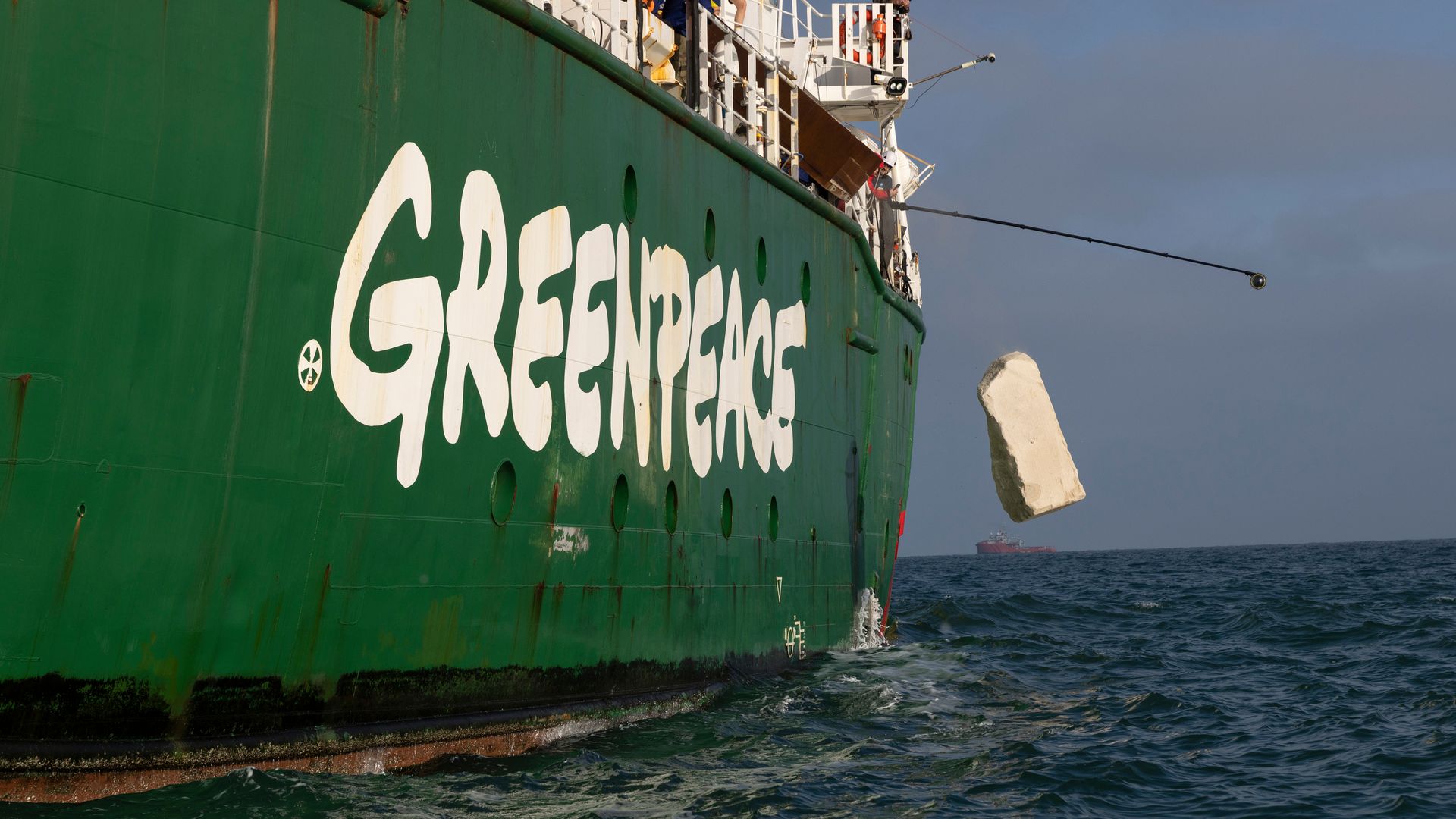
Deploying multi-ton granite boulders onto the seabed of a protected marine zone is not an act of ecological restoration; it is an asymmetric area-denial tactic designed to force regulatory enforcement through physical infrastructure. When Greenpeace drops boulders into the North Sea—specifically within designated Natura 2000 sites like the Sylt Outer Reef or Dogger Bank—to protect harbor porpoises (Phocoena phocoena), the organization is executing a calculated intervention to resolve a persistent institutional failure: the gap between legal marine protection and actual industrial exclusion.
The Structural Failure of Paper Parks
Marine Protected Areas (MPAs) across European waters frequently operate as "paper parks"—jurisdictions where conservation status exists in statutory text without corresponding restrictions on extractive economic activity. Under the European Union’s Habitats Directive and the Common Fisheries Policy (CFP), member states are obligated to maintain favorable conservation status for designated species, including the harbor porpoise. However, the bureaucratic mechanism required to restrict commercial fishing in offshore waters relies on joint recommendations from all member states holding fishing interests in those specific zones.
This governance architecture creates a structural veto. Because consensus among competing national fishing ministries is slow and politically costly, bottom-trawling fleets continue operating inside nominally protected habitats. The economic incentive favors the status quo: industrial beam trawlers and pulse trawlers extract high-value demersal species (such as sole and plaice) using heavy gear dragged directly across the benthic zone. Without physical enforcement or automated spatial exclusion, the regulatory framework fails to alter fleet behavior.
The Physics and Ecology of Benthic Disruption
To understand the rationale behind seabed boulder deployment, one must trace the causal chain linking bottom-contact fishing gear to harbor porpoise mortality and displacement.
Benthic Habitat Degradation
Bottom trawling utilizes heavy tickler chains, rockhopper gear, and otter boards to penetrate the upper centimeters of seabed sediment. This mechanical disturbance flattens complex three-dimensional seabed topography, destroys slow-growing epifauna (such as sponges, hydroids, and tubeworms), and resuspends fine sediments into the water column.
Trophic Cascade and Prey Depletion
Harbor porpoises are small cetaceans with exceptionally high metabolic rates and limited fat reserves relative to larger whales. Consequently, they require near-continuous access to high-calorie prey—primarily sandeels, herring, sprat, and juvenile gadoids. Bottom trawling disrupts the spawning grounds and shelter habitats of these forage fish. When benthic complexity collapses, local prey density drops, forcing porpoises to expend more energy foraging across wider territories, which directly reduces reproductive fitness and calf survival rates.
Acoustic Masking and Bycatch
Beyond trophic disruption, industrial fishing operations introduce high-decibel low- and mid-frequency underwater noise. Harbor porpoises rely entirely on high-frequency echolocation clicks (around 130 kHz) for navigation and foraging. While vessel noise primarily masks lower frequencies, the physical presence of gillnets and mid-water or demersal trawls creates a direct mortality risk via entanglement and asphyxiation (bycatch).
The Mechanics of Physical Area Denial
By placing natural, unworked granite boulders—typically weighing between one and four metric tons—onto the seafloor at calculated intervals, activists alter the risk-reward calculus for trawler captains.
- Gear Snagging and Mechanical Failure: Bottom trawls are engineered to glide over relatively uniform sand or gravel substrates. Encountering an unexpected, immobile multi-ton obstacle causes the trawl net to tear or the heavy steel doors to snag.
- Economic Deterrence: Repairing or replacing damaged industrial trawl gear incurs immediate capital costs alongside lost fishing days. Once the coordinates of a boulder field are logged and shared across maritime navigational networks, the area becomes an operational hazard.
- Zero-Latency Enforcement: Unlike satellite monitoring (AIS or VMS) followed by months of administrative litigation and negligible fines, a boulder enforces exclusion instantaneously. The physical barrier bypasses the state monopoly on maritime regulation.
Risk Matrix and Operational Limitations
While physical seabed obstruction achieves immediate spatial exclusion of bottom-towing gear, the intervention carries distinct operational, ecological, and legal liabilities that prevent it from serving as a scalable conservation model.
Navigational and Maritime Safety Hazards
Dropping unmapped obstacles into busy maritime corridors introduces risks to maritime safety. If a vessel's gear becomes inextricably fast on a boulder in heavy seas, the resulting tension can compromise vessel stability, potentially leading to capsizing and loss of life. To mitigate this, Greenpeace routinely publishes the exact GPS coordinates of dropped boulders to maritime authorities, effectively converting covert sabotage into overt spatial zoning.
Ecological Trade-offs and Substrate Alteration
Introducing hard granite substrate into predominantly sandy or muddy benthic ecosystems alters local hydrodynamics and species composition. While boulders eventually become colonized by hard-substrate organisms—creating artificial reefs that attract crabs, lobsters, and reef fish—this represents an ecological shift rather than a pure restoration of the original soft-bottom habitat. In dynamic tidal zones, heavy boulders can also cause localized seabed scouring, altering sediment transport patterns.
Jurisdictional and Legal Exposure
Under international maritime law, specifically the United Nations Convention on the Law of the Sea (UNCLOS), coastal states exercise sovereign rights over their Exclusive Economic Zones (EEZ). Unauthorized placement of materials on the seabed can be prosecuted as illegal dumping under the London Convention or national marine licensing laws, exposing the executing organization to vessel seizure, heavy financial penalties, and criminal charges for ship captains.
The Strategic Calculus of Direct Action
The North Sea boulder deployments illustrate a specific evolutionary phase in environmental advocacy: the transition from awareness campaigns to infrastructural intervention. Traditional lobbying and public relations campaigns fail when the economic asymmetry between concentrated industrial interests (commercial fishing fleets) and diffuse public goods (marine biodiversity) is too wide.
By introducing physical friction into the supply chain of bottom-trawled seafood, the tactic forces state regulators into a binary choice. Authorities must either expend public funds to physically remove the boulders—an optically disastrous move that visibly aligns the state with destructive fishing practices inside a protected zone—or formalize the exclusion by codifying the no-trawl zone into enforceable maritime law.
Forward Strategic Play
For marine conservation organizations, regulatory bodies, and maritime operators, the escalation to physical seabed barriers signals the obsolescence of voluntary compliance and delayed policy implementation.
- For Regulatory Agencies: Accelerate the deployment of mandatory Remote Electronic Monitoring (REM)—combining closed-circuit television, gear sensors, and high-frequency GPS—across all vessels operating near Natura 2000 boundaries. Automated geofencing with instant financial penalties is the only institutional mechanism capable of matching the enforcement speed of physical barriers without introducing maritime safety hazards.
- For Conservation Strategists: Shift capital allocation from generic public awareness to targeted legal injunctions paired with hydroacoustic and AIS data analytics. Documenting exact spatial overlaps between trawler tracks and porpoise acoustic detections provides the evidentiary threshold required to compel national courts to enforce existing EU Habitats Directive mandates.
- For Commercial Fishing Operators: Transition capital expenditure away from heavy bottom-contact gear toward low-impact, passive fishing methods (such as pots, traps, and selective hook-and-line systems) within buffer zones. As spatial squeeze from offshore wind farms and strict MPA enforcement accelerates across the North Sea, heavy bottom trawling faces terminal operational restriction regardless of activist intervention.