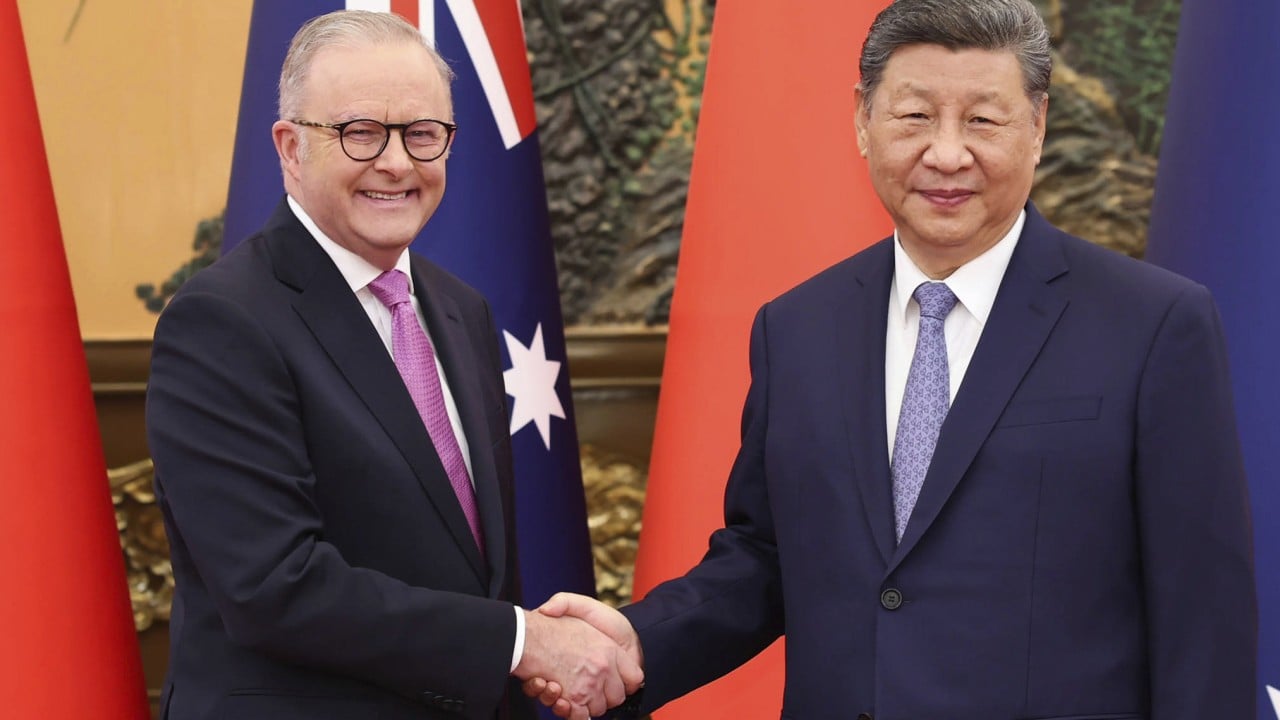
Scheduling a bilateral state visit to Beijing immediately following a China-hosted Asia-Pacific Economic Cooperation (APEC) summit represents a calculated exercise in diplomatic compartmentalization. Rather than signaling a comprehensive strategic realignment, the Australian Prime Minister’s itinerary reflects a structural attempt to decouple bilateral trade normalization from unresolved regional security friction. To understand why Canberra is executing this two-stage engagement—and why tensions remain entrenched beneath the diplomatic choreography—analysts must evaluate the competing incentive structures, economic dependencies, and security constraints governing the Indo-Pacific theater.
The Architecture of Dual-Track Diplomacy
Standard political commentary often treats diplomatic summits as binary indicators of friendship or hostility. In practice, mid-sized powers operating between competing hegemons rely on dual-track diplomacy: separating multilateral consensus-building from bilateral grievance resolution.
- The Multilateral Buffer (APEC): Hosted by Beijing, the APEC forum operates on non-binding commitments and economic facilitation. Attending the summit allows Canberra to participate in regional trade governance without making unilateral concessions. The multilateral setting dilutes bilateral pressure, forcing Beijing to act as a institutional host rather than a coercive negotiator.
- The Bilateral Crucible (Beijing State Visit): Extending the trip into a dedicated bilateral visit shifts the operational dynamic. In Beijing, the Australian delegation loses the institutional insulation of the 21-member APEC bloc. Every handshake, communiqué, and ministerial meeting becomes a direct signal to domestic constituencies, regional allies, and global markets.
This sequencing is deliberate. By anchoring the trip to an unavoidable multilateral calendar event, the Australian government lowers the domestic political cost of visiting Beijing. It frames the bilateral leg not as an act of supplication, but as a logical extension of routine regional attendance.
The Three Pillars of Sino-Australian Friction
Surface-level coverage frequently reduces ongoing bilateral friction to vague "simmering tensions." Operational analysis requires disaggregating these tensions into three distinct, non-overlapping domains, each governed by different escalation thresholds.
Maritime and Aerial Interception Dynamics
The most acute friction occurs in the kinetic domain, specifically within the South China Sea and the East China Sea. Interactions between the People’s Liberation Army (PLA) and the Australian Defence Force (ADF) operate near the threshold of miscalculation. Incidents involving unsafe aerial interceptions, sonar pulses near naval divers, and contested freedom-of-navigation operations are not random tactical errors; they are deliberate signaling mechanisms used by Beijing to contest the operational reach of U.S.-aligned militaries within the First Island Chain. Canberra cannot trade away maritime transit rights for agricultural tariff relief, creating a permanent structural floor beneath bilateral tension.
Minilateral Deterrence Frameworks
Australia’s deepening integration into non-traditional security architectures—specifically the AUKUS trilateral security partnership (focused on conventionally armed, nuclear-powered submarines and advanced defense technologies) and the Quadrilateral Security Dialogue (Quad)—fundamentally alters Beijing’s threat perception. From a realist international relations perspective, China views AUKUS not as a defensive procurement program, but as an offensive containment mechanism designed to project power into the Western Pacific. Because AUKUS timelines span decades, this friction point is structurally locked in regardless of which political party governs in Canberra.
Cyber Operations and Foreign Interference
Beneath the threshold of conventional military confrontation lies persistent gray-zone competition. Australian intelligence agencies have consistently documented state-sponsored cyber intrusions targeting critical infrastructure, alongside covert influence operations aimed at diaspora communities and sub-national political institutions. Addressing these issues requires defensive domestic legislation and counter-intelligence hardening—actions Beijing routinely characterizes as ideological hostility.
The Economic Cost Function of Stabilization
If security interests are fundamentally misaligned, the primary driver of the Beijing visit is economic risk management. Understanding this requires examining the asymmetric trade interdependence between the two nations.
Australia possesses a highly concentrated export profile heavily weighted toward bulk commodities—specifically iron ore, liquefied natural gas (LNG), and metallurgical coal. China remains the primary global marginal buyer for these inputs, particularly iron ore required for domestic steel production. Conversely, Beijing previously demonstrated a willingness to weaponize trade dependencies by imposing punitive tariffs and informal bans on Australian exports where China held alternative supply options, including barley, wine, beef, timber, and thermal coal.
The economic stabilization sought by Canberra is not aimed at expanding market share into high-tech sectors, which remain restricted by national security screening. Instead, the objective is variance reduction:
- Eliminating Arbitrary Disruption: Ensuring that agricultural and resource exports are governed by World Trade Organization (WTO) baselines rather than administrative bottlenecks at Chinese ports.
- Insulating High-Value Commodities: Protecting the iron ore trade from political contagion while Chinese domestic property markets experience prolonged structural contraction.
- Diversification Buying Time: Stabilization is a bridging strategy. Canberra recognizes that decoupling from the Chinese market is economically unviable in the short term; maintaining predictable trade flows buys the necessary fiscal runway to subsidize domestic critical minerals processing and expand trade agreements with Southeast Asian and Indian markets.
For Beijing, hosting the Australian Prime Minister provides tangible macroeconomic and diplomatic returns. Facing domestic deflationary pressures, sluggish consumer demand, and escalating trade barriers from the United States and the European Union, China needs stable, reliable suppliers of raw materials and a demonstration that Western allies are not monolithic in their approach to economic containment.
The Structural Limitations of the "Stabilization" Doctrine
Canberra’s current diplomatic doctrine rests on the formula of "cooperating where we can, disagreeing where we must." While operationally pragmatic, this framework contains inherent vulnerabilities that limit its long-term efficacy.
First, Beijing rejects compartmentalization. Chinese statecraft explicitly links political compliance with economic access. When Beijing lifts trade restrictions, it views those actions as revocable concessions contingent upon Australian restraint regarding Taiwan, human rights in Xinjiang, and regional security alignments. If Australia takes a firm stance on a core Chinese security interest, Beijing retains the unilateral ability to re-impose non-tariff barriers under the guise of customs inspections or biosecurity standards.
Second, domestic political polarization constrains executive flexibility. In Australia, maintaining a functional relationship with Beijing requires walking a narrow corridor between business lobbies demanding market access and national security hawks warning against strategic complacency. Any perceived concession during the Beijing visit—such as softening language on maritime disputes or delaying defense posture enhancements—immediately triggers domestic political backlash and invites scrutiny from Washington.
Third, structural shifts in the Chinese economy reduce future complementarity. Even with frictionless diplomatic relations, the peak era of Chinese infrastructure-led growth—which drove the Australian mining boom—has concluded. As Beijing pivots capital toward advanced manufacturing, electric vehicles, and green energy supply chains, Australia’s role shifts from a primary beneficiary of Chinese urbanization to an upstream supplier of raw lithium and rare earths, sectors where Beijing actively seeks to control downstream processing and pricing power.
Strategic Execution in Beijing
To extract measurable value from the post-APEC bilateral meetings without compromising deterrence, the Australian delegation must treat the engagement as a risk-mitigation exercise rather than a diplomatic breakthrough.
Canberra should anchor its bilateral agenda on three non-negotiable operational outcomes:
- Institutionalizing Crisis Communication Channels: Establish direct, binding military-to-military hotlines between ADF and PLA theater commanders to prevent tactical encounters in the South China Sea from escalating into strategic crises. Economic dialogue cannot survive an accidental maritime casualty.
- Enforcing Regulatory Predictability Over Market Expansion: Prioritize formal mechanisms that lock in tariff-free access and transparent customs clearance for existing agricultural and resource exports, explicitly avoiding new dependency traps in emerging sectors like green energy hardware or telecommunications infrastructure.
- Maintaining Strategic Ambiguity on Regional Contingencies: Resist Beijing’s inevitable pressure to extract joint communiqué language endorsing Chinese definitions of regional sovereignty or criticizing minilateral security pacts. Silence or adherence to standard international law phrasing preserves diplomatic maneuverability.
The post-APEC visit to Beijing will not resolve the fundamental clash between Australia’s alliance architecture and China’s regional ambitions. Success must be measured not by the warmth of the rhetoric, but by the absence of economic coercion and the establishment of reliable guardrails against military miscalculation over the subsequent twenty-four months.