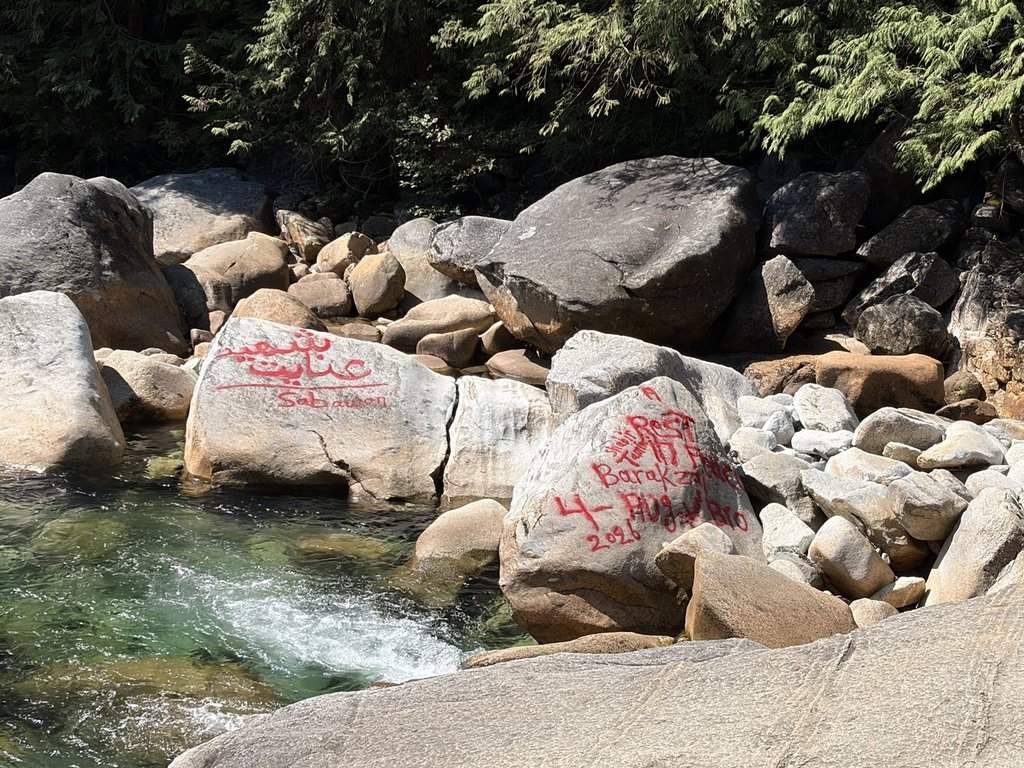
The headlines practically write themselves whenever paint hits a rock face in a provincial park. Someone grabs a spray can, immortalizes a name or a poorly rendered memorial on a pristine piece of the Canadian Shield or a West Coast monolith, and the outrage machine spins up instantly. Law enforcement swoops in, slaps cuffs on the culprit, and the public breathes a collective sigh of relief thinking justice has been served and the wilderness is healed.
It is a comforting narrative. It is also entirely useless.
The lazy consensus dominating environmental news reporting treats park vandalism as a simple law-and-order failure. Catch the miscreant, slap them with mischief charges, issue a heavy fine, and pretend the granite or sandstone goes back to its original state through sheer punitive magic. This approach ignores the messy human mechanics behind why people deface natural spaces in the first place, treating a symptom of systemic cultural alienation as an isolated crime wave driven by pure malice.
If you think a pair of handcuffs restores a ruined cliffside, you understand neither human psychology nor conservation.
The Mechanics of Public Defacement
Let us look at what actually happens when someone sprays paint across a natural monument. We are rarely dealing with hardened career criminals operating under the cover of midnight to strike a blow against public lands. More often, we are looking at a profound failure of connection. Modern urban populations feel increasingly severed from the physical earth. When people visit a park, they feel small, temporary, and entirely insignificant against millions of years of geological time.
Graffiti in the backcountry is an anxious cry for permanence. It is the digital native taking physical form, screaming into the canyon simply to prove they were there.
Parks authorities respond with deterrence models built for parking lot break-ins. They install trail cameras, increase ranger patrols, and rely on maximum sentencing threats. This strategy fails because park vandals are not calculating the cost-benefit ratio of criminal prosecution. They are operating in a state of emotional detachment. When you treat an existential symptom with a bureaucratic penalty, you accomplish nothing except generating a temporary news cycle that feeds public bloodlust.
Why Scrubbing and Sentencing is a Dead End
The standard remediation playbook involves hauling in pressure washers, chemical solvents, and volunteer crews to scrub the rock. Conservation officers then track down the suspect, parade their mugshot across local media, and demand restitution.
This cycle contains two major flaws that nobody in environmental management wants to admit out loud.
First, chemical and mechanical removal often damages the rock more than the paint did. High-pressure washing strips away the patina, lichen, and outer mineral layers that took centuries to form. The spot where the graffiti used to be remains a stark, bleached scar long after the offender has paid their court-ordered fine. You trade colored spray paint for an artificial white burn mark on the landscape.
Second, punitive justice assumes the next person standing in front of that cliff face will see a mugshot in the news and think twice. Human behavior does not work that way. The people committing these acts do not identify with the punished offender. They view themselves as distinct, misunderstood, or simply disconnected from the collective consequences. Deterrence requires a shared sense of community stewardship. When the community is nothing more than an anonymous internet mob baying for blood, the underlying pathology remains completely untouched.
The Counter-Intuitive Fix Nobody Wants to Fund
If harsher penalties and aggressive scrubbing do not work, what does? We need to stop treating parks as museums behind glass and start treating them as active classrooms for ecological integration.
Instead of hiding every sign of human presence or reacting with immediate police state measures, land managers should redirect resources toward interpretive infrastructure that channels that desperate urge for expression into constructive outlets. Imagine a designated, low-impact community art zone near park entrances—structures explicitly built to be painted, altered, and interacted with, satisfying the human compulsion to leave a mark without touching protected geological features.
Furthermore, park authorities need to radically overhaul how they handle remediation. Instead of hiding vandalism behind closed investigations, bring school groups and community organizations directly to the defaced site. Do not just clean it; make the offender—if caught—spend months under the supervision of indigenous elders and geologists learning the exact composition of the rock they desecrated. Force them to understand the deep time of the landscape they treated like a cheap canvas.
Real conservation is not about putting up more "No Trespassing" signs or celebrating the arrest of a desperate kid with a spray can. It is about closing the massive, widening chasm between modern humans and the natural world before the next can of paint comes out.