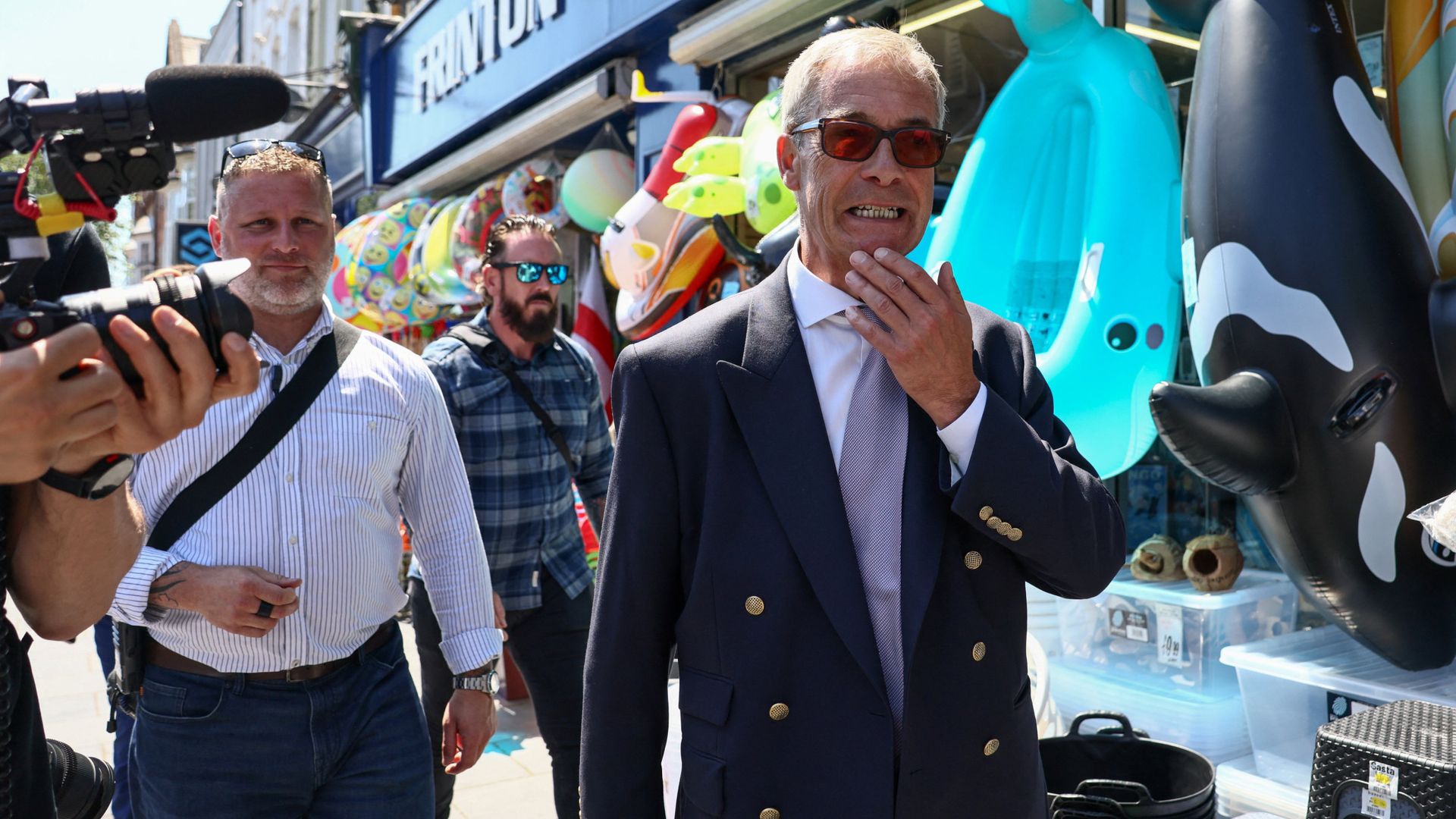
A man gets arrested in his bedroom for writing a stupid, violent sentence on social media about Nigel Farage. The press runs the headline. The establishment pats itself on the back for taking threats seriously. Nigel Farage gets another week of free, high-octane publicity, framing himself as the most dangerous man to the status quo.
Everyone plays their part in this theater. Everyone wins, except the taxpayer and the concept of proportion.
The media coverage of the latest arrest over a social media post threatening to shoot Farage is a masterclass in missing the point. The mainstream consensus is simple: online threats are an existential crisis, policing them is a vital national security priority, and every arrest is a victory for democracy.
This consensus is completely wrong.
By treating every low-IQ, keyboard-bound idiot with the full dignity of a state counter-terrorism operation, we are not making politicians safer. We are doing three highly destructive things instead: we are validating the troll, draining finite policing resources from actual physical security, and handing populist politicians the ultimate political gold—state-certified martyr status.
The Outrage Economy and the Threat Industrial Complex
We have built an entire ecosystem around online outrage. It has its own supply chains, its own market makers, and its own currency.
When an angry, anonymous individual posts a threat online, they are throwing a match into a forest of dry wood. In a sane society, that match goes out. In our society, the police, the media, and the target of the threat team up to pour gasoline on it.
- The Troll wants attention, validation, or a cheap hit of dopamine from behind a screen.
- The Politician wants to demonstrate that they are so incredibly threatening to the establishment that people want them dead. It solidifies their base and weaponizes victimhood.
- The Media wants the clicks that come with the terrifying headline of an assassination plot.
- The Police want to show they are "doing something" about online safety to satisfy political pressure.
This is not security. This is a performance.
When a 25-year-old is arrested for a tweet, the state elevates a pathetic piece of digital noise into an official national security event. We are treating the symptom of online brain rot as if it were an organized paramilitary conspiracy.
The Keyboard Commando vs. The Credible Threat
I have spent years analyzing how security operations and threat intelligence actually work. In the physical world, security professionals evaluate threats based on a strict matrix of capability, intent, and opportunity.
| Threat Level Variable | The Keyboard Commando | The Genuine Threat |
|---|---|---|
| Anonymity | Uses real name, easily traceable IP, or a poorly hidden burner account. | Operates in silence, avoids digital footprints, uses encrypted channels. |
| Capability | Has no access to firearms, no tactical training, and lives in a suburban semi-detached house. | Has access to illicit networks, financing, and weaponry. |
| Intent | Wants to vent frustration, gain internet clout, or shock an audience. | Wants to execute a plan without getting caught beforehand. |
| Opportunity | Has no proximity to the target, no knowledge of their schedule, and no way to bypass security. | Studies movements, identifies gaps in physical protection, plans logistics. |
When the state treats these two columns as identical, it fails at basic risk assessment.
The vast majority of online threats are not "pre-delinquency" signs of an impending attack. They are the digital equivalent of shouting drunken abuse outside a pub. It is offensive. It is hostile. It is obnoxious. But it is not a credible assassination plot.
By sending police officers to knock down doors for digital noise, we are telling the public that we cannot distinguish between a highly coordinated threat and a guy who has had three beers and an argument on X.
The Martyrdom Loop: How We Feed Populism
Let us look at the political mechanics of this. Populism thrives on a very specific narrative: They are trying to stop us because we speak for you.
Every time a critic or a troll goes too far, and the state steps in with handcuffs, it validates that exact narrative. The populist politician does not look at an online threat and tremble; their campaign team looks at it and sees an fundraising email campaign waiting to be written.
The sequence is entirely predictable:
- The Post: An angry user posts a violent, half-baked threat online.
- The Outcry: The politician’s supporters flag it, magnifying its reach tenfold.
- The Intervention: The police, terrified of looking negligent, make a highly publicized arrest.
- The Triumph: The politician posts about how they "will not be silenced" by the radical left, the deep state, or whatever bogeyman fits the brand.
- The Reward: Donations pour in. Media appearances booked. The base is energized.
If you wanted to design a system to keep populist figures in the headlines forever, you could not build a better machine than this. The arrest of a random online troll is a free, state-subsidized campaign ad. It converts cheap words into valuable political capital.
The Misallocation of Physical Security
While police forces are busy tracking down IP addresses and deploying officers to arrest social media users, actual physical security is failing.
Let us look at the facts. The politicians who have been tragically murdered in recent UK history—Jo Cox and David Amess—were not killed by people who posted loud, obvious, trackable threats on public social media feeds beforehand. They were targeted by individuals who operated under the radar, driven by ideological obsession, exploiting gaping holes in physical security at local constituency surgeries.
Real security is boring, expensive, and physical. It involves:
- Physical perimeter control at public events.
- Vetting attendees at constituency meetings.
- Professional close-protection details.
- Rapid response coordination with local police units.
Monitoring millions of social media posts for keywords is a giant, expensive distraction from this work. It creates a false sense of security. It allows authorities to claim they are "tackling the problem" while leaving the actual physical vulnerabilities of public servants completely unaddressed.
If a politician is at risk, you do not protect them by policing the internet. You protect them by securing the room they are standing in.
The Free Speech Trap
There is another, deeper cost to this approach: the degradation of the legal standard for what constitutes a crime.
When we lower the bar for police intervention to include offensive, stupid, or hyperbolic speech online, we create a weapon that will inevitably be used against everyone. The laws used to arrest someone threatening a populist today can, and will, be used to arrest someone criticizing a government policy tomorrow.
The state should not be in the business of policing bad manners, online bravado, or distasteful venting. The moment we ask police officers to act as the hall monitors of the digital world, we compromise their primary mission.
We also make ourselves look incredibly fragile. A confident, stable democracy does not tremble because an anonymous teenager on the internet said something vile. It ignores them, or it laughs at them, or it lets the platform's terms of service handle it. It does not send three police officers and a squad car to validate their existence.
Stop Treating Social Media as a Crime Scene
If we want to fix this, we have to change how we respond to digital noise.
First, the police must raise the threshold for what triggers an investigation. Unless a post contains a specific, actionable plan, showing capability, intent, and proximity, it should be treated as low-level harassment or simple incivility—not a counter-terrorism event.
Second, the media needs to stop treating every stupid comment on a platform as a major news story. Stop writing articles about what "User12345" said. It is not news. It is gossip dressed up as security reporting.
Third, politicians need to take responsibility for their own physical security without demanding that the state police the minds of the entire population to make them feel safe.
The current system is a farce. We are wasting taxpayer money, distracting our police force, and handing populists the exact victim narrative they need to win elections. It is time to turn off the cameras, ignore the trolls, and put the handcuffs away unless there is a real, physical threat standing in front of us.