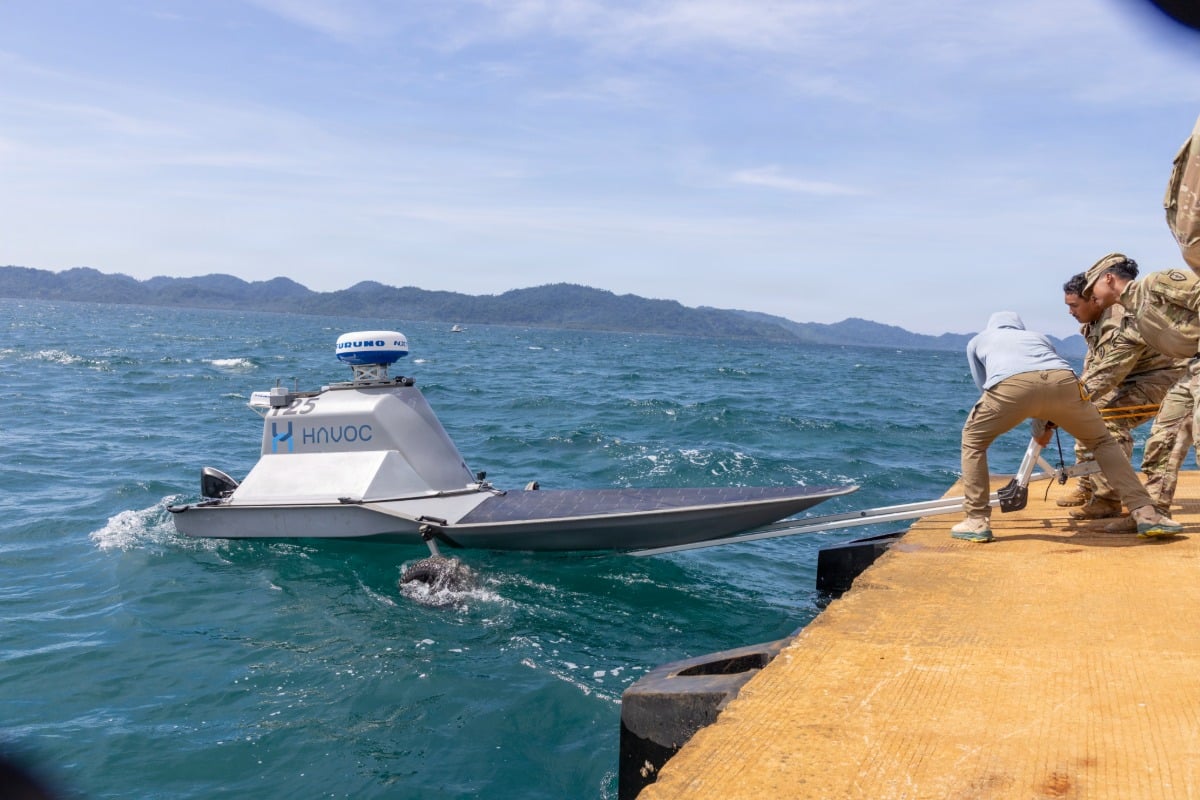
The U.S. Army just sent a fleet of robotic boats into the waters of the Philippines, and it completely alters how we look at island warfare. During the Salaknib 2026 military exercises in Casiguran Sound, soldiers from the 25th Infantry Division deployed a swarm of Unmanned Surface Vessels, or USVs, to run security for a massive 260-mile logistics mission.
This is not just some tech demo. It is a direct answer to a massive problem. If you look at the geography of the Indo-Pacific, moving troops and heavy armor through narrow waterways is a nightmare. It is highly predictable, slow, and dangerous. By throwing a swarm of autonomous boats ahead of a massive U.S. Army Logistics Support Vessel, the military proved it can protect its heavy assets without risking human lives on the front line. Read more on a connected subject: this related article.
Let's look past the press releases and break down what actually happened on the water, why the Army is suddenly messing around with naval drones, and what this means for regional security.
The Casiguran Sound Drill by the Numbers
The setup was straightforward but high-stakes. The U.S. Army needed to help move Philippine Army armored personnel carriers and troops from Port Tobaco to Port Casiguran. That is a 260-mile trek. Additional reporting by CNET delves into comparable perspectives on this issue.
As the massive logistics ship approached the port, soldiers from the 125th Intelligence and Electronic Warfare Battalion didn't hop into patrol boats. Instead, they launched a swarm of autonomous USVs.
These small, robotic boats spread out across a six-mile perimeter outside the port. They acted as a scout network, running a security screen to look for threats, anomalies, or hidden dangers in the water. They didn't just sail around aimlessly. The boats used onboard sensors to feed real-time tracking data back to commanders on the shore.
According to military personnel on the ground, the system compressed the commander's decision-making process from hours down to literal seconds. The automated boats give leaders the ability to find, fix, target, kill, and confirm threats before a human crew even spots them on traditional radar.
Why the Army is Stepping on Navy Toes
You might wonder why the U.S. Army is operating boat swarms in the first place. Isn't that the Navy's job?
Historically, yes. But the modern Pacific theater requires a strategy called littoral maneuver. The Army realizes it can't just sit on land and wait for the Navy to drop off gear. In a real conflict inside the first island chain, ports will be highly contested. Ships are massive targets.
By taking ownership of small, expendable, autonomous maritime drones, the Army can secure its own landing zones. If a couple of robotic boats get taken out by an adversary, it is a bad day for the budget, but nobody goes home in a body bag.
This ties directly into a broader shift happening across the military right now. Just days after the Salaknib drill, U.S. Special Operations Command launched a market research blitz to find tiny electronic intelligence payloads to mount on these exact types of maritime drones. They want these boats to do more than just look for threats. They want them to sniff out enemy signals, geolocate communication hubs, and map out electronic warfare environments.
The Tech Behind the Swarm
The word "swarm" gets thrown around a lot, but it has a specific meaning here. We aren't talking about remote-controlled toy boats where one soldier operates one vessel with a joystick.
True autonomy means a small group of soldiers can manage a whole fleet. The boats communicate with each other to divide up the patrol space. If one boat identifies a blind spot, another shifts over to cover it. They navigate the waves, adapt to changing currents, and maintain their perimeter without constant human steering.
The immediate benefit is persistent awareness. Humans get tired, lose focus, and can't see past the horizon. A network of autonomous sensors doesn't sleep. It creates a digital bubble around vulnerable transport ships, providing a clear picture of the maritime space in real time.
The Bigger Geopolitical Picture
You can't separate this technology from the tension brewing in the South China Sea. The Philippines and the U.S. have been rapidly tightening their defense alliance, running back-to-back exercises like Balikatan and Salaknib.
We are seeing a massive shift toward distributed lethality. During these same timelines, the Army has been island-hopping M142 HIMARS rocket launchers onto remote islands like Balabac, right on the doorstep of contested waters.
The strategy is clear. Use autonomous boat swarms to secure the shorelines and ports, move long-range missile launchers onto the islands via logistics craft, and establish a network that can deny an adversary freedom of movement. It is a high-tech game of chess, and autonomous systems are turning into the most valuable pawns on the board.
Moving Beyond the Hype
The technology is impressive, but it is not magic. Operating a bunch of autonomous boats in a controlled exercise is vastly different from doing it during active electronic jamming.
If an enemy cuts the satellite links or floods the area with wireless interference, how well do these boats talk to each other? That is the real test the military is trying to solve behind closed doors. The push by SOCOM for better signal processing payloads tells us they know the hardware needs to get smarter and more resilient against electronic attacks.
If you are tracking the future of defense tech, the takeaway here is that autonomy has officially left the lab. It is operating in real tropical waters, alongside foreign allies, protecting actual logistics pipelines.
The next step for defense planners and tech contractors isn't just building a faster boat. It is about building better data links and smarter software that can survive a messy, jammed environment. Watch the upcoming defense procurement cycles closely. The money is moving away from massive, heavy platforms and flowing directly into small, smart, expendable swarms.