Diego Maradona did not just cheat an entire nation out of a World Cup quarterfinal in 1986. He fundamentally rewired the moral framework of global sport.
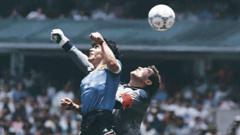
Four decades after the Tunisian referee Ali Bennaceur stared into the blinding Mexico City sun and missed a left fist punching a football into the English net, we remain obsessed with the "Hand of God." The competitor narrative treats this as a nostalgic milestone, a colorful vignette from a simpler era of broadcasting. That view is lazy. The 51st minute of that match at the Estadio Azteca was not a quaint historical anomaly. It was a cold, calculated exercise in competitive cynicism that succeeded because of structural failures in officiating, a masterclass in psychological manipulation, and the toxic geopolitical tension of the post-Falklands era.
To understand why the world ultimately sanctified a blatant act of rule-breaking, we have to look past the romantic myth. We must examine the mechanics of the deception itself and the dark brilliance of the man who orchestrated it.
The Blind Spots that Allowed the Theft
Match officials do not miss a handball in a World Cup quarterfinal by accident. They miss it because of positioning, optics, and sheer intimidation.
When Jorge Valdano’s miscontrolled pass looped high into the air over the English penalty area, England goalkeeper Peter Shilton had a clear physical advantage. He was nearly eight inches taller than Maradona. Under normal aerodynamic and physical laws, Shilton wins that ball every single time. Maradona knew this. He did not jump to challenge for the ball with his head; he jumped with the explicit intent to create an optical illusion.
By raising his left fist close to his head, Maradona ensured that his body shielded the point of contact from the referee’s primary line of sight. Referee Bennaceur was trailing the play from the center circle, roughly 30 yards away. He was looking at Maradona’s back and side. The linesman, Bogdan Dotchev of Bulgaria, was trapped on the right touchline, squinting across a pitch distorted by midday heat shimmer and shifting stadium shadows.
Maradona exploited the human eye's inability to process high-speed, micro-movements from a distance. The entire sequence took less than half a second.
The real genius of the cheat, however, occurred after the ball hit the net. Maradona did not look back at the referee with a guilty conscience. He ran toward the corner flag, celebrating with intense, performative fury. He later admitted that he yelled to his teammates to come hug him so the referee wouldn't suspect anything.
This psychological trick is standard in modern dive mechanics, but in 1986, it was devastatingly effective. Officials are conditioned to look for hesitation as a sign of guilt. Maradona offered nothing but raw, unadulterated ecstasy. Bennaceur looked at Dotchev, Dotchev remained stationary, and the biggest heist in sporting history was certified.
The Myth of Retribution and the Falklands Shadow
You cannot separate the Hand of God from the blood spilled in the South Atlantic four years prior. The British media often frames the match as a pure sporting tragedy, but for Argentina, it was a proxy war. The Falklands War, or Guerra de las Malvinas, had ended in a humiliating Argentine defeat in 1982, costing the lives of hundreds of young Argentine conscripts.
Maradona understood this pressure intimately. While he publicly maintained that the match had nothing to do with the war, his later memoirs revealed the truth. He admitted that Argentine players felt they were defending a flag, avenging the mothers who had lost sons in the cold waters of the south.
This context is exactly why the handball was not just forgiven in Buenos Aires—it was deified. In the slums of Villa Fiorito where Maradona grew up, survival depended on viveza criolla, a cultural concept translating roughly to "native cunning" or the art of outsmarting an authority figure through deception. To the Argentine public, outworkng the English was good, but tricking them was divine. It was the ultimate revenge of the global underclass against an old imperial power.
The English team, led by Bobby Robson, reacted with predictable, righteous indignation. Shilton spent the rest of his life refusing to forgive Maradona, a stubbornness that underscored the massive cultural divide between the two nations. England viewed sport through the lens of Victorian fair play; Argentina viewed it as a struggle where survival justified any means necessary.
The Double Standard of Genius
Just four minutes after using his fist, Maradona scored what is widely considered the greatest goal ever captured on film. He took the ball in his own half, spun past Peter Beardsley and Peter Reid, left Peter Couzens in the dust, turned Terry Fenwick inside out, and bypassed Shilton before sliding the ball home.
This second act is crucial to why the first act was normalized.
Had a less gifted player—say, a rugged defender—fisted the ball into the net and won the match 1-0, history would judge them as a dirty player. They would be lumped into the same category as Harald Schumacher, the West German goalkeeper who brutally wiped out Patrick Battiston in 1982. Instead, Maradona’s second goal acted as a retrospective absolution for his first.
The sheer beauty of the "Goal of the Century" blinded the footballing world to the criminality of the first. It created a narrative that Maradona was simply operating on a higher spiritual plane than anyone else on the pitch. The world chose to see the match not as a compromised contest, but as a complete manifestation of human capability, capturing both our lowest urges to deceive and our highest capacity for artistic brilliance.
The Lasting Legacy of Controlled Corruption
The ultimate tragedy of the Hand of God is that it validated the idea that winning by any means is acceptable if you are talented enough to get away with it. It paved the way for Thierry Henry’s handball against Ireland in 2009, Luis Suarez’s deliberate goal-line clearance against Ghana in 2010, and the endless parade of tactical simulation that plagues the modern sport.
We now live in an era dominated by Video Assistant Referees (VAR), a technological panacea designed to eliminate human error. If that match were played today, Maradona’s goal would be disallowed inside twenty seconds, and he would likely receive a yellow card. The stadium would experience a sterile, agonizing three-minute delay while technicians in a remote bunker reviewed multiple camera angles.
Yet, something vital would be missing.
The absence of technology in 1986 allowed football to remain a human drama, complete with all our flaws, injustices, and historical grievances. Maradona’s fist did not just puncture a ball; it punctured the illusion that sport is a vacuum of pure fairness. It proved that sometimes, history is written by the villain, and if the villain is charming enough, the world will applaud anyway.