The air in the Kirya, Tel Aviv’s military headquarters, does not move. It is trapped by concrete, subterranean steel, and the heavy, collective breathing of people who have spent decades calculating the exact cost of a second. Inside these rooms, geopolitical strategy is not an academic exercise. It is a sensory experience. It is the hum of server racks, the smell of stale espresso, and the scratch of a fountain pen across a map that hasn't changed its borders but changes its threats every hour.
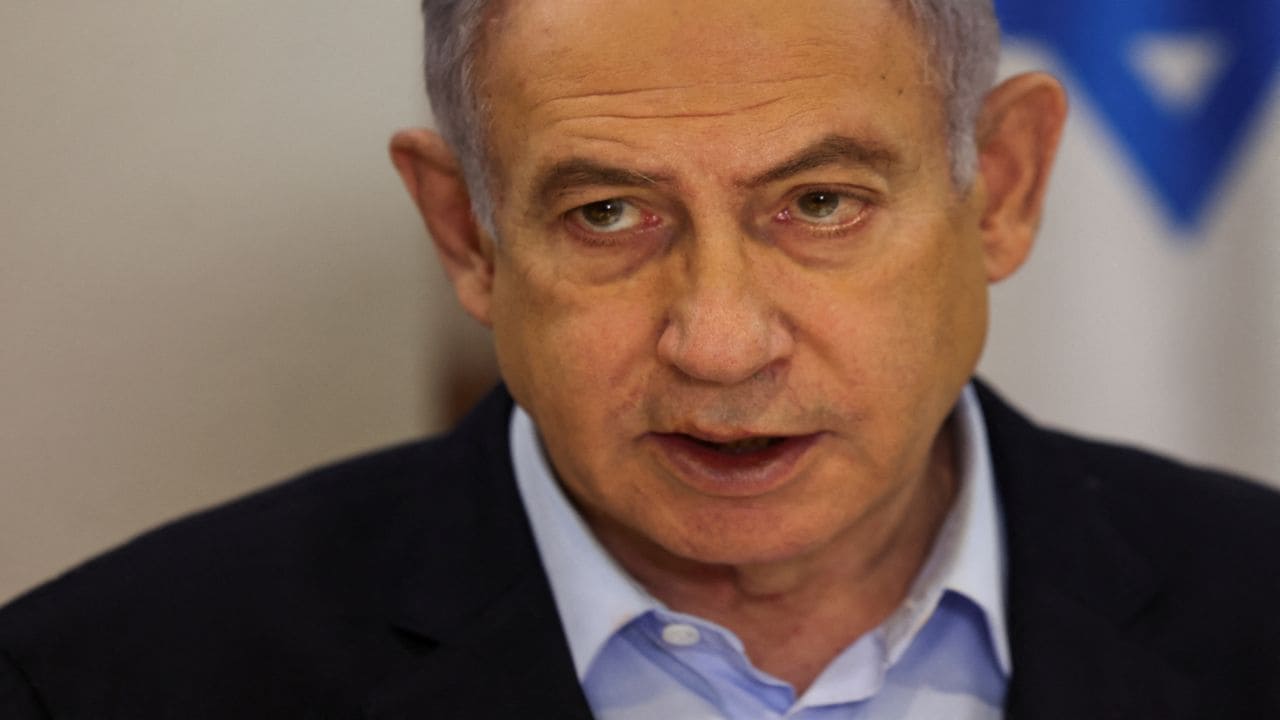
When Benjamin Netanyahu stands before a microphone to speak about Iran, the words are familiar. We have heard them in Washington. We have heard them at the United Nations, accompanied by literal cartoon bombs drawn on cardboard. Because of this repetition, it is easy for the outside world to treat the rhetoric as background noise. A standard political refrain. A predictable posture.
But down in the bunkers, and across the border in the centrifuges of Natanz, that noise is a countdown.
To understand the absolute vow that Iran will never obtain a nuclear weapon while Netanyahu holds the Prime Minister’s office, you have to look past the podium. You have to look at the human calculus of a man who views his entire existence through the lens of historical prevention.
The Shadow of the Basement
Imagine a scientist named Dariush. He is a hypothetical composite of the minds working within Iran’s nuclear program, but his daily reality is entirely real. Dariush does not think about grand geopolitical chess pieces. He thinks about the vibrational frequency of an IR-6 centrifuge. He worries about the cascade efficiency of uranium hexafluoride gas.
Every day, Dariush walks into a facility buried deep beneath a mountain, shielded by meters of reinforced concrete and anti-aircraft batteries. He is a family man who loves poetry, yet his life’s work is the refinement of isotopes. When he adjusts a valve, he is shortening a timeline.
Now shift the lens a few hundred miles to the west. Sit in a small apartment in Jerusalem where an elderly woman watches the news. She remembers a time before the state of Israel existed. She knows what it means when an adversary promises your elimination. For her, the phrase "existential threat" is not a talking point used to pass a budget. It is a visceral memory of a world that once permitted the unimaginable.
This is the gap Netanyahu operates within. His rhetoric bridges the technical precision of the scientist’s centrifuge with the deep-seated trauma of his nation's history.
When a leader states that a rival will never achieve a specific capability under their watch, they are drawing a line in the sand with a sword, not a pen. It creates a psychological trap for both sides. For Iran, it becomes a challenge of strategic patience—how far can they push the enrichment levels before the line is crossed? For Israel, it creates a rigid operational reality. If the line is breached, action is the only remaining currency.
The Geography of Peril
Distance changes everything.
If you live in London or New York, the concept of a nuclear-armed state in the Middle East is an abstract security concern. It is a headline to digest over morning coffee. For Israelis, the geography dictates a different kind of math. The distance between Tehran and Tel Aviv is roughly one thousand miles. A ballistic missile can traverse that distance in under fifteen minutes.
Fifteen minutes is not enough time to debate. It is barely enough time to reach a shelter.
This terrifyingly brief window explains why the Israeli doctrine—originally established by Prime Minister Menachem Begin in 1981—dictates that no adversarial nation in the region can be allowed to acquire weapons of mass destruction. It was applied in Iraq at the Osirak reactor. It was applied again in Syria in 2007.
But Iran is different.
The Iranian program is not a single, vulnerable reactor sitting exposed in the desert. It is a sprawling, decentralized network of facilities buried so deep within mountains that standard munitions cannot reach them. Fordow is carved into a mountain core. Natanz is subterranean. The knowledge is distributed across hundreds of minds like Dariush. You cannot bomb a thought. You cannot assassinate a mathematical formula.
This reality makes Netanyahu’s vow incredibly complex to execute. It requires a quiet, relentless campaign of friction.
Consider what happens when a centrifuge suddenly tears itself apart because its software was subtly altered by a line of code introduced months prior. Consider the sudden, unexplained explosion at a missile depot, or the ambush of a top nuclear scientist on a suburban road outside Tehran. This is the gray zone. It is a twilight war fought with magnets, cyber-payloads, and shadows. Netanyahu’s policy has long been to keep Iran perpetually off-balance, forcing them to rebuild what they have lost, dragging the timeline out year after year.
The Weight of the Chair
Power changes a person, but responsibility isolates them.
The Prime Minister’s office in Jerusalem is surprisingly modest. It does not possess the sweeping grandeur of the White House or the gilded history of the Elysée Palace. It feels like the office of a regional manager who has been given the keys to a kingdom under siege.
Netanyahu’s political longevity is tied directly to his presentation as the ultimate guardian. His supporters see him as the only figure capable of standing against global pressure, a leader who will look an American president in the eye and say "no" if he believes Israel’s survival is on the line. His detractors view this stance as an intentional strategy designed to maintain power by keeping the public in a state of perpetual anxiety.
Yet, regardless of domestic politics, the underlying calculation remains unchanged.
The real problem lies in the perception of certainty. When a leader declares that something will never happen on their watch, they remove their own room to maneuver. It is an intentional strategy. By publicly burning the bridge of compromise, Netanyahu signals to the international community that Israel will act alone if forced. It is a leverage play designed to compel western allies to maintain harsh sanctions, ensuring they know that the alternative to economic pressure is a regional conflagration.
But what happens when the calculations fail?
The Invisible Threshold
There is a technical term used by intelligence analysts: "breakout time." It is the amount of time required for a nation to produce enough weapons-grade uranium for a single nuclear device.
For years, that timeline was measured in months or years. Today, because of advanced centrifuges and accumulated expertise, that timeline is measured in weeks, sometimes days. Iran has enriched uranium to 60 percent purity—a short technical hop from the 90 percent required for a bomb. They are standing on the porch of the nuclear club, their hand resting on the doorknob.
They have purposely chosen not to turn it.
This is the nuance missing from standard news reports. Iran’s strategy is not necessarily to build a physical bomb tomorrow. The true value lies in becoming a "threshold state." By possessing the capability, the materials, and the knowledge to build a weapon at a moment's notice, they gain all the diplomatic leverage of a nuclear power without triggering the military strikes that would follow an actual test.
For Netanyahu, a threshold state is indistinguishable from a nuclear state. The line he has drawn does not distinguish between the capability and the artifact.
This creates a terrifying game of chicken. If Iran pushes enrichment a fraction higher, do the jets take off from Tel Aviv? Does the cyber-command press the button that drops the Iranian power grid into darkness? Or does the world adjust to a new, fragile reality where the Middle East exists under a nuclear umbrella held by an ideological regime?
The Unforgiving Ledger
Every decision made in this silent conflict is written in a ledger of consequences.
If Israel launches a massive preemptive strike, it might delay the Iranian program by two or three years. But the retaliation would be immediate. Thousands of rockets from Hezbollah in Lebanon would rain down on Israeli cities. The economy would halt. The regional stability would fracture entirely.
If Israel does not strike, and Iran crosses the threshold, the entire region will rush to arm itself. Saudi Arabia, Turkey, and Egypt will seek their own deterrents. The most volatile region on Earth would become a matrix of nuclear tripwires.
This is the choice that sits on the desk in the Kirya. It is not an abstract debate between hawk and dove. It is a choice between a certain war today or a catastrophic war tomorrow.
Netanyahu has staked his historical legacy on the belief that he can prevent both through sheer willpower and tactical disruption. It is a high-wire act performed without a net, over a canyon filled with explosives.
Late at night, when the cameras are turned off and the press releases have been archived, the maps remain on the wall. The hum of the servers continues. The scientists in Iran keep their eyes glued to the monitors, and the pilots in Israel continue their long-range fueling exercises over the Mediterranean. The vow remains fixed in the air, a heavy, unyielding promise that binds the fate of two nations to the movement of an isotope. The line has been drawn, the stakes are absolute, and the clock refuses to stop.


