Long before basketball became a global television spectacle of neon lights, high-flying acrobatics, and multi-million-dollar footwear contracts, it was a game played on the raw, unpolished edges of post-war America. Gymnasiums echoed with the sharp squeak of Chuck Taylors on splintered wooden floors, heat radiating from clanking radiators while cigarette smoke hazed the rafters. Into this gritty landscape stepped a lanky teenager from Baton Rouge who could not even make his high school varsity team as a sophomore.
His name was Bob Pettit. And he would quietly rewrite what it meant to conquer the hardwood.
When news broke that Pettit had passed away at the age of ninety-three, the sports world lost a living link to its foundational era. To understand Pettit is to understand a different planet of sport—an era where professional athletes worked offseason jobs to make ends meet, where travel meant cramped commercial propeller planes or grueling train rides, and where television cameras rarely captured the sweat equity poured into empty practice gyms.
Pettit was never supposed to be a titan. Cut from the varsity roster at Baton Rouge High for being too skinny, too uncoordinated, and seemingly lacking the natural gifts of a traditional athlete, he did what legends do when confronted with a closed door. He built a key. Every single day, long after the coaches had gone home and the gym lights were dimmed, he practiced. He rebounded his own missed shots until his arms burned. He refined a sweeping, one-handed jumper and learned how to leverage his slender six-foot-nine frame against heavy-handed bruisers who treated the paint like a war zone.
By his junior year, he made the team. By college, he was an All-American at LSU, drawing crowds that packed arenas just to watch a young phenomenon dominate the Southeastern Conference. But college was merely a prelude to a professional revolution.
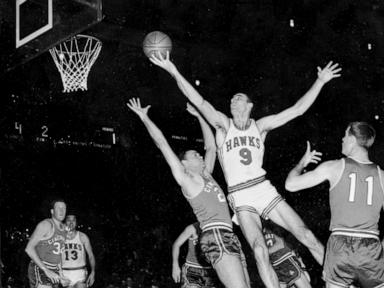
When Pettit entered the NBA in 1954—drafted by the Milwaukee Hawks before the franchise migrated south to St. Louis—the center position belonged exclusively to giants who played with their backs rigidly planted toward the basket, relying on brute force to drop the ball through a iron ring. Pettit changed the geometry of the game. Lean, graceful, and conditioned to a razor-thin edge, he stepped away from the rim. He faced the basket. He drove, he floated, and he out-jumped opponents who outweighed him by thirty pounds.
Consider what he achieved in an 11-year career where he was named an All-Star every single season. In 1956, the league introduced a brand-new accolade: the Most Valuable Player award. Before Bill Russell, before Wilt Chamberlain, before Kareem, Jordan, or LeBron, the very first name etched into the lineage of individual NBA immortality was Robert Lee Pettit Jr. He captured that inaugural MVP honor by leading the league in scoring, pumping in 25.7 points a night alongside a staggering 16.2 rebounds.
Numbers alone, however, fail to capture the sheer weight of his will.
The defining moment of his career arrived in the spring of 1958. The St. Louis Hawks stood toe-to-toe with the Boston Celtics juggernaut in the NBA Finals. The Celtics were building a dynasty, a terrifying green machine designed to crush opposition through relentless defense and depth. In Game 6, with the championship hanging in the balance, Pettit decided that defeat was simply not an option.
He scored fifty points that night. Fifty. On the road, in a hostile Boston Garden, against a legendary defense. When the final buzzer sounded, the Hawks had clinched a 110-109 victory and their first—and still only—franchise championship. It was a performance so monumental that decades later, it remains one of the greatest closing acts in finals history. Celtics legend Bill Russell famously remarked that Pettit was the ultimate competitor, a player whose relentless motor simply could not be extinguished.
Yet, perhaps the most striking chapter of Pettit’s story is what happened after the final whistle of his playing days blew in 1965. There were no multi-million-dollar broadcasting contracts waiting for him, no endless tour of celebrity endorsements. At the peak of his fame, walking away as one of the premier scorers the sport had ever witnessed, Pettit quietly packed his bags, returned to his native Louisiana, and went to work in banking and financial consulting.
He traded the hardwood for spreadsheets. He wore suits to the office, raised a family with his late wife Carole, and blended seamlessly into the fabric of Baton Rouge life. To the young bank customers who crossed paths with him, he was polite, unassuming, and soft-spoken. Most had no idea they were shaking hands with a pioneer who had permanently altered the DNA of professional basketball.
That was the essence of Bob Pettit. He did not demand a spotlight; he commanded respect through execution.
When modern fans look back at archival footage of those grainy black-and-white broadcasts, they see players launching set shots and referees in crisp trousers. It looks ancient, almost quaint compared to the high-definition acrobatics of today. But peel back the aesthetics, and the core truth remains entirely unchanged. Excellence is forged in solitude. It is built during the hours when nobody is watching, through bruised knees, missed shots, and an unyielding refusal to accept the boundaries that others try to set for you.
The bronze statue outside LSU's arena will weather through the Louisiana humidity. The retired jersey bearing the number nine will continue to hang quietly in the rafters of the arena in Atlanta. Generations of athletes will chase scoring titles, MVPs, and championship rings, standing tall on the broad shoulders of the men who laid the foundation.
The gym lights are out. The final buzzer sounded long ago. But the foundation Bob Pettit poured remains as solid as ever.
Basketball Hall of Famer Bob Pettit remembered
This video segment looks back at the extraordinary career and lasting legacy of the legendary Bob Pettit following his passing.