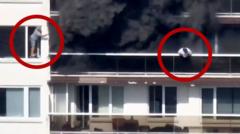
A dramatic escape from a burning apartment building in Antwerp, Belgium, captured on video as a man scaled down the exterior of a balcony to flee engulfing smoke, highlights a systemic failure in modern urban residential safety. While public attention immediately fixated on the individual's desperate survival instincts, the incident exposes a more troubling reality. Emergency response times, architectural design choices, and a reliance on singular escape routes are increasingly leaving high-rise residents vulnerable during fast-moving structural fires. This is not an isolated piece of dramatic footage, but a warning sign for metropolitan housing infrastructure across Europe.
The Illusion of the Fireproof High Rise
Modern apartment complexes are built under the assumption of containment. Regulatory frameworks across the European Union dictate that individual residential units must act as fire-rated boxes, theoretically keeping a blaze isolated for anywhere from 30 to 120 minutes. This concept, known as compartmentalization, is designed to allow emergency services time to arrive and extinguish the threat while neighbors remain safely inside their homes.
The Antwerp incident proved that theory does not always match reality.
When a fire spreads to the exterior facade or engulfs primary exit corridors, residents are instantly trapped. The architecture that was supposed to protect them becomes a cage. In the Antwerp case, the rapid accumulation of thick, toxic smoke forced an occupant onto the exterior balcony structure. This dynamic reveals a critical flaw in current building philosophies. We assume people can wait for help, but fire behavior often dictates otherwise.
The Mechanics of Exterior Spread
Exterior balconies and facades are frequently the weak link in modern building safety. Even when interior materials are strictly regulated, external elements can act as a highway for flames.
- The Chimney Effect: Recessed balconies can trap heat and channel smoke upward with intense velocity.
- Material Hazards: Thermal insulation, decorative cladding, and even synthetic balcony flooring can ignite, bypassing interior fire doors entirely.
- Upward Progression: Once a fire breaks out of a window, it naturally licks upward, threatening the immediate floor above within seconds.
Why Aerial Rescue is Hitting a Ceiling
Urban density is outpacing emergency response capabilities. As city centers grow denser and more vertical, municipal fire departments are facing unprecedented logistical hurdles that slow down the deployment of ladder trucks and aerial platforms.
Minutes matter. A standard aerial ladder truck requires significant space to stabilize its outriggers before extending its arm. In narrow European streets, frequently cluttered with parked cars, delivery vans, and low-hanging utility lines, positioning these massive vehicles is a logistical nightmare.
Furthermore, standard fire department ladders max out around 30 meters, roughly equivalent to the ninth floor of a building. Anything higher requires internal intervention by firefighters climbing the stairwells, a process that takes considerable time while occupants upper levels face deteriorating air quality.
The Problem with Retrofitted Urban Infrastructure
Older European cities are integrating high-density housing into historical layouts. The streets were designed for horses and carts, not 30-ton emergency vehicles. When a fire occurs, the physical constraints of the surrounding neighborhood directly dictate who lives and who dies.
If a truck cannot park safely due to street geometry, the aerial rescue option is off the table. Residents are then left with two choices: brave a smoke-filled internal stairwell or attempt a highly dangerous external descent, precisely as witnessed in the Antwerp escape.
The Flawed Logic of Stay Put Policies
For decades, fire safety professionals have advocated for the "stay put" strategy. The logic is simple: unless your specific apartment is on fire, you are safer inside with the doors closed than wandering into a smoke-filled hallway. This strategy prevents panic and keeps stairwells clear for ascending firefighters.
But this strategy relies on absolute perfection in construction and maintenance.
If a fire door is propped open by a resident, the containment system fails. If a utility pipe penetration was poorly sealed during a renovation, smoke penetrates adjacent units. The Antwerp footage shows the breaking point of this policy. When an occupant sees thick black smoke billowing into their living space, psychological panic overrides regulatory advice. They will choose the balcony, and if the balcony catches fire, they will jump or climb.
Technical Deficiencies in Residential Fire Mitigation
The global construction industry remains resistant to mandatory retrofitting of active suppression systems in residential blocks. While commercial office spaces are routinely fitted with comprehensive sprinkler systems, residential buildings face far laxer standards due to cost concerns raised by developers.
| Safety Feature | Commercial Standards | Residential Reality (Apts) |
|---|---|---|
| Automated Sprinklers | Mandatory in almost all modern jurisdictions | Rarely mandatory outside of high-rise luxury units |
| Dual Escape Routes | Standard requirement for large floor plans | Often reliant on a single central stairwell |
| Pressurized Stairwells | Common to keep smoke out of exit paths | Frequently absent in older or mid-rise complexes |
Sprinklers change the entire equation. They suppress a fire at its origin, preventing the rapid flashover that forces residents onto balconies in the first place. Yet, lobbying efforts consistently frame residential sprinklers as an unnecessary financial burden, shifting the responsibility of survival onto municipal emergency services and individual luck.
Rethinking Personal Escape and Structural Accountability
Relying on structural permanence is a gamble that urban planners are currently losing. If cities continue to permit high-density, vertical developments, the baseline requirements for tenant survival must change.
First, the single-stairwell design dominant in many European apartment blocks needs a critical re-evaluation. A single point of failure in an emergency exit route is unacceptable. If that stairwell fills with smoke due to a single failed fire door, every resident above the fire floor is compromised.
Second, developers must be held legally and financially accountable for the lifetime performance of fire barriers. Post-construction modifications by tenants or utility companies often compromise the integrity of fire rating zones without anyone noticing until disaster strikes. Regular, destructive testing of fire barriers should be a standard component of building code enforcement, rather than relying on visual inspections that miss hidden gaps behind drywall.
The terrifying footage from Antwerp should not be viewed as a spectacular feat of individual survival. It is a stark indictment of a system that allowed a resident to be backed into a corner where climbing down a multi-story exterior wall was the only logical choice left.