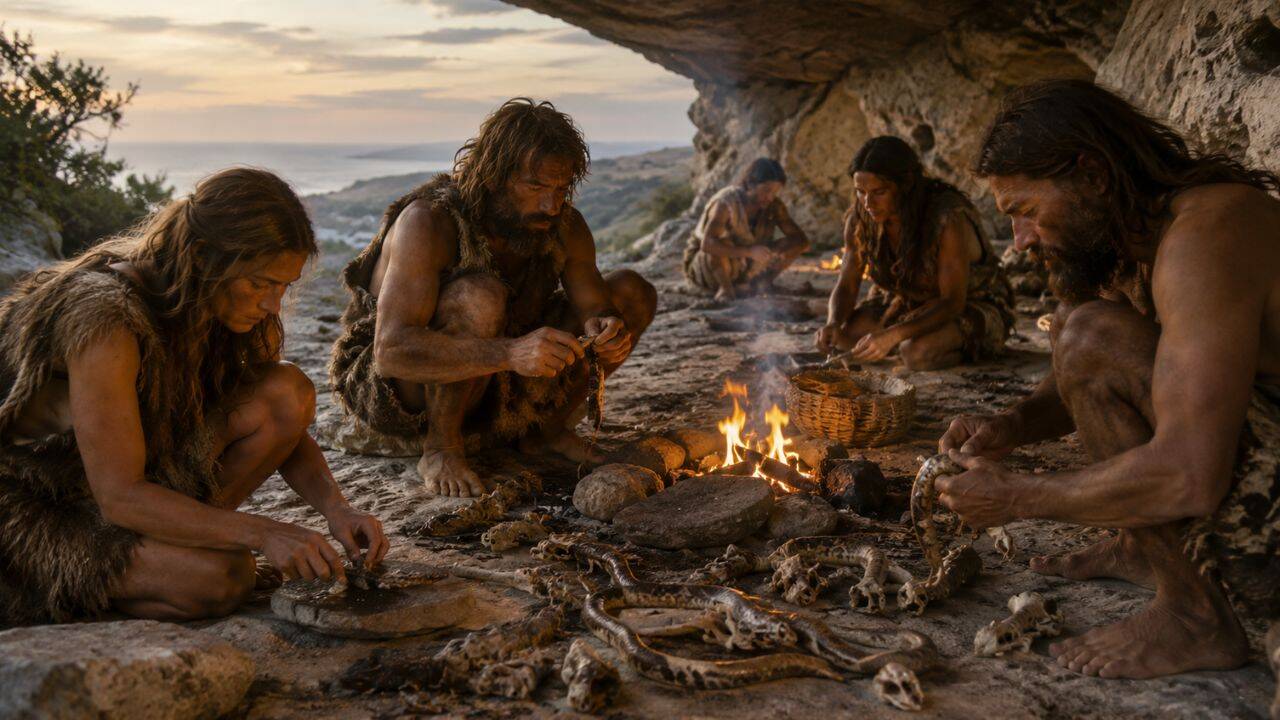
History books love a good mammoth story. We picture ancient humans huddled around massive campfires, roasting giant beasts and carving up prime steaks from creatures that weigh several tons. It paints a grand picture of prehistoric survival.
Reality was far messier.
About 15,000 years ago, ancient foragers living in the Levant region—modern-day Israel—weren't just hunting big game. They were eating snakes, lizards, birds, and small rodents by the thousands. Recent archaeozoological studies from sites like Hayonim Cave in the Galilee show a dramatic shift in human diet during the Natufian culture. When the environment changed and large animals became scarce, these ancient populations didn't panic. They adapted. They simply looked down at the dirt and started treating reptiles as a primary food source.
You rarely hear about this part of human history. Why? Because small bones don't look as impressive in a museum display case as a massive woolly mammoth tusk.
The Natufian Shift Toward Small Prey
Let's talk about the Natufians. These folks lived right on the cusp of the agricultural revolution, bridging the gap between mobile hunter-gatherer bands and the first permanent farming villages. They built stone houses, stored wild grains, and apparently, had a serious appetite for reptiles.
Zooarchaeologists examining micro-fauna remains from this era found thousands of burned and cut reptile bones. We are talking about agile whip snakes, massive spur-thighed tortoises, and various lizards. These weren't accidental inclusions in the archaeological record where a snake happened to die in a cave. The burn marks tell a clear story of human roasting, skinning, and consumption.
Why make the effort? Catching a snake or a lizard takes actual skill. You can't just throw a spear at a skink from twenty yards away. You need to know where they bask, how to trap them, and how to handle venomous species safely.
It tells you something fundamental about human resourcefulness. When big game hunting became inefficient due to climate shifts and over-hunting, our ancestors expanded their menu instead of starving. They wrangled cold-blooded prey and turned it into routine calories.
What Zooarchaeology Teaches Us About Survival
Most people assume prehistoric diets were top-heavy with red meat. That assumption is dead wrong.
If you look at the actual refuse left behind in ancient Levantine rock shelters, small game made up a massive percentage of daily caloric intake. Tortoises were practically the canned food of the Upper Paleolithic—slow-moving, packed with protein, and easy to harvest in bulk. Lizards and snakes provided quick, reliable protein when tracking a gazelle for three days yielded nothing.
The transition from large mammals to broad-spectrum diets marked a massive turning point in human evolution. It required a complete redesign of tools and gathering techniques. People started making smaller microliths, fine nets, and woven baskets designed to catch fast, small creatures.
You see the same pattern across the globe whenever human populations grow and large mammals disappear. People innovate. They stop looking at the horizon for the next big herd and start paying attention to the ecosystem right under their feet.
The Modern Disconnect From Our True Diet
We like to sanitize our food history. Walk into any modern supermarket, and the meat is shrink-wrapped, deboned, and completely divorced from any living animal. We buy chicken breasts and beef tenderloins, forgetting that for 99 percent of human history, eating meant consuming whatever was available, accessible, and manageable.
Eating snakes and lizards sounds shocking to a modern urban palate. Yet, reptile meat remains a staple in many parts of the world today. It is lean, high in protein, and environmentally efficient to produce compared to cattle.
The Natufians understood something we often forget. Food is energy, and survival rewards flexibility. Refusing to eat certain animals because of cultural squeamishness is a luxury of modern abundance.
Next time you think about ancient diets, ditch the mammoth myth. Picture a Natufian hunter carefully lifting a flat stone in the dry hills of the Galilee, searching for dinner. That grit built the foundation for everything we have today.