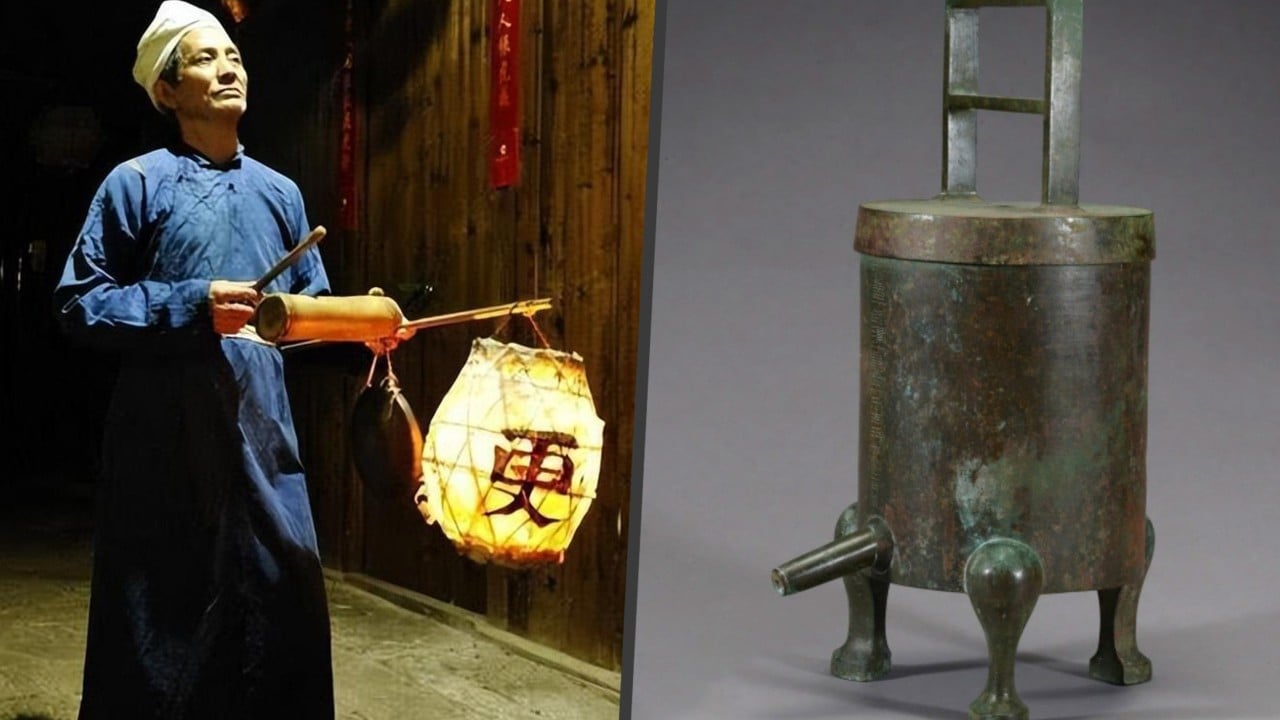
Before smartphones, mechanical clocks, or streetlights existed, walking through a Chinese city after sundown could get you arrested on the spot. Most people think ancient cities went completely dead once the sun dropped below the horizon. They didn't. Behind closed wooden gates and darkened alleyways, a specialized workforce stayed wide awake, tracking every passing hour with nothing more than dripping water, burning incense, and wooden clappers.
These men were the gengfu (更夫)—the ancient Chinese night watchmen. If you've ever watched a historical Chinese drama and heard someone shouting "Tian gan wu zao, xiao xin huo zhu!" ("The weather is dry, watch out for candles!"), you've heard a tiny echo of their actual job. The reality behind how they patrolled streets and measured time is far more ingenious than television makes it look.
Why Ancient Chinese Cities Locked Down at Night
To understand the night watchman's job, you have to understand how ancient Chinese urban planning worked. From the Tang Dynasty (618–907 CE) through the Ming and Qing dynasties, major cities like Chang'an, Kaifeng, and Beijing operated under strict curfew systems known as xiaojin (宵禁).
Cities weren't sprawling, open grids like modern metropolises. They were divided into walled residential wards called lifang (里坊). Once the evening drums sounded at dusk, the heavy wooden gates of each ward slammed shut and bolted from the outside. Nobody went in. Nobody came out.
Breaking curfew wasn't a minor misdemeanor. Under Tang legal codes, wandering the streets after the evening drum without an official permit earned you twenty blows with a bamboo rod. If you climbed over a ward wall, the punishment jumped to seventy blows. The state wanted total control over movement after dark to prevent theft, arson, and political conspiracies.
That left a massive logistical problem. If thousands of residents were locked inside wooden-framed houses using oil lamps and charcoal braziers for heat, how did the city prevent catastrophic fires or stop thieves who bypassed the walls?
Enter the night watchmen. They were the sole legal presence on the silent streets, acting simultaneously as timekeepers, fire marshals, and beat cops.
The Five Watches of the Chinese Night
Ancient China didn't divide the day into twenty-four equal hours the way we do now. Instead, timekeepers split the entire twenty-four-hour cycle into twelve double-hours called shichen (时辰), each equivalent to two modern hours.
Nighttime specifically fell into five distinct intervals known as geng (更), or "watches." Each watch lasted roughly two hours, running from 7:00 PM to 5:00 AM.
Here is how the night broke down:
- First Watch (Yigeng, 7:00 PM – 9:00 PM) was called huanghun (dusk). The curfew drums beat, ward gates closed, and people settled in for the night.
- Second Watch (Ergeng, 9:00 PM – 11:00 PM) was rending (people settling). Household lights went out, and the streets went completely quiet.
- Third Watch (Sangeng, 11:00 PM – 1:00 AM) was yeban (midnight). This was the deepest, coldest part of the night—and the prime window for burglars.
- Fourth Watch (Sigeng, 1:00 AM – 3:00 AM) was jiming (rooster crowing). Exhaustion hit the watchmen hardest here.
- Fifth Watch (Wugeng, 3:00 AM – 5:00 AM) was pingdan (dawn). Morning drums sounded at the end of this watch, unlocking the city gates for merchants and farmers.
Every single watch had to be announced aloud across the entire city. Without a reliable way to track those two-hour blocks in total darkness, the whole system would collapse into chaos.
How Dripping Buckets Actually Told Time
You can't look at a sundial at midnight. Candle clocks burned inconsistently when drafts blew through guard towers. So Chinese engineers perfected the louhu (漏壶), or water clock—literally a "dripping pot."
The basic concept sounds deceptively simple. Water drips steadily from a perforated vessel into a collection basin, raising a floating wooden indicator stick marked with graduated notches. Watch the stick rise, read the mark, and you know what watch it is.
In practice, physics gets in the way fast. A single bucket full of water drains quickly at first because the water pressure at the bottom is high. As the water level drops, pressure decreases, and the dripping slows to a crawl. A single dripping bucket loses accuracy within an hour.
Chinese horologists solved this fluid dynamics problem centuries before European clockmakers caught up. During the Han Dynasty, inventors introduced multi-tiered cascading water clocks. Instead of one bucket, they stacked three or four bronze or copper vessels like a staircase.
The top reservoir fed water into an overflow tank beneath it. That middle tank featured a small overflow spout near the rim that drained excess water away, keeping the water level—and therefore the downward water pressure—completely constant. That stabilized tank then dripped at a dead-even rate into the bottom measuring cylinder.
By the Song Dynasty (960–1279 CE), imperial astronomers like Su Song built monumental water-driven astronomical clock towers in Kaifeng that used escapement mechanisms—predating European mechanical escapements by over two hundred years. Meanwhile, down at the neighborhood guardhouses, watchmen relied on simpler, rugged bronze louhu sets staffed by dedicated water-tenders who kept the top reservoirs topped up and adjusted the floats for seasonal temperature changes.
When water froze in northern winters, watchmen switched to fine sand or specialized incense sticks calibrated to burn at exact rates.
Gear and Routine on a Midnight Patrol
Watching the dripping bucket was only half the job. Someone had to walk the freezing, pitch-black alleys to prove the city was still standing.
A night watchman didn't carry heavy armor or swords. Usually drawn from the lower economic rungs of society, gengfu wore thick, padded cotton coats to survive winter chills and carried three essential tools:
- The Bangzi (梆子) — A hollowed-out block of hard wood, typically jujube or locust wood, struck with a wooden mallet. It produced a sharp, dry clack-clack sound that carried cleanly down narrow stone alleys without waking heavy sleepers unnecessarily.
- A Small Bronze Gong (Luo) — Paired with the wooden clapper to signal the exact watch number.
- An Oil-Paper Lantern — Dim enough not to blind the watchman's night vision, bright enough to check door bolts and spot smoke curling out of wooden eaves.
The audio code was strict. Watchmen didn't just bang randomly. They used a rhythmic combination of drum/gong strikes and wooden clapper beats to broadcast the exact time to anyone lying awake in bed.
For the First Watch, the watchman struck the gong once, followed by one slow beat on the wooden clapper (yi luo yi bang). By the Third Watch—midnight—the pattern changed to three gong strikes followed by three rapid clapper beats. People lying in the dark didn't need to open their eyes or light a candle to know whether it was 11:30 PM or 3:30 AM. They just counted the beats outside their window.
Why Fire Prevention Mattered More Than Catching Thieves
Modern movies portray night watchmen constantly fighting rooftop assassins. Real historical records tell a very different story.
The number one enemy of an ancient Chinese city wasn't a martial arts master. It was a knocked-over oil lamp.
Traditional Chinese architecture relied heavily on timber framing, wooden lattice windows covered in oiled paper, and densely packed courtyard homes. A single unattended kitchen ember in the middle of the Second Watch could burn down an entire residential ward before dawn. In 1201 CE, a massive fire in the Southern Song capital of Lin'an (modern Hangzhou) burned for four straight days, destroying over fifty thousand buildings and leaving tens of thousands homeless.
Because of disasters like that, fire prevention sat at the very top of a watchman's checklist. As they walked their beats, they sniffed the air for woodsmoke, checked courtyard walls for stray sparks, and yelled standardized safety reminders into the dark.
Their chants weren't poetic improvisation. They were public service announcements tailored to the weather. On dry, windy autumn nights, they shouted warnings to extinguish candles and cover charcoal stoves before sleeping. During heavy summer rainstorms, they switched their chants to warn residents about leaking roofs, collapsing mud walls, and flooded drainage ditches.
The Brutal Reality of the Watchman's Life
Romanticizing the gengfu is easy until you look at their actual working conditions. It was widely considered one of the hardest, worst-paid jobs in imperial China.
Watchmen worked every single night while everyone else slept, ruining their circadian rhythms permanently. They patrolled through sub-zero Beijing blizzards, torrential southern monsoons, and oppressive summer humidity. Because they carried minimal weapons, stumbling across armed burglars or desperate bandits meant serious danger.
Local governments also held watchmen strictly liable for crimes committed on their beat. If a wealthy merchant's house got robbed during the Third Watch and the watchman failed to spot the intruders or raise the alarm, the local magistrate frequently threw the watchman in jail or ordered him flogged for negligence.
Pay came from a mix of meager municipal stipends and small monthly fees collected directly from neighborhood households. During holidays like Lunar New Year, watchmen would beat celebratory rhythms outside wealthy gates hoping for red envelopes containing a few copper coins or leftover holiday pastries. Many worked secondary jobs during the day—repairing shoes, carrying water, or sweeping streets—just to feed their families.
What Happened to China's Night Watchmen
The gradual disappearance of the night watchman happened alongside the collapse of walled urban curfews and the arrival of modern technology.
Actually, the strict curfew system began loosening much earlier than most people realize. During the Song Dynasty, booming commercial trade forced authorities to abolish the rigid lifang ward walls in major commercial hubs like Kaifeng and Hangzhou. Night markets exploded with street food vendors, wine shops, and storytelling theaters staying open until the Third or Fourth Watch. Even then, watchmen remained essential for timekeeping and fire patrols.
The real end arrived in the late nineteenth and early twentieth centuries. Western mechanical pocket watches, municipal clock towers, electric streetlights, and organized modern police forces made human timekeepers obsolete. By the 1930s, the sound of the wooden bangzi had vanished from major cities like Shanghai and Beijing, lingering only in remote rural towns into the mid-twentieth century.
Today, you can still see surviving multi-tiered bronze louhu water clocks preserved at the Palace Museum in Beijing and the National Museum of China. If you visit historic old towns like Pingyao in Shanxi Province or Lijiang in Yunnan, you'll occasionally spot costumed performers walking the stone streets at dusk striking wooden clappers for tourists.
Next time you glance at your phone screen at 2:00 AM without thinking twice, remember the gengfu—the underpaid night owls who stood beside dripping bronze buckets in the freezing dark just so an entire city could sleep safely until dawn.