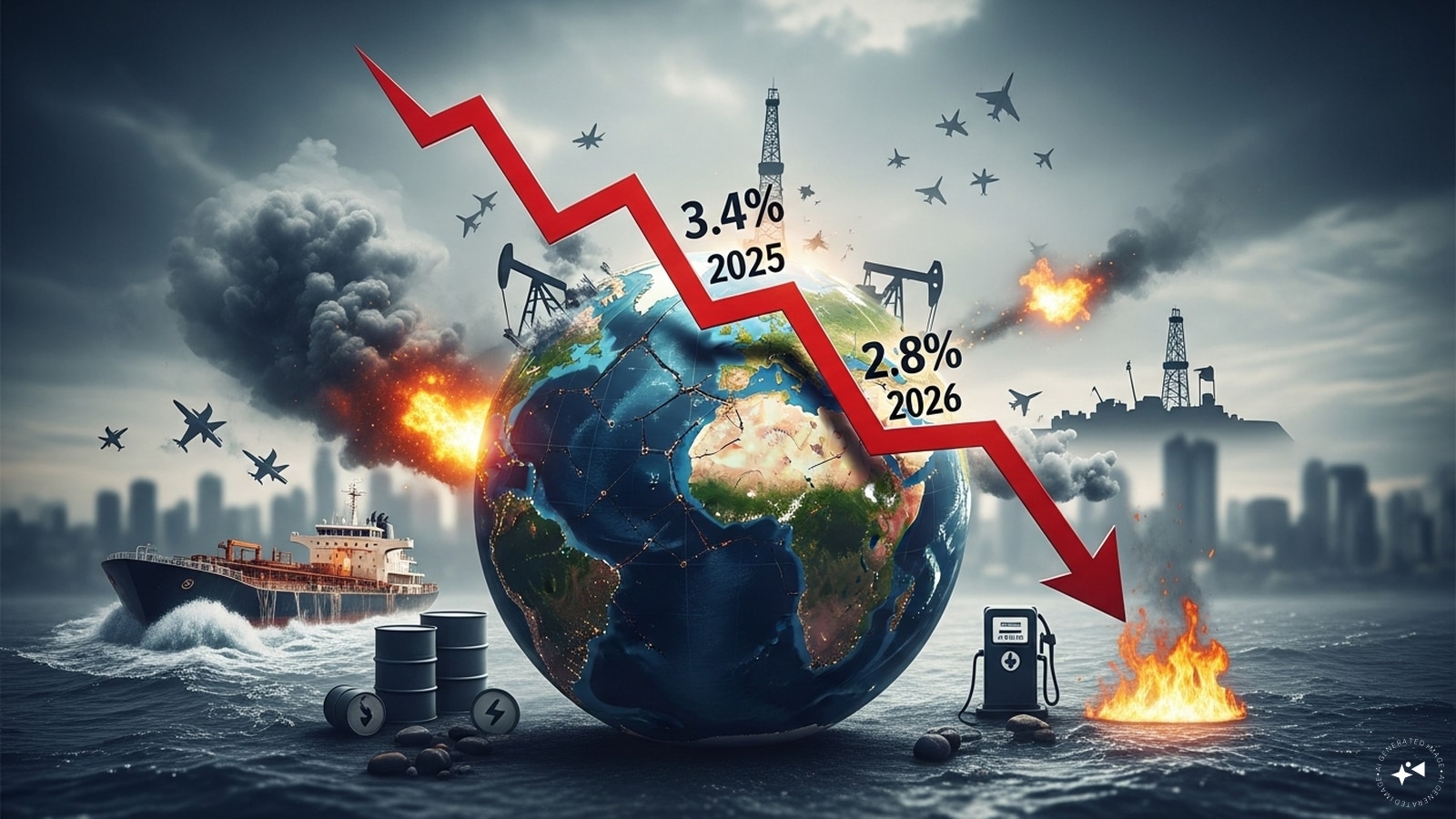
The global economy is entering a structural bottleneck where geopolitical friction directly degrades industrial capacity and distorts capital allocation. The latest Organisation for Economic Co-operation and Development (OECD) Economic Outlook establishes that the US-Iran conflict has bypassed localized disruption to become the primary variable anchoring macroeconomic projections. By analyzing the transition from a 3.4% global GDP growth rate in 2025 down to divergent 2026 paths, we can map the exact transmission mechanisms converting a regional maritime chokepoint crisis into systematic global stagflation.
The core vulnerability relies on the structural dependence of global trade on the Strait of Hormuz. When an energy chokepoint of this magnitude experiences sustained operational friction, the economic fallout does not manifest as a simple price increase; it functions as a supply-side tax that cascades through complex global value chains, resetting corporate cost structures and forcing central banks into a destructive policy trade-off.
The Dual Transmission Vectors: How Chokepoint Friction Destabilizes Growth
To accurately measure the macroeconomic degradation, the crisis must be separated into two distinct operational vectors: the primary energy supply constraint and the secondary industrial input shortage. Traditional commentary conflates these dynamics under the vague umbrella of "market instability," yet their operational pathways are profoundly different.
Vector 1: The Energy Supply Contraction and Forced Rationing
A near-complete closure of the Strait of Hormuz creates an immediate, non-linear deficit in global crude oil and liquefied natural gas (LNG) inventories. The OECD framework models this through two distinct operational horizons:
- The Time-Limited Disruption Horizon: This path assumes regional energy production and maritime infrastructure return to baseline capacity by the third quarter of 2026. Under this assumption, global GDP growth decelerates to 2.8% in 2026 before recovering to 3.1% in 2027. G20 inflation climbs to 4.0% before stabilizing.
- The Prolonged Disruption Horizon: If hostilities extend well into 2027, the structural supply deficit forces absolute volume constraints. Global GDP growth collapses to 2.1% in 2026 and contracts further to 1.8% in 2027—a contraction level historically reserved for systemic financial panics.
The prolonged horizon triggers an economic mechanism known as enforced rationing. When physical volumes of hydrocarbons fall below minimum industrial thresholds, price mechanisms alone fail to clear the market. Governments are forced to implement administrative allocations of power. Industrial manufacturing operations face rolling shutdowns, directly lowering the global aggregate supply curve.
Vector 2: The Industrial Input Multiplier
The disruption to hydrocarbon extraction severely truncates the production of down-stream industrial inputs. Hydrocarbon processing yields vital secondary materials that form the base of global manufacturing:
- Sulphur and Fertilizers: A direct byproduct of oil and gas refining, restricted sulphur production drives up the marginal cost of agricultural fertilizers. This creates a lagged food production shock, disproportionately lowering real household disposable income in emerging economies where food commands a high share of consumption.
- Helium and Industrial Gases: Crucial for semiconductor fabrication and advanced cooling systems, shortages in these trace inputs create immediate assembly bottlenecks in electronics supply chains, uncoupling production timelines from consumer demand.
The Technology Bottleneck: Destabilizing the AI Capital Expenditure Loop
The prevailing economic narrative throughout 2025 attributed resilient growth to a sustained capital expenditure boom in artificial intelligence (AI) infrastructure. The prolonged US-Iran conflict introduces a severe supply-side constraint that threatens this investment loop through an unfavorable shift in data center economics.
Data centers are highly sensitive to power infrastructure costs. In a prolonged disruption scenario, the marginal cost per megawatt-hour escalates sharply. This operational cost spike occurs simultaneously with hardware supply chain constraints caused by industrial gas shortages. The intersection of these two forces alters the return-on-investment (ROI) calculations for major technology firms.
When data center operating costs shift upward while physical hardware deployments are delayed by supply shortages, the capacity and incentive for high-scale capital expenditure degrades. The resulting deceleration in AI investment removes a core productivity tailwind, exposing underlying structural weaknesses in developed economies—particularly the United States, where growth is projected to slow to 2.0% in 2026 and contract to 1.8% in 2027 under stress conditions.
The Monetary Policy Dilemma: Asymmetrical Liquidity Shocks
Central banks are facing an acute policy bottleneck characterized by conflicting economic signals. Supply-driven inflation cannot be efficiently corrected via traditional demand-side monetary tightening without inflicting disproportionate damage on employment and output.
                  [Geopolitical Shock / Strait of Hormuz Closure]
                                        |
                         [Supply-Side Hydrocarbon Deficit]
                                        |
                 -----------------------------------------------
                |                                               |
     [Energy & Input Price Spikes]                   [Forced Industrial Rationing]
                |                                               |
     [Elevated G20 Inflation]                        [Aggregate Output Contraction]
                |                                               |
                 -----------------------------------------------
                                        |
                        [Central Bank Policy Dilemma]
                                        /       \
                                       /         \
    [Option A: Rate Hikes (50-75 bps)]             [Option B: Maintain / Cut Rates]
                    |                                               |
    [Anchors Inflation / Deepens Recession]        [Exacerbates Second-Round Inflation Spikes]
The Cost of Inflation Anchoring
Under the milder, time-limited scenario, monetary authorities can look through temporary supply spikes, provided long-term inflation expectations remain anchored. However, under the prolonged disruption scenario, price pressures broaden into second-round effects as businesses pass structural energy costs down to consumers.
The OECD framework indicates that to prevent an unanchoring of inflation expectations, central banks in most major economies would be required to execute interest rate increases of 50 to 75 basis points in 2026. Raising borrowing costs into an energy-constrained slowdown risks accelerating a corporate debt crisis.
The $90 Trillion G20 Corporate Debt Wall
The systemic vulnerability of this monetary tightening is concentrated in corporate balance sheets. Total corporate debt across G20 economies reached $90 trillion by the third quarter of 2025. Crucially, 25% of this total volume is scheduled to mature within the next three years.
A sharp, policy-driven interest rate increase forces corporations to refinance legacy, low-yielding debt at significantly higher marginal rates. This debt service expansion shifts corporate capital away from productive investment and toward balance-sheet preservation.
Furthermore, this stress concentrates within the opaque private credit sector. Unlike highly regulated commercial banking sectors, private credit funds feature interconnected asset structures and less stringent liquidity reserves. A rapid wave of corporate downgrades or defaults within these private portfolios presents severe cross-market spillover risks, potentially forcing central banks to halt quantitative tightening and unexpectedly deploy emergency quantitative easing or targeted long-term refinancing operations to avoid a systemic credit freeze.
Structural Vulnerabilities in Emerging and Developed Markets
The economic consequences of the conflict do not distribute symmetrically. The severity of the damage is dictated by an economy's fiscal capacity, currency fragility, and net energy balance.
| Economic Variable | Developing / Emerging Economies | Developed / Surplus Economies (e.g., US) |
|---|---|---|
| Energy Consumption Profile | High share of food and energy in household consumption; limited reserves. | Lower relative share of essential consumption; strategic reserves present. |
| Fiscal Capacity | Constrained; elevated debt-to-GDP limits capacity for household energy subsidies. | Higher fiscal headroom, though limited by legacy pandemic and climate debt. |
| Currency Dynamics | Fragile; structural capital flight drives depreciation, exacerbating imported inflation. | Reserve currency status insulates against severe capital flight dynamics. |
| Domestic Energy Balance | Net importers face direct balance-of-payments crises. | Net exporters (e.g., US natural gas surplus) enjoy a relative cost advantage. |
This divergence creates a fragmented global landscape. While the United States faces decelerating growth and localized margin compression, emerging markets face structural balance-of-payments crises. Because their currencies depreciate against a strengthening US dollar, their real cost of importing dollar-denominated energy increases exponentially, compounding domestic inflationary pressures.
The Strategic Playbook for Asset Allocation and Supply Chain Architecture
Relying on short-term political resolutions or temporary government interventions is an unviable strategy for corporate and institutional planners. Broad-based fiscal interventions—such as artificial price caps or untargeted tax cuts—are fundamentally counterproductive; they artificially sustain energy demand during a physical supply crunch, worsening the underlying deficit while increasing sovereign debt burdens.
Strategic execution must pivot toward structural resilience:
- Supply Chain Decoupling from Single Chokepoints: Organizations must audit their direct and indirect exposure to the Strait of Hormuz. This requires shifting sourcing for industrial inputs—specifically chemical fertilizers, sulphur, and specialized industrial gases—toward geographic regions independent of Middle Eastern maritime corridors.
- Accelerated Energy Efficiency and Self-Sourcing: Industrial operators must transition from a variable-cost energy model to a localized, self-contained energy framework. Investing in dedicated on-site renewable generation and high-density battery storage eliminates vulnerability to grid-enforced energy rationing.
- Capital Structure De-risking: Given the high probability of a 50 to 75 basis point rate hike cycle under prolonged stress, corporate treasuries must aggressively extend debt maturities before the 2026–2027 wall arrives. Relying on floating-rate private credit or short-term commercial paper introduces unhedged systemic risk to capital structures.