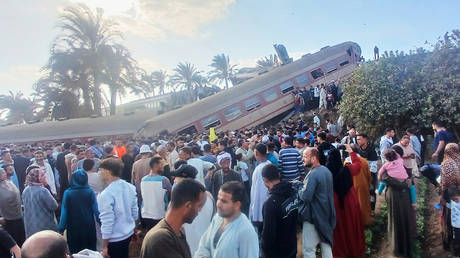
Seven fatalities from a dual-train collision in Egypt represent the predictable output of a rail network operating beyond its signaling and maintenance thresholds. Standard news coverage treats these crashes as isolated tragedies, cataloging immediate casualty figures and viral video footage while ignoring the structural variables that make collisions statistically inevitable. To understand why Egyptian National Railways (ENR) continues to experience high-severity incidents despite multi-billion-dollar capital injections, the event must be deconstructed through systems engineering, failure mode analysis, and operational economics.
When two trains occupy the same block of track simultaneously, the failure is rarely singular. It is almost always a cascade across three distinct operational layers: physical signaling infrastructure, human-machine interface protocols, and rolling stock maintenance cycles. Treating the crash as merely a "train collision" obscures whether the root cause was a legacy mechanical interlocking failure, a bypassed Automatic Train Protection (ATP) system, or a dispatch communication breakdown under single-track bottleneck conditions.
The Mechanics of Single-Block Occupancy Failures
Rail safety relies on a foundational principle: spatial separation enforced by time and block signaling. A rail line is divided into discrete segments, or "blocks." Only one train is permitted inside a block at any given moment. In modern networks, track circuits or axle counters detect a train's presence and automatically set the preceding signal to red, physically preventing a second train from entering via automated braking enforcement.
In the Egyptian rail corridor, particularly outside the newly modernized Cairo-Alexandria main trunk, large stretches of track still rely on legacy mechanical signaling or aging relay-based interlocking systems installed decades ago. These systems create three primary vulnerabilities:
- Manual Dispatch Dependencies: Where automated track circuits fail due to corrosion, ballast contamination, or copper theft, stationmasters revert to manual "paper-line-clear" or telephonic dispatch protocols. Human error rates in manual block allocation spike exponentially under high-traffic conditions.
- Degraded Braking Distances: Freight and older passenger rolling stock frequently operate with uneven brake-shoe wear or compromised pneumatic air-brake lines. A train traveling at 80 kilometers per hour requires roughly 800 to 1,000 meters to come to a complete stop. If a signal aspect is obscured by dust, glare, or poor maintenance, the kinetic energy cannot be dissipated before impact.
- ATP Override Culture: Even on corridors equipped with Automatic Train Control (ATC) or European Train Control System (ETCS) Level 1 equivalents, operational pressures often lead drivers to isolate or override onboard safety computers. When wayside transponders transmit false restrictive codes due to poor calibration, drivers face a binary choice: allow the system to trigger an emergency brake application that stalls network throughput, or switch the system to "isolated" mode to maintain schedule adherence. Once isolated, the safety net vanishes entirely.
The kinetic physics of a collision between two heavy rail consists are unforgiving. Unlike automotive crashes, where crumple zones absorb energy over milliseconds, steel-wheeled railcars transmit shockwaves directly through rigid couplers. When a locomotive strikes a stationary or slower-moving passenger consist, the trailing carriages experience violent deceleration. Without modern crash-energy management (CEM) anti-climbers, the chassis of one car overrides the frame of the next, causing telescoping—the catastrophic crushing of passenger compartments that accounts for the high fatality-to-passenger ratio in these events.
The Capital Allocation Paradox in Rail Modernization
A recurring misconception in public reporting is that Egypt's rail accidents stem from a lack of financial investment. In reality, the Egyptian Ministry of Transport has executed massive capital expenditure programs over the past decade, procuring new locomotives from Western manufacturers, overhauling passenger coaches, and contracting international firms to upgrade signaling along the Nile Valley corridor.
This creates a dangerous transitional state known in infrastructure management as the "hybrid-network trap."
- Asymmetric Velocity Profiles: Introducing high-horsepower modern locomotives onto tracks shared by aging, slow-moving freight and commuter trains widens the speed differential across the network. Higher closing speeds reduce the margin for error when dispatch mistakes occur.
- Brownfield Integration Friction: Upgrading signaling on an active, heavily utilized rail line—a brownfield project—is vastly more complex than building a new greenfield high-speed line. During the multi-year transition, drivers must navigate shifting rulebooks, transitioning from automated cab-signaling zones directly into dark or mechanically signaled territories within a single shift.
- The OpEx Deficit: Capital expenditure (CapEx) buys new trains and signaling hardware; operational expenditure (OpEx) funds the daily inspection of rail fasteners, ultrasonic testing for internal rail flaws, and the continuous recalibration of wayside sensors. Political and institutional incentives heavily favor visible CapEx announcements over invisible OpEx maintenance budgets. When OpEx lags behind CapEx, brand-new rolling stock deteriorates rapidly on poorly tamped track geometry.
The relationship between track geometry and derailment or collision risk is direct. High temperatures in Upper and Lower Egypt induce thermal expansion in continuous welded rail. Without precise ballast tamping and stress-free temperature management, rails buckle laterally—a phenomenon known as sun kinks. If a train encounters a sun kink at speed, it derails into the adjacent track's loading gauge, creating an immediate obstruction for oncoming traffic on double-track lines.
Human Factors and Organizational Drift
Standard post-accident investigations in state-owned rail monopolies overwhelmingly attribute blame to frontline operators: the locomotive engineer who passed a signal at danger (SPAD) or the signalman who threw a switch prematurely. From an operational risk perspective, blaming the operator is a diagnostic dead end.
In high-reliability organizations, a SPAD event is treated as a symptom of systemic interface failure rather than isolated negligence. Several organizational factors degrade operator vigilance across long-haul rail networks:
- Fatigue and Shift Scheduling: Chronic shortages of certified locomotive engineers force remaining personnel into extended shift rotations. Cognitive fatigue impairs visual scanning and delays reaction times when interpreting distant semaphore or color-light signals.
- Alarm Fatigue: In cabs retrofitted with mismatched telemetry and safety alerts, frequent nuisance alarms desensitize drivers. When an audible warning sounds every few minutes due to a faulty sensor, the human brain filters it out as background noise, masking genuine critical alerts.
- Punitive Reporting Cultures: When frontline staff face severe criminal liability or immediate dismissal for reporting near-misses or equipment defects, systemic vulnerabilities remain hidden until they align to cause a fatal crash. Without a non-punitive reporting mechanism—similar to the Aviation Safety Reporting System—management operates blind to daily operational workarounds.
These variables interact according to James Reason’s Swiss Cheese Model of accident causation. Every defensive layer—track maintenance, signaling hardware, cab telemetry, dispatch verification, and driver alertness—contains holes. Most days, the holes do not align, and trains arrive safely despite degraded equipment. A fatal collision occurs only when a transient failure in human attention aligns precisely with a latent defect in signaling or braking hardware.
Limitations of Technological Fixes
Deploying advanced signaling technology such as ETCS Level 2 or Positive Train Control (PTC) is frequently prescribed as the definitive solution to rail collisions. Operational reality demonstrates that technology cannot compensate for foundational institutional deficits.
First, advanced signaling relies on continuous, high-integrity power and telecommunications infrastructure. In environments prone to power fluctuations, extreme ambient heat, and physical vandalism of trackside fiber-optic cables, high-tech systems frequently degrade to fallback modes. Fallback modes are inherently slower and more reliant on human judgment than the legacy systems they replaced, because operators are no longer practiced in manual block procedures.
Second, automated systems require a rigid spare-parts supply chain. Procuring proprietary European or American signaling hardware creates long-term foreign-currency dependencies for replacement circuit boards, relays, and software patches. When procurement bottlenecks delay spare parts, local technicians are forced to cannibalize idle units or bypass faulty circuits to keep trains moving.
Third, rolling stock heterogeneity complicates standardized braking curves. An automated train protection system calculates braking distance based on known train mass, length, and deceleration rates. If freight manifests are inaccurately weighed, or if brake pipe pressure varies across coupled cars, the computer’s calculated braking curve becomes invalid, resulting in signal overruns even when the electronics function flawlessly.
Strategic Imperatives for Network Stabilization
Reversing the collision trajectory requires shifting institutional focus from hardware acquisition to operational discipline and basic engineering hygiene.
- Enforce Zero-Tolerance for Isolated ATP: Establish strict telemetry auditing at terminal checkpoints. Any locomotive arriving at a depot with its onboard train protection system isolated without a logged, verifiable wayside transponder failure code must trigger an immediate operational stand-down and line audit, rather than quiet administrative forgiveness.
- Decouple Freight and Passenger Corridors: Where track capacity permits, separate slow, heavy freight movements from high-frequency passenger schedules temporally or spatially. Eliminating speed differentials drastically reduces closing velocities and simplifies dispatch calculations.
- Reallocate Budgets Toward Track Geometry and OpEx: Freeze non-essential rolling stock purchases and redirect capital into automated track-recording cars, ultrasonic rail-flaw detection, and continuous ballast tamping. A modernized signal is useless if the rail bed cannot hold the train within its loading gauge.
- Institute Independent Technical Investigation Boards: Separate the accident investigation authority entirely from the Ministry of Transport and the rail operator. Investigations must be legally barred from assigning criminal blame, focusing exclusively on publishing transparent, engineering-grade root-cause analyses within 90 days of every incident.
Until operational governance prioritizes maintenance integrity and non-punitive safety telemetry over visible capital expansion, adding new trains to the network will only increase the kinetic energy available for the next systemic failure.