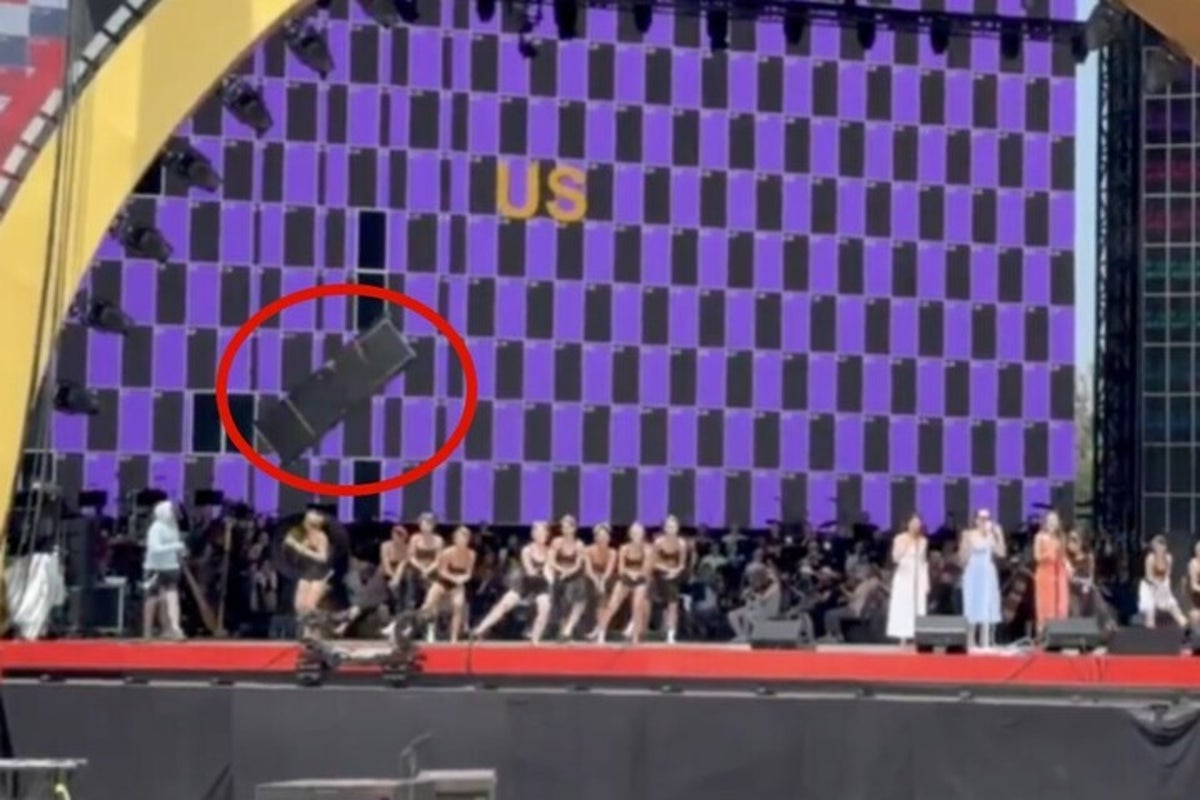
Large-scale public events scale linearly in cost but exponentially in operational complexity. The structural failure during a July 2, 2026 rehearsal for the Freedom 250 July 4 celebration—where an overhead stage component detached and fell onto the main performance deck—is not an isolated mechanical error. Instead, it serves as a lagging indicator of compressed procurement timelines, severe environmental stressors, and compromised oversight frameworks. When a public organization attempts to fast-track municipal-scale entertainment infrastructure within highly polarized political and environmental climates, structural integrity transforms from a mathematical baseline into a variable managed by risk tolerance.
Understanding the operational collapse of the Freedom 250 infrastructure requires analyzing the compounding variables that turned a standard outdoor performance stage into a high-risk operating environment.
The Three Pillars of Live Event Operational Failure
Live performance infrastructure relies on three interdependent systems: structural engineering integrity, environmental resilience, and vendor accountability. When any single pillar is compromised, the remaining two must absorb the resulting operational stress. In the case of the Great American State Fair on the National Mall, all three pillars experienced simultaneous degradation.
1. The Procurement and Timeline Compress Function
The production lifecycle of an event of this magnitude typically mandates a twelve-month horizon from engineering sign-off to site deployment. Freedom 250 has faced persistent logistical friction, characterized by delayed infrastructure deployment and high-profile vendor and performer attrition. When initial timelines compress, the structural assembly window shrinks.
This creates a strict trade-off between installation velocity and rigorous safety validation. A compressed timeline forces field technicians to prioritize assembly over multi-stage inspection protocols, increasing the probability of human error in securing load-bearing overhead rigging elements.
2. Extreme Thermal Degradation of Materials
The structural failure occurred during a prolonged mid-Atlantic heat wave, with ambient temperatures in Washington, D.C., reaching 100 degrees Fahrenheit. Structural steel, aluminum rigging truss systems, and locking mechanisms possess distinct thermal expansion coefficients.
$$\alpha = \frac{\Delta L}{L_0 \Delta T}$$
Where:
- $\alpha$ is the coefficient of linear thermal expansion
- $\Delta L$ is the change in length
- $L_0$ is the original length
- $\Delta T$ is the temperature differential
When temporary structures are assembled in moderate conditions and subsequently subjected to sustained, extreme heat, the resulting expansion induces unexpected mechanical strain on joints, pins, and tension-based couplers. This physical phenomenon was further aggravated by the reported failure of auxiliary climate control systems across multiple event exhibits, compounding the thermal load on internal stage components and accelerating structural fatigue.
3. Oversight Degradation Under Financial Strain
The operational efficiency of the Freedom 250 organization has been impacted by aggressive budget reallocations. Sweeping federal spending reductions executed by the Department of Government Efficiency (DOGE) directly targeted humanities and cultural funding, forcing municipal sub-events to downsize.
When capital expenditures are abruptly reduced midway through a project lifecycle, project managers frequently cut costs in secondary operational layers—specifically quality assurance, independent engineering inspections, and secondary safety monitoring teams. The absence of these independent validation layers allowed a critical installation error in the overhead rigging to pass completely undetected until physical failure occurred.
The Near-Miss Mechanical Breakdown
Footage from the incident indicates that the detached overhead element fell directly onto a performance deck occupied by a rehearsing dance troupe. The mechanism of failure appears to be a localized rigging shear or a coupling disconnect rather than a systemic collapse of the foundational stage scaffolding.
Temporary outdoor performance stages rely heavily on overhead grids suspended by chain hoists to support lighting arrays, LED video panels, and scenic elements. These systems are bound by safe working load (SWL) limits and require secondary safety steel backups—independent cables that catch the load if the primary mechanical attachment fails. The instantaneous detachment and uninhibited fall of the structure component suggest two distinct possibilities:
- Total Fastener Failure: The primary coupling mechanism sheared completely under uncalculated kinetic or thermal stress, indicating material defect or improper rating.
- Absence of Secondary Rigging: The mandatory secondary safety steels were either omitted during the rushed assembly phase or were incorrectly anchored to the main grid, failing to arrest the component's descent.
The operational consequence of a near-miss of this magnitude is severe. In industrial risk management, the Heinrich Triangle principle dictates that for every major accident, there are approximately 30 minor injuries and 300 near-miss incidents caused by the exact same underlying hazards. By treating this incident merely as a political talking point or a minor rehearsal interruption, organizers ignore the mathematical reality that the underlying systemic hazards—rushed labor, unchecked thermal strain, and absent oversight—remain uncorrected.
The Bottleneck of Compressed Remediation
Organizers face a severe logistical bottleneck. With the main July 4 celebration scheduled less than 48 hours after the structural failure, a standard comprehensive remediation path is mathematically impossible. A thorough engineering forensic review, teardown, and recertification of a multi-tiered stage array normally requires three to five days of static site access.
Instead, the organization must operate under a compressed remediation model. This model forces a reliance on spot inspections and visual verification of load points rather than dynamic load testing. This approach introduces an elevated level of residual risk for the upcoming scheduled performances, including highly publicized addresses. If the underlying cause was material expansion due to the ongoing 100-degree heat wave, the structural components remain under continuous environmental stress, meaning the risk profile increases every hour the heat wave persists.
Strategic Operational Directives
To mitigate the immediate physical and reputational liabilities associated with the Freedom 250 event infrastructure, the organizing committee must execute a rapid operational pivot away from aesthetic complexity and toward strict risk containment.
First, the technical production team must immediately initiate a permanent load-reduction protocol. All non-essential, purely cosmetic overhead elements must be stripped from the rigging grid, lowering the total static weight and reducing the structural strain on the primary support towers.
Second, the event must transition to a zero-overhead performance model. Any performance elements that require dynamic kinetic motion directly beneath active lighting or scenic arrays must be staged on the front apron or extended stage decks, completely outside the vertical drop zone of the primary overhead grid.
Finally, independent municipal safety inspectors must be granted absolute veto authority over the site layout, operating completely detached from the political and administrative timelines of the White House or the fair's executive planners. Without these structural boundaries, the event operates not as a calculated logistical exercise, but as a high-stakes gamble against mechanical probability.