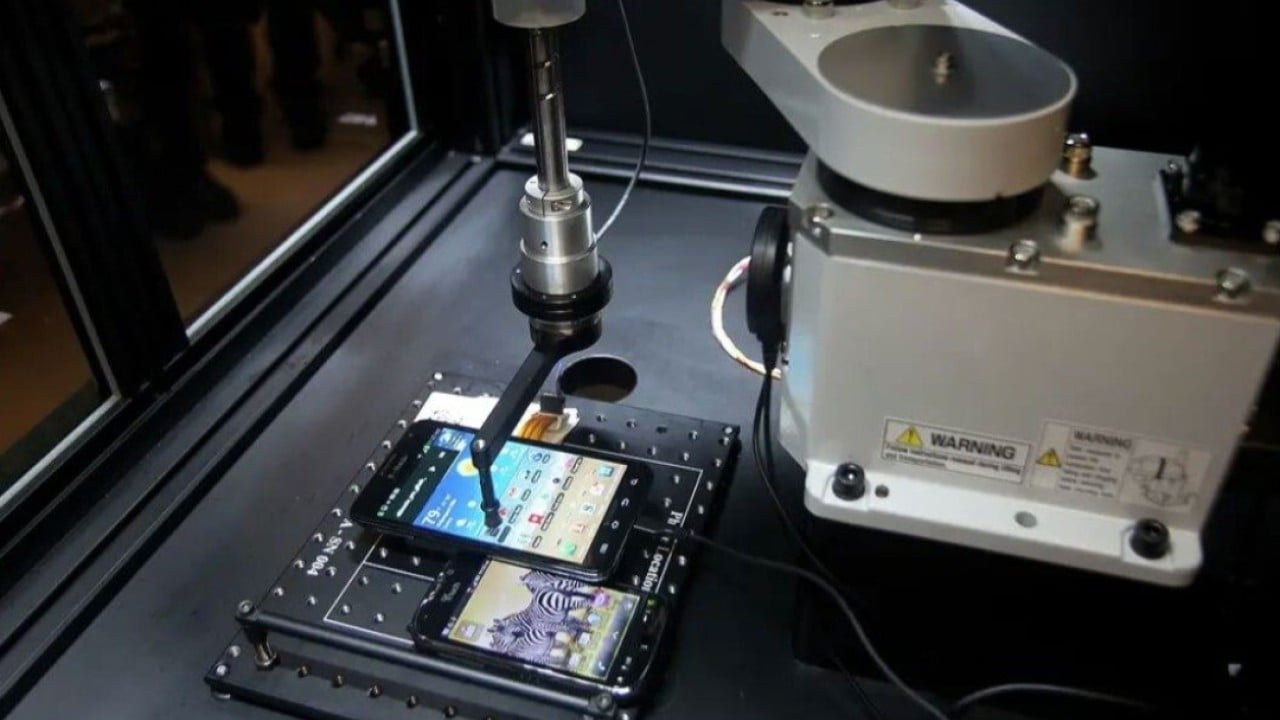
The laboratory lights in Bellevue, Washington, hummed with a quiet, sterile persistence long after the midnight hour. On the polished concrete floor stood Tappy. It was not a grand machine of science fiction, nor was it built to look imposing. It was a slender, functional assembly of metal joints, sensors, and actuators—a robotic testing apparatus designed for one hyper-specific, grueling task: repeatedly jabbing smartphone touchscreens to measure durability, responsiveness, and human-like interaction.
To an outside observer, Tappy looked like a mechanical arm attached to a metal frame. To the engineers who spent thousands of hours refining its software and physical tolerances, Tappy represented a quiet triumph of proprietary engineering. It was a competitive edge, forged through endless trial, error, and institutional patience. Meanwhile, you can explore related stories here: Russia Says Space Arms Race Can Still Be Stopped.
Then came the late nights when the lab was empty, save for those whose intentions stretched beyond collaboration.
In the high-stakes theater of global telecommunications, secrets are rarely stolen with crowbars or masked intruders. They are smuggled out through the quietest vulnerabilities of human trust. What unfolded between the sprawling corporate apparatus of Huawei and the American carrier giant T-Mobile was not a thriller movie plot with high-speed chases. It was something much more insidious. It was an extraction of ingenuity, executed through badge swipes, clandestine photographs, and the systematic erosion of boundaries. To explore the complete picture, check out the excellent article by Mashable.
Consider what happens next in any high-stakes corporate environment. You build a wall. You patent your ideas. You assume that the legal frameworks of international commerce will hold the line. But intellectual property is a ghost. Once captured by an unauthorized lens, once copied onto a rogue thumb drive, it can be replicated halfway across the world in a matter of hours, stripped of its context, its creator, and its cost.
The allegations that eventually surfaced were stark. Huawei, facing fierce global competition and eager to accelerate its own robotic testing capabilities, allegedly sought to bypass the arduous years of research required to build its own mechanical testing arms. Instead of innovating, the playbook shifted to acquisition—not through legal purchase, but through industrial espionage.
Let us be honest about why this happens. Innovation is agonizingly expensive. Failure is guaranteed nine times out of ten. Success is fleeting. When a multi-billion-dollar enterprise looks at a competitor's breakthrough device, the temptation to leapfrog the timeline by acquiring the blueprints directly can be overwhelming. The calculus is cold: pay millions in potential legal penalties years down the road, or secure market dominance today.
Security guards in the Bellevue lab began noticing anomalies. Badges used when they shouldn't have been. Visitors lingering near Tappy with unauthorized measuring devices. Photographs taken of proprietary assemblies that were strictly off-limits under non-disclosure agreements.
When the news broke that Huawei was accused of stealing robot tech to get hands on T-Mobile’s trade secrets, the tech world gasped, but industry insiders nodded with a weary familiarity. This was not an isolated incident. It was part of a broader, systemic pattern of intellectual property acquisition that has come to define the friction points of modern globalization.
We often talk about trade secrets as if they are abstract legal terms floating in corporate boardrooms. They are not. A trade secret is the sweat of an engineer who missed their child’s birthday party to fix a calibration glitch. It is the sleepless night of a programmer rewriting code because a sensor misread a millimeter of pressure. When that secret is compromised, something fundamental is stolen from the creator: agency.
The legal fallout that followed T-Mobile’s discovery laid bare the mechanics of the breach. Courtrooms became arenas where engineering schematics were projected onto screens alongside emails detailing attempts to smuggle Tappy's parts or specifications out of the country. The defense offered standard corporate refutations, pointing to independent development and miscommunication. Yet the digital paper trail told a different story—a story of targeted curiosity, deliberate circumvention, and the quiet erosion of corporate ethics.
The real problem lies elsewhere, buried beneath the legal briefs and diplomatic posturing. Every time a trade secret is pilfered without consequence or merely slapped with a manageable fine, the incentive structure of global capitalism tilts dangerously. It punishes the builder and rewards the copyist. If the penalty for industrial espionage is cheaper than the cost of genuine research and development, then theft becomes a line item in a business plan.
Step back and look at the broader landscape of how technology moves across borders. The smartphone in your pocket, the network towers routing your phone calls, the automated systems managing our logistics—they are all built on a fragile foundation of shared trust. When that trust is weaponized, the collateral damage extends far beyond the two corporate entities involved. It poisons cooperation. It builds walls of suspicion that stifle international scientific exchange.
Tappy eventually faded from the headlines, relegated to court transcripts and archival journalism. T-Mobile reinforced its security protocols. Huawei adjusted its strategies. But the machine itself remains a haunting monument to an age where everything that can be digitized, measured, and photographed can also be stolen.
Innovation requires a sanctuary. It demands a space where creators can fail in private, iterate in safety, and trust that the fruits of their labor will not be harvested by those who refused to plant the seeds. When that sanctuary is breached, we lose more than proprietary hardware or confidential code. We lose the pure, wild belief that building something better actually matters.
The lab in Bellevue is quiet now. The lights are dimmed. Somewhere across the ocean, a mechanical arm executes a programmed routine, jabbing a screen over and over again, testing the limits of endurance. But it carries a ghost inside its circuitry—the invisible weight of a secret taken before its time.