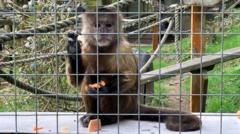
Operating a legacy animal sanctuary requires managing a delicate equilibrium between fixed real estate costs, volatile donation revenue, and escalating biological upkeep. When Wild Futures announced the closure of its Cornwall-based Monkey Sanctuary after more than six decades of operation, it exposed the vulnerability of traditional wildlife charity models when faced with asset depreciation and transaction failure. The shutdown was triggered not by a sudden lack of operational intent, but by the convergence of a failed property divestment strategy and compounding physical infrastructure deficits. Understanding why a six-decade-old institution collapsed requires examining the underlying economic and operational vectors that dictate modern animal welfare management.
The Real Estate Liquidity Trap
The foundational crisis began when Wild Futures listed its physical site, Murrayton House, for sale in June 2025. For legacy non-profits, real estate is frequently treated as an immutable anchor rather than a liquid asset. When operational costs outpace incoming capital streams, selling the physical plant to lease it back or partner with a commercial entity serves as a standard restructuring mechanism.
The strategy relied on two critical assumptions:
- The identification of a buyer willing to accept the liabilities of a specialized wildlife facility.
- The successful execution of a co-management agreement where a commercial entity maintains structural upkeep while the charity handles animal care.
After six months of negotiations, the prospective buyer withdrew without notice. This dynamic highlights the primary risk of single-buyer dependency in specialized real estate markets. Commercial buyers face high opportunity costs and severe due diligence hurdles when evaluating properties encumbered by wildlife zoning, historical designations, and specialized enclosures. Once the transaction fell through, the charity lost its liquidity bridge, exposing a cash-flow bottleneck that rendered ongoing operations unsustainable.
The Cost Function of Infrastructure Aging
Simultaneously, the due diligence process uncovered structural land and building deficiencies that fundamentally altered the capital expenditure forecast. Physical assets degrade according to predictable depreciation curves, but specialized animal sanctuaries face accelerated wear due to high humidity, constant enclosure scrubbing, and the physical force exerted by captive primates.
The economic reality of these structural issues can be modeled through capital allocation logic:
- Capital injection requirements for remediation reached hundreds of thousands of pounds.
- Projected maintenance costs exceeded the internal revenue generation capacity of the charity.
- Investing finite capital into a compromised geographic footprint represented an unacceptable risk to organizational solvency.
Pouring donor funds into a deteriorating land asset violates fiduciary duty when the underlying foundation is fundamentally compromised. By halting operations rather than throwing capital into an architectural sinkhole, the administration prioritized short-term liquidity preservation for animal transport over long-term sunk cost recovery.
The Operational Mechanics of Primate Rehoming
Closing a sanctuary housing complex, socialized primates introduces a complex logistical and biological challenge. Unlike inanimate assets, primates maintain strict social hierarchies, inter-group bonds, and specialized dietary or medical requirements. Rehoming them requires navigating a rigid network of accredited global partners, primarily governed by strict welfare standards such as those enforced by the Global Federation of Animal Sanctuaries (GFAS).
The relocation process operates under severe constraints:
- Social Cohesion: Primate groups cannot be arbitrarily split without inducing severe psychological trauma, self-harm, or behavioral regression.
- Capacity Matching: Destination facilities must possess pre-existing, appropriately sized enclosures that match the specific climatic and social needs of the incoming animals.
- Biosecurity Protocols: Veterinary clearances, transport permits, and quarantine regulations lengthen the transition timeline, driving up operational burn rates during the winding-down phase.
The transition requires shifting remaining capital reserves entirely into an emergency rehoming fund. This expenditure reallocates resources away from public education and legislative campaigning toward direct logistics, transport crates, veterinary oversight, and the subsidization of care at receiving institutions.
Strategic Capital Realignment for Wildlife Charities
The collapse of the Cornwall sanctuary signals a broader structural warning for animal welfare organizations dependent on legacy physical locations. Traditional models relying on static visitor numbers and localized donor bases face severe margin compression as structural maintenance costs rise faster than inflation.
Future-proofing animal welfare operations necessitates a shift away from decentralized, high-overhead physical properties toward pooled resource networks, digital advocacy models, and flexible endowment structures. When physical infrastructure becomes a liability rather than a tool, institutional survival requires separating the mission of animal advocacy from the burden of real estate ownership.