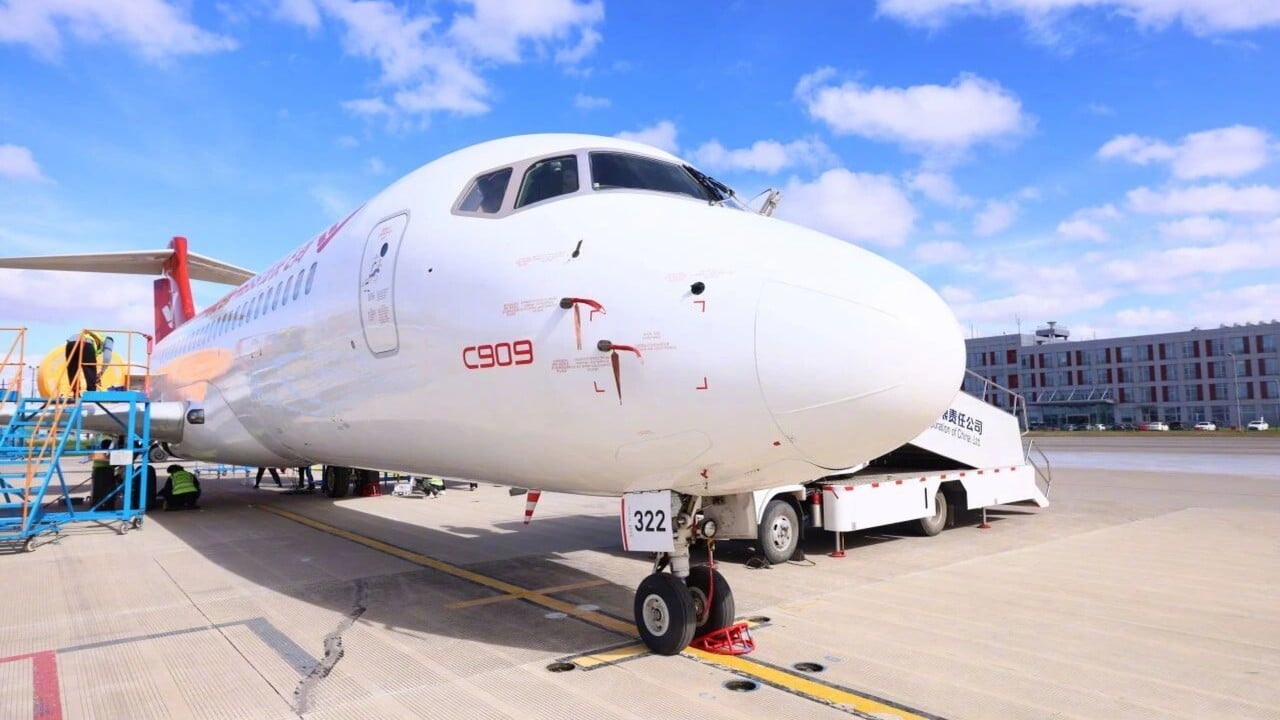
The scaling of commercial aviation asset distribution across geographically fragmented territories is governed by two immutable realities: the unit economics of empty seats and the physical constraints of high-density altitudes. In the far-western territory of Xinjiang, Chinese state-backed operators have accelerated the integration of the Commercial Aircraft Corporation of China (COMAC) C909 regional jet, deploying 30 airframes across more than 120 internal routes within a 36-month window. While surface-level analysis credits this surge to political mandate or state-subsidized experimentation, the operational logic is driven by a precise alignment between sub-100-seat capacity dynamics, high-altitude engine performance profiles, and localized network optimization patterns.
To evaluate the systemic shift toward the C909—formerly designated as the ARJ21-700—analysts must look past the overarching narrative of industrial self-reliance and isolate the technical, operational, and macroeconomic levers dictating regional fleet allocations.
The Network Geometry of Fragmented Geographies
Xinjiang spans more than 1.6 million square kilometers, presenting a classic hub-and-spoke development problem characterized by massive geographic displacement and minimal population density between urban nodes. Ground infrastructure projects face high capital expenditure requirements and lengthy amortization schedules due to desert topography and extreme seasonal shifts.
Aviation serves as the primary mechanism for rapid capital and population mobility under these conditions. However, the structural hurdle for trunk airlines operating standard narrowbody aircraft, such as the Airbus A320neo or Boeing 737 MAX 8, lies in the load factor penalty.
A standard 150-to-180-seat narrowbody requires a baseline passenger density to achieve its break-even load factor (BELF). On emerging regional legs, like Kashgar to Yining, seasonal demand fluctuations drop passenger volumes below this structural threshold for extended periods of the fiscal year.
Operating a partially empty narrowbody generates severe cash burn per block hour. The C909, configured to seat between 78 and 97 passengers in a single-class layout, shifts the capacity floor down by roughly 45%. This capacity reduction alters the network deployment strategy in two ways:
- Frequency Modulation Over Capacity Dumping: Instead of scheduling a single daily narrowbody flight that runs at a sub-optimal load factor, operators can deploy the C909 twice daily. This structural adjustments captures time-sensitive business and tourism travel, enhancing utility for the end user without increasing total seat inventory risk.
- De-risking Thin Point-to-Point Segments: The sub-100-seat architecture allows network planners to bypass major regional hubs like Urumqi for secondary city-pairs. By routing directly between periphery destinations, airlines capture localized yields that would otherwise be lost to multi-stop itineraries or ground transport alternatives.
Isolating the Hourly Contribution Margin Differential
Data from COMAC’s research divisions indicates that the C909 yields a contribution margin—defined as gross passenger revenue minus variable operating costs—that runs 6,000 to 10,000 yuan ($890 to $1,480) higher per operating hour than a Boeing 737 on low-density routes. This operational margin advantage is explained by analyzing the cost function components of a regional flight cycle.
+-------------------------------------------------------------+
|               Hourly Operating Cost Architecture            |
+-------------------------------------------------------------+
| [Fixed Cost Baseline] -> High Airframe Dry-Weight Penalty    |
| [Variable Cost Matrix]                                      |
|    |---> Fuel Burn Profile: Lower Absolute Volumetric Flow  |
|    |---> Navigation Fees: Lower Maximum Takeoff Weight      |
|    |---> Crew Ratios: Opt. 2+3 Seating / Reduced Cabin Crew |
+-------------------------------------------------------------+
The core variable cost matrix reveals where the asset outperforms larger platforms on short-haul sectors:
Trip Fuel vs. Seat-Mile Fuel Mechanics
The C909 is an aerodynamically heavy aircraft relative to its size, possessing an empty weight of approximately 25 metric tons. This high structural weight penalizes its fuel burn per seat-mile when compared to highly optimized Western single-aisle platforms.
However, on a short sector length under 400 nautical miles, the absolute trip fuel consumed by the C909's twin General Electric CF34-10A turbofans is lower than that of a larger narrowbody simply due to the reduced scale of the total mass being moved. The absolute volumetric flow of fuel per hour is lower, making the airframe cheaper to cycle on brief flights regardless of seat-mile inefficiencies.
Airport and Air Navigation Charges
Landing fees, handling costs, and en-route navigation assessments are tied directly to an aircraft’s Maximum Takeoff Weight (MTOW). The C909 Extended Range (ER) variant features an MTOW of 43,500 kg, whereas a Boeing 737 MAX 8 sits near 82,000 kg. On high-frequency regional networks where an aircraft completes four to six cycles a day, the compounded savings in weight-based airport tariffs form a major protective barrier for operational margins.
Crew Resource Allocations
The cabin layout uses a five-abreast (2+3) seat configuration. This maintains a cabin crew requirement below that of main-fleet single-aisle jets, optimizing personnel utilization rates in isolated crew bases.
The High and Hot Performance Vector
Airport infrastructure in western China is structurally defined by high elevation and extreme ambient temperatures. Airfields like Khunjerab Airport in Taxkorgan operate at severe density altitudes, where thin air degrades aerodynamic lift and limits engine thrust capacity.
The C909 was engineered from its inception to satisfy these specific operational constraints. Its design requirements were dictated by the Civil Aviation Administration of China (CAAC) Chapter 25 airworthiness standards, with an explicit emphasis on operations in the western provinces.
+-----------------------------------------------------------------------+
|             Density Altitude Operational Impact Flow                  |
+-----------------------------------------------------------------------+
| Thin Air / Elevated Ambient Temperatures                              |
|   |--> Reduction in Air Mass Flow through Engine                      |
|   |--> Degraded Aerodynamic Lift Generation                           |
|                                                                       |
| [C909 Countermeasures]                                                |
|   |--> Antonov Supercritical Wing (25° Sweep) -> Enhances Low-Speed Lift|
|   |--> GE CF34-10A Thrust Profile -> Flat-Rated to 30°C Sea Level       |
|                                                                       |
| [Operational Output]                                                   |
|   +--> Mitigates Payload Lift-Off Restrictions at Critical Airfields  |
+-----------------------------------------------------------------------+
The aircraft's wing geometry, engineered in coordination with Antonov, utilizes a high-lift supercritical design featuring a 25-degree sweepback angle and integrated winglets. This aerodynamic configuration maximizes lift generation at lower speeds, allowing the jet to operate from truncated runways without forcing airlines to take severe payload penalties.
Powerplant engineering reinforces this structural adaptation. The General Electric CF34-10A high-bypass turbofan engines are flat-rated to 30°C at sea level, providing 17,640 pounds of takeoff thrust per unit.
When departing from high-altitude runways during mid-summer temperature spikes, standard commercial powerplants experience early thermal limits, forcing flight computers to restrict passenger or fuel weight to ensure safe climb gradients in the event of an engine failure. The C909's thrust-to-weight margins allow it to maintain payload integrity under conditions that would disrupt the dispatch reliability of traditional passenger fleets.
Industrial Lifecycle Optimization and Risk Boundaries
Every deployment strategy contains operational trade-offs and structural limitations. The rapid injection of the C909 into the domestic network functions as an industrial feedback mechanism for COMAC's broader commercial aircraft portfolio, which includes the narrowbody C919 and the long-haul C929 under development.
Commercial aircraft maturity cannot be simulated inside an engineering facility; it requires real-world data generated across thousands of block hours under stressful conditions. By centering the C909 fleet within the demanding operational environment of Xinjiang, COMAC executes a continuous validation strategy.
The airframe has undergone more than 1,000 design modifications driven directly by field telemetry. These upgrades target components ranging from environmental control systems exposed to dust storms to cockpit avionics integration and engine casing thermal management.
The strategic risk boundary for this deployment centers on supply chain vulnerability. While the C909 is designated as a domestic product with independent Chinese intellectual property rights, its underlying architecture remains connected to Western tier-one aerospace suppliers.
The flight deck relies on the Rockwell Collins (now Collins Aerospace) Pro Line 21 integrated avionics suite alongside the FMS-4200 flight management system. The primary propulsion relies entirely on US-manufactured General Electric turbofans.
Consequently, the fleet's long-term dispatch reliability faces a constant bottleneck: the availability of foreign components, line-replaceable units (LRUs), and specialized maintenance tooling. If geopolitical trade friction limits the flow of these critical assemblies, domestic operators will face escalating aircraft-on-ground (AOG) durations that degrade the economic advantages of the sub-100-seat strategy.
Tactical Asset Allocation Mandate
Airlines managing regional capacity within high-altitude networks must adopt a rigid, multi-variable allocation matrix to maximize network profitability.
Operators should immediately audit all regional routes under 500 nautical miles that currently show average load factors below 68% when serviced by 150+ seat single-aisle aircraft. These specific sectors should be systematically transitioned to sub-100-seat regional jet architectures.
By offloading structural excess capacity from underutilized narrowbody fleets and reallocating it to high-thrust, right-sized regional platforms, carriers can extract structural yield improvements while simultaneously lowering absolute trip fuel costs across complex, high-density altitude geography.
Turning into CLINIC in AIR, China's C909 jetliner aids Xinjiang with top Eye & ENT care This video provides insight into how the C909's specialized variants are being deployed for air medical services directly within remote regions of Xinjiang, illustrating its operational adaptability beyond standard passenger routes.