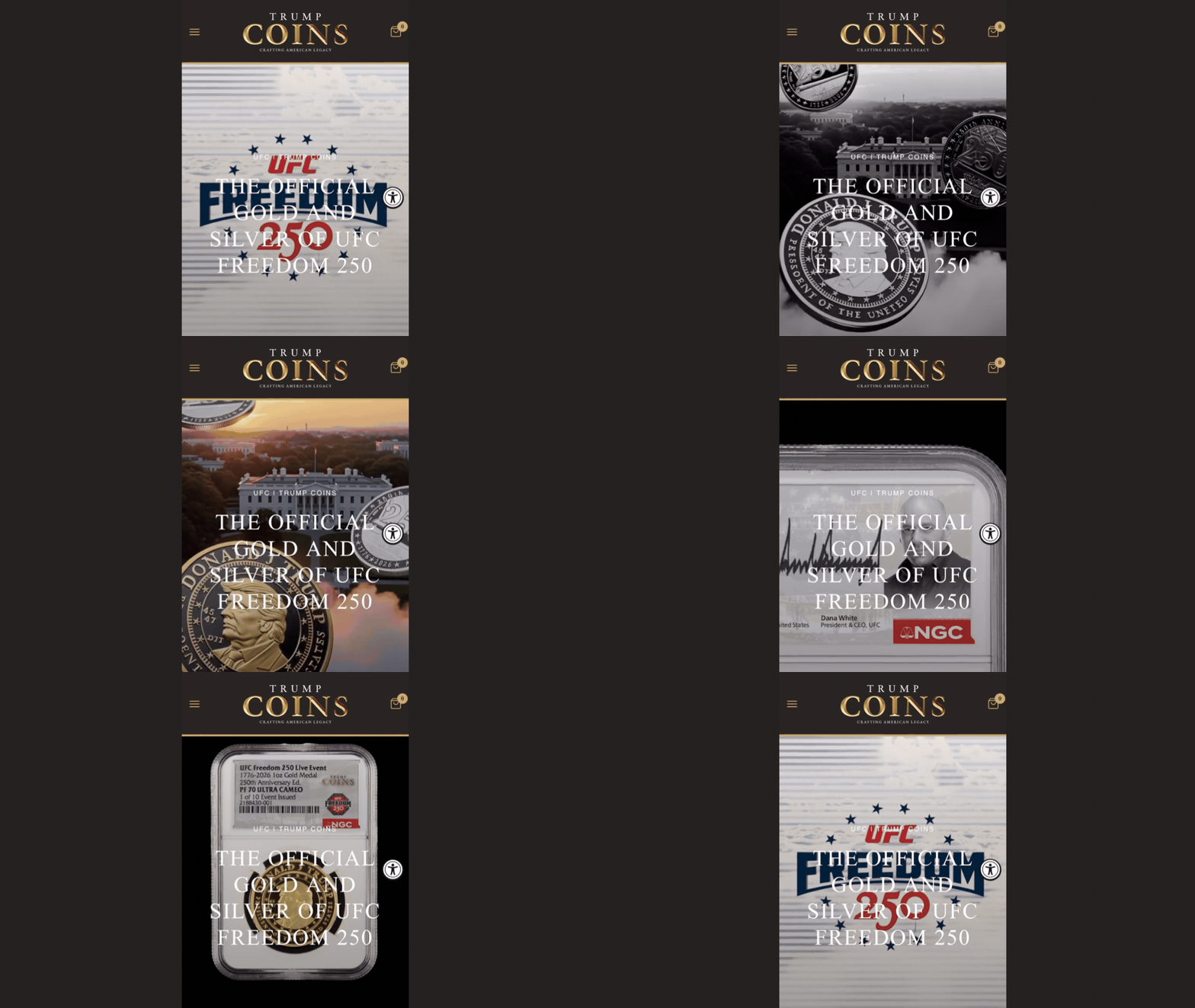
The sale of "Freedom 250" themed silver and gold medallions, marketed directly via the "Trump Coins" platform, represents a textbook execution of high-margin brand monetization. Priced from $250 to nearly $12,000, these items are timed to coincide with a high-profile Ultimate Fighting Championship (UFC) match hosted at the White House and the president’s 80th birthday. While mainstream commentary focuses on the optic of a sitting president capitalizing on corporate spectacles, an objective evaluation reveals a highly sophisticated financial mechanism designed to extract maximum economic rents from brand equity, completely decoupled from the intrinsic valuation models of precious metals.
To understand the economic reality of these products, one must separate the underlying commodity from the premium applied by the brand.
The Mechanics of Premium Arbitrage
The foundational flaw in evaluating these medallions as traditional investments lies in misinterpreting their cost function. In standard numismatic investing, a coin’s market price is determined by an equation involving three specific variables:
- The Intrinsic Spot Value: The raw market price of the physical precious metal (gold or silver) contained within the asset.
- The Minting and Production Premium: The nominal cost associated with refining, striking, and distributing the physical asset.
- The Scarcity Premium: A variable driven by verified supply caps, historical significance, or official grading by independent bodies like the Professional Coin Grading Service (PCGS).
The "Freedom 250" collection actively subverts this equation by introducing a fourth, dominant variable: The Affiliation Premium.
When a top-tier gold medallion in this collection is priced at $11,999.99, its market value is almost entirely psychological. Even assuming the asset contains multiple troy ounces of fine gold, the retail price outpaces the spot value of the raw metal by an astronomical factor. The consumer is not purchasing a hedge against inflation; they are acquiring a high-priced token of political alignment and cultural membership.
The Three Pillars of Political Intellectual Property Monetization
The operational architecture behind the "Trump Coins" initiative relies on a three-pronged strategy that insulates the venture from standard commercial risks while optimizing cash flow.
                  ┌──────────────────────────────┐
                  │  IP Licensing Architecture   │
                  └──────────────┬───────────────┘
                                 │
         ┌───────────────────────┼───────────────────────┐
         ▼                       ▼                       ▼
┌─────────────────┐     ┌─────────────────┐     ┌─────────────────┐
│ Brand Isolation │     │ Event-Driven    │     │ Scarcity        │
│   (LLC Model)   │     │ Demand Capture  │     │ Engineering     │
└─────────────────┘     └─────────────────┘     └─────────────────┘
1. Corporate Isolation via Intellectual Property Licensing
The financial flow does not feed directly into a political campaign or the personal bank account of the officeholder. Instead, the mechanism operates through DTTM Operations LLC, the entity tasking itself with managing the licensing and intellectual property of the Trump brand. Managed by Donald Trump Jr. and Eric Trump, this structural layer serves a dual purpose. It protects the principal from direct operational liabilities while legally segmenting commercial revenue from public office, bypassing traditional conflict-of-interest frameworks through standard intellectual property licensing agreements.
2. Event-Driven Demand Capture
Traditional retailers spend heavily on customer acquisition. This venture minimizes those costs by leveraging structural synergy with major entertainment properties. By tying the coin release to a White House-hosted UFC event and a milestone birthday, the marketers exploit a concentrated burst of media attention. The inclusion of UFC branding and portraits alongside Dana White serves as an endorsement mechanism, instantly converting sports entertainment fans into a transactional customer base.
3. Legal and Psychological Scarcity Engineering
The marketing copy explicitly positions these items as "the only officially licensed Donald J. Trump medallions on the market," even going so far as to label unapproved third-party alternatives as potentially "unlawful." This creates an artificial monopoly over the president's likeness. By framing the purchase as a "defining patriotic moment" and claiming the items were "designed by President Trump himself," the platform converts a generic manufacturing process into an exclusive, highly curated asset class in the mind of the buyer.
Structural Pitfalls and Liquidity Constraints
For the consumer, executing a purchase within this framework carries significant structural risks that are routinely omitted from commercial promotional materials.
The primary constraint is illiquidity. True sovereign bullion coins, such as the US Mint's American Gold Eagle, possess a highly liquid secondary market with razor-thin buy-sell spreads. They can be converted back to cash instantly at close to global spot prices.
Collectibles driven by specific political branding enjoy no such liquidity guarantee. The secondary market for highly politicized memorabilia is thin, fragmented, and highly volatile. The pool of future buyers is limited exclusively to ideological adherents. Should political fortunes shift, or should the cultural relevance of the brand diminish over a multi-year horizon, the Affiliation Premium risks collapsing toward zero. Under that scenario, the asset's secondary market value defaults strictly to its raw metallic content, forcing the investor to absorb a capital loss representing the vast majority of the initial purchase price.
Strategic Asset Allocation Reality
From an objective asset-management perspective, allocating capital to high-premium political medallions must be categorized as discretionary consumption rather than capital preservation or investment.
When evaluating these products against benchmark alternatives, capital allocators should utilize a stark binary framework:
- For Wealth Preservation: Capital should be directed exclusively to sovereign, low-premium bullion or physical exchange-traded funds (ETFs) where the tracking error against the spot price of gold or silver is minimized.
- For Brand Speculation: Capital allocated to these medallions must be viewed with the expectation of immediate sunk-cost accounting. The premium paid over the spot price should be written off instantly as the price of admission to a political subculture, with zero expectation of systematic yield or predictable capital appreciation.
The optimal strategy for a defensive consumer is to avoid conflating ideological support with portfolio diversification. If the goal is financial exposure to precious metals, purchase unbranded bullion. If the goal is political expression, treat the expenditure as a non-recoverable sunk cost, entirely disconnected from financial optimization frameworks.