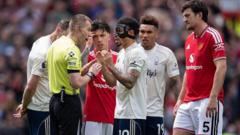
Professional Game Match Officials Limited (PGMOL) operates on an unspoken framework of reputational risk mitigation. When referee Michael Salisbury was omitted from the match day appointments for the final round of the Premier League season, the governing body signaled a tactical retreat rather than a routine rotation. This administrative sidelining follows Salisbury’s decision to allow Matheus Cunha’s goal to stand for Manchester United against Nottingham Forest—defying a direct recommendation from the Video Assistant Referee (VAR) to disallow it for a clear handball by Bryan Mbeumo in the build-up.
To analyze this omission as a simple "dropping" of an official misses the structural mechanics at play. The PGMOL functions under intense commercial and institutional pressure where structural integrity, officiating authority, and club relations constantly collide. By dissecting the metrics of referee accountability, the breakdown of the VAR-to-on-pitch hierarchy, and the long-term precedent of club-driven official blacklisting, we can map the exact cost functions that govern modern football governance.
The Hierarchy Breakdown: Systemic Friction Between VAR and On-Pitch Authority
The structural failure at Old Trafford reveals a profound flaw in the operational protocols governing English officiating. The protocol dictates that a VAR intervention occurs only in the event of a "clear and obvious error." When the VAR recommends an on-pitch review, the system is designed to correct human misjudgment. The statistical conversion rate of a referee visiting the pitchside monitor to changing their decision hovers above 90%.
When Salisbury broke this trend, he exposed the structural friction between two distinct roles:
- The Analytical Monitor (VAR): Operates via objective, multi-angle video playback, isolating exact points of physical contact.
- The Subjective Field Authority (Referee): Operates via dynamic positioning, human intuition, and immediate situational context.
By ruling the handball "accidental" despite Mbeumo wedging the ball between his arm and body, Salisbury prioritized personal on-pitch autonomy over systemic verification. This created an immediate institutional bottleneck. The PGMOL relies on the illusion of absolute consistency; when an official publicly rejects the system's safety net, it diminishes the structural authority of the technology itself.
The Cost Function of Reputational Damage Control
Chief Refereeing Officer Howard Webb’s subsequent communication with Nottingham Forest—acknowledging that a superior decision should have been reached—serves as an explicit admission of operational error. This private concession, followed by Salisbury’s complete omission from the final-day fixtures, outlines the PGMOL's risk-minimization matrix.
The final day of a Premier League season carries exponential commercial stakes, specifically regarding merit payments driven by final league positions and broadcasting rights allocations. Introducing an official tied to an active, high-profile controversy increases the variance of match-day volatility.
The mechanism behind benching Salisbury is governed by three primary administrative drivers:
- Heat De-escalation: Removing the flashpoint variable from public scrutiny allows media cycles to reset ahead of the off-season.
- Asset Protection: Continuous exposure of a compromised official leads to hyper-scrutiny on future calls, permanently damaging their long-term operational utility.
- Institutional Liability Reduction: Leaving Salisbury active on the final day would invite immediate bad-faith narratives from competing clubs if another high-impact error occurred under his supervision.
The Precedent of Structural Appeasement: The Two-Year Blacklist
Salisbury’s omission cannot be viewed in isolation; it operates within an established behavioral pattern of appeasing disgruntled clubs. The most stark validation of this mechanism is the quiet, institutional blacklisting of Stuart Attwell from refereeing Nottingham Forest fixtures.
Following a highly contentious 2-0 defeat to Everton in April 2024, Nottingham Forest released a public statement explicitly questioning Attwell’s integrity as the VAR, citing his alleged allegiances to relegation rivals Luton Town. While the club faced regulatory sanctions and fines for bringing the game into disrepute, the structural reality over the subsequent two years reveals that the PGMOL yielded to the pressure. Attwell has not been appointed to a single Nottingham Forest fixture since that statement.
This creates a dangerous operational precedent:
$$C_{\text{appeasement}} = f(R_{\text{club}}, P_{\text{public}})$$
Where the cost of institutional appeasement is a function of club resistance ($R_{\text{club}}$) and public pressure ($P_{\text{public}}$). When the PGMOL quietly alters appointment mechanics to prevent friction, it inadvertently rewards aggressive public relations strategies from member clubs.
The structural risk is clear. If elite clubs realize that public hostility or high-profile errors can systematically alter the pool of officials assigned to their matches, the administrative independence of the refereeing body is fundamentally compromised. Salisbury's final-day removal is the immediate symptom of a system that manages crises through tactical concessions rather than rigid structural enforcement.
The long-term play for the PGMOL cannot rely on this reactive cycle of benching officials and issuing post-match apologies. True systemic stabilization requires an overhaul of the appointment architecture itself. The governing body must decouple match assignments entirely from club-relations management, substituting human concession with an immutable, performance-indexed algorithm that determines selection based strictly on historical accuracy and process compliance. Until the administrative framework shifts from protecting individual reputations to defending the absolute consistency of the system, officiating will remain a volatile variable in the multi-billion-pound ecosystem of elite football.