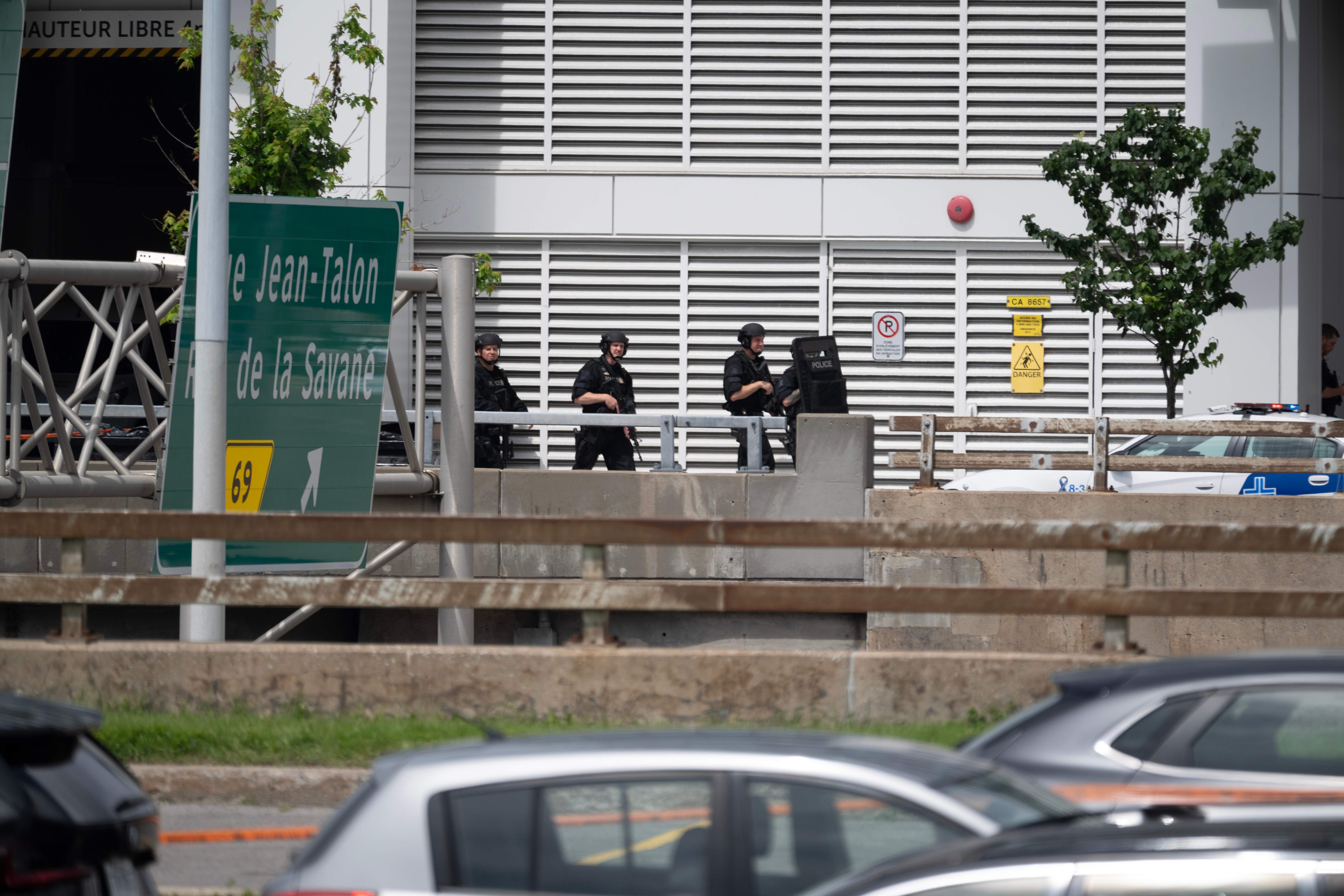
Active shooter incidents in dense urban environments impose a distinct operational strain on emergency response frameworks, exposing the limits of rapid-containment protocols. The June 22, 2026, mass shooting in Montreal’s Côte-des-Neiges neighborhood—resulting in the deaths of Constable Mohamed Lamine Benredouan, civilian Michael Moshe Mizrahi, and the suspect—highlights a critical friction point: the convergence of tactical asymmetry, digital-era radicalization, and the statutory requirements of post-incident oversight. Standard media narratives treat these events as isolated tragedies, but an analytical dissection reveals systemic challenges in operational security, counter-extremism tracking, and multi-jurisdictional accountability.
Analyzing this event requires evaluating the specific failure modes of urban active-shooter response, the mechanism of modern misogynistic radicalization, and the legal anatomy of the parallel investigations now underway.
Tactical Asymmetry and the Mechanics of Urban Containment
The physical site of the deployment introduces variables that degrade traditional police containment strategies. When officers responded to a 11:35 a.m. emergency call regarding an individual brandishing a long gun at a Hilton hotel near De Courtrai and Trans Island avenues, they entered an environment characterized by high structural density and civilian exposure.
Urban active shooter response relies on a compressed timeline where the speed of neutralizing the threat directly correlates with survival rates. This operational model breaks down under tactical asymmetry, which occurs when a perpetrator possesses superior range, suppression capability, or positioning relative to first responders.
[911 Call: Suspect with Long Gun]
       │
       ▼
[Rapid Tactical Deployment] ──► [Exposure to Long-Gun Fire]
                                       │
                                       ▼
                         [High-Density Urban Friction]
                         (Suppression / Spatial Constraints)
                                       │
                                       ▼
                         [Multi-Agency Criminal Investigation]
A long gun utilized in an open or semi-enclosed urban corridor significantly outerforms standard-issue law enforcement sidearms in effective range and ballistic penetration. This disparity creates an immediate containment bottleneck:
- Suppression and Spatial Constraints: The suspect was positioned outside the hotel, leveraging structural cover to suppress incoming response units. This dynamic forced arriving personnel into exposed lines of sight, neutralizing the traditional advantage of numerical superiority during the initial phase.
- Ballistic Vectors in High-Density Zones: Long-gun rounds retain lethal kinetic energy across wider radii, transforming surrounding commercial infrastructure—such as nearby storefronts and pizzerias—into high-risk secondary impact zones. The death of the civilian bystander, alongside injuries sustained by a second officer, demonstrates how ballistic saturation overcomes standard urban cover.
- The Reload Bottleneck: Analysis of available bystander footage indicates that the suspect was neutralized only when adjusting or reloading the weapon. This underscores a critical vulnerability in asymmetric engagements: first-responder advancement is frequently throttled until the perpetrator experiences a mechanical or ammunition-capacity interruption.
The Digital Pipeline: Quantifying Ideological Radicalization
Initial statements from the Quebec Domestic Security Ministry classified the shooting as a domestic case rather than an international terrorist plot. However, intelligence assessments quickly pivoted to ideological vectors when reports from Radio-Canada identified a manifesto left behind by the suspect, which contained virulent anti-woman rhetoric explicitly linked to the Incel (involuntary celibate) movement.
This transition shifts the analytical framework from localized criminal pathology to algorithmic radicalization. The Incel ideology operates within decentralized digital ecosystems that function as asynchronous radicalization pipelines. Law enforcement intelligence units face a structural challenge in predicting these threats due to specific traits of the ecosystem:
- Asymmetric Data Signatures: Unlike traditional extremist networks with centralized hierarchies or identifiable cell structures, digital misogynistic subcultures rely on stochastic terrorism. Ideological platforms generate high volumes of radicalizing material, but the transition from digital consumption to physical execution occurs independently, leaving a minimal operational footprint.
- The Cross-Jurisdictional Intelligence Gap: The threat signature in Montreal triggered an immediate warning from the RCMP British Columbia headquarters to law enforcement agencies across Western Canada, citing the potential for copycat manifestos targeting police with violence. This rapid multi-provincial alert highlights a structural reality: digital extremism is borderless, meaning localized incidents generate immediate tactical risks across vast geographic distances.
The Dual-Investigation Framework: Statutory Watchdogs vs. Criminal Probes
Because the suspect was neutralized during an active engagement with law enforcement, Quebec’s legal framework triggers an mandatory, bifurcated investigation. This structure splits into two distinct legal operations with separate objectives, datasets, and operational silos: the Bureau des enquêtes indépendantes (BEI) and the Sûreté du Québec (SQ).
| Analytical Dimension | Bureau des enquêtes indépendantes (BEI) | Sûreté du Québec (SQ) |
|---|---|---|
| Primary Mandate | Independent Oversight & Police Use-of-Force Analysis | Criminal Investigation & Forensic Reconstruction |
| Legal Object | Law enforcement conduct, discharge of service weapons, tactical compliance. | Suspect culpability, ballistics matching, manifesto provenance, network mapping. |
| Jurisdictional Boundary | Exclusive authority over the actions of the responding SPVM units. | Broad criminal scope, excluding direct oversight of officer actions. |
| Operational Output | Accountability report delivered to the Attorney General to determine legal compliance. | Evidentiary brief detailing the mechanics of the mass shooting event. |
This parallel approach resolves a fundamental conflict of interest but introduces operational complexities. The BEI must isolate and analyze the actions of the Service de police de la Ville de Montréal (SPVM) to ensure objective verification of the use of lethal force. Simultaneously, the SQ must reconstruct the entire criminal event.
The primary investigative bottleneck rests in ballistic forensics. Because both the suspect and responding officers discharged firearms in a dense corridor, determining the precise origin of the lethal round that struck the civilian bystander requires rigorous spatial mapping and chemical analysis of bullet fragments. Until these forensic metrics are finalized, the operational sequence remains technically incomplete.
Strategic Allocation of Municipal and Intelligence Resources
Managing the fallout of this event requires shifting municipal policy away from reactive policing and toward predictive threat mitigation. Municipal administrations frequently rely on visual solidarity, such as high-profile mayoral visits to affected communities. However, structural security optimization demands precise resource reallocation based on the operational realities exposed by the incident.
First, intelligence architectures must calibrate natural language processing models to track localized, algorithmic extremism within open-source and dark-web forums. The transition of the Incel ideology from a digital subculture to an active threat matrix requires dedicated threat-assessment units capable of evaluating manifesto patterns before kinetic actions occur.
Second, urban tactical training must adapt to weapon-disparity scenarios. Assuming standard patrol units can rapidly contain a long-gun threat without specialized tactical intervention introduces an unacceptable failure rate. Municipalities must invest in advanced ballistic protection for first-responding vehicles and revise active-containment protocols to account for the suppression capabilities of high-velocity firearms.
Ultimately, urban safety relies on eliminating the latency between threat identification and tactical neutralization. Mitigating stochastic, digitally driven violence requires integrating algorithmic monitoring with decentralized, rapidly deployable tactical assets. Without this structural overhaul, urban police forces will remain fundamentally reactive, exposed to the severe tactical asymmetries seen in high-density corridors.


