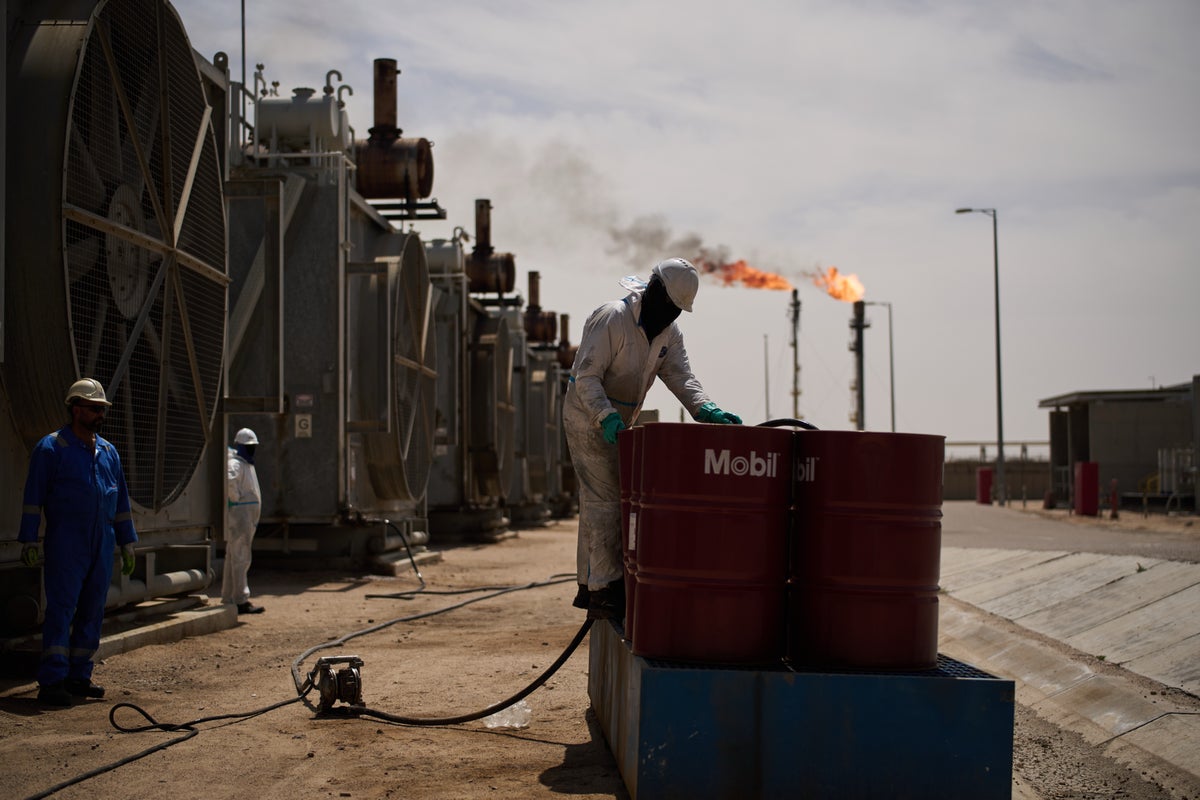
Iraq's fiscal architecture is actively disintegrating because its primary revenue mechanism lacks a diversified extraction and distribution topography. The shutdown of the Strait of Hormuz by Iran has not merely slowed the country's economic activity; it has exposed a terminal failure in sovereign logistics.
Iraq depends on hydrocarbon sales for approximately 90% of its national budget. Because the vast majority of this crude is produced in southern fields and funneled exclusively through Gulf terminals, the state is effectively a landlocked economic actor when the narrow mouth of the Persian Gulf is obstructed.
The current crisis provides a textbook study in single-point-of-failure vulnerability. To understand why Iraq cannot simply pivot its massive reserves to alternative channels requires breaking down the hard physical and operational limits dictating its energy sector.
The Production-Storage Disconnect
The immediate crisis manifesting in southern Iraq is not a shortage of oil, but an acute exhaustion of storage capacity. The mechanism at play is a strict industrial feedback loop.
- Storage Depletion: Unlike diversified petrostates that maintain extensive strategic reserves or secondary pipeline networks, Iraq's storage infrastructure at its southern terminals is designed for high-velocity turnover, not prolonged containment. When tanker loading stops, these tanks fill to maximum capacity within days.
- Mandatory Shut-ins: Once storage is full, upstream production must be throttled or halted entirely to prevent catastrophic overpressurization of the delivery infrastructure. In the Zubair field, output has dropped from 400,000 barrels per day to roughly 250,000. Province-wide across Basra, output has cratered from 3.1 million barrels per day to approximately 900,000.
- Reservoir Degradation Ris: Oil fields are not faucets; they are complex geological pressurized systems. Prolonged shutdowns, particularly in fields where water injection is heavily utilized to maintain reservoir pressure, risk causing permanent subsurface damage, degrading the long-term recoverable volume of the asset.
The Three Pillars of Iraqi Export Paralysis
The inability to reroute the stranded 2.2 million barrels per day of lost Basra production rests on three immutable constraints.
1. The Fleet Deficit and Risk Asymmetry
Iran has offered theoretical assurances that Iraqi crude can safely transit the Strait of Hormuz. However, this guarantee is commercially irrelevant. Iraq does not possess a sovereign tanker fleet of sufficient scale to move its own volume. It relies entirely on chartered vessels owned by international shipping conglomerates.
For these commercial operators, the risk-reward calculus is broken. The destruction of the Marshall Islands-flagged Safesea Vishnu and the Malta-flagged Zefyros by Iranian forces in March established a baseline of kinetic threat that insurance underwriters refuse to cover. Without maritime insurance, commercial vessels will not enter the Gulf, rendering Iran's "assurances" empty.
2. Pipeline Atrophy and Geopolitical Friction
The secondary theoretical relief valve for Iraqi crude is the northern pipeline route running from Kirkuk to the Turkish port of Ceyhan. In a functional system, southern crude could be pumped north to bypass the Strait of Hormuz entirely.
This route is operationally dead for two reasons. The physical infrastructure has suffered from years of underinvestment, sabotage, and conflict, leaving it without the pump-station compression required to handle diverted southern volumes. More critically, ongoing legal and financial disputes between the Federal Government in Baghdad, the Kurdistan Regional Government, and Turkey have legally frozen the transit mechanism.
3. The Absurdity of Overland Scale
Proposals to bypass the maritime blockade by trucking crude oil overland through Jordan or Syria fail on the basic mathematics of volume and density.
A standard oil tanker can hold 2 million barrels of crude. A standard tanker truck holds roughly 200 barrels. To replace the daily volume of a single crude tanker requires a fleet of 10,000 trucks operating in a continuous, perfectly synchronized 24-hour relay across international borders. The fuel cost, road degradation, labor requirements, and border crossing bottlenecks make overland crude transport at scale an economic impossibility. It functions only as a high-cost method for small-scale localized supply, not as a sovereign export strategy.
The Cost Function of Port Workarounds
The paralysis extends beyond energy exports to the vital import of goods, specifically at Umm Qasr, Iraq's primary deep-water port. The closure of the Strait has forced a radical restructuring of supply chains that doubles down on inefficiency.
Large mother ships carrying containerized cargo can no longer risk entering the Gulf to reach Umm Qasr. Instead, logistics firms are offloading Iraqi-bound cargo at ports in the United Arab Emirates. From there, the cargo is either loaded onto smaller feeder vessels willing to run the risk of the Strait or loaded onto trucks to transit the length of the Arabian Peninsula before entering Iraq via land borders.
This workaround introduces extreme friction:
- Double Handling: Offloading and reloading cargo at UAE hubs adds days to transit times and incurs heavy port handling fees.
- Capital Tie-up: Extended transit times mean inventory sits idle longer, increasing the cost of capital for Iraqi importers.
- Volume Reduction: Port director data indicates that container volumes reaching Umm Qasr have been halved, threatening the domestic supply of basic commodities and industrial inputs.
The Hard Timeline of Sovereign Insolvency
Iraq’s financial buffer is purely a function of time. Government experts indicate that existing cash reserves are sufficient to fund state operations and public sector salaries until mid-May 2026 without new oil sales.
Beyond that inflection point, the state enters a forced borrowing posture. With no clear timeline for the cessation of hostilities or the reopening of the Strait of Hormuz, Iraq will be forced to seek emergency credit lines. Given the high-risk profile of a war-adjacent petrostate with severed revenue streams, the cost of this debt will be punitively high, mortgaging future oil revenues to survive the current quarter.
The structural play for the Iraqi state is not to seek complex, low-yield workarounds for its southern crude. The only viable strategic lever is the immediate and aggressive resolution of the legal and technical bottlenecks governing the northern pipeline to Turkey. Baghdad must concede fiscal terms to the Kurdistan Regional Government and Ankara to unlock that infrastructure, accepting a loss of margin in exchange for the restoration of volume. Failing that, the state must prepare for a severe contraction of public payrolls by late Q2.
Would you like me to map out the financial impact on Iraq's national budget if the shutdown extends past the mid-May threshold?