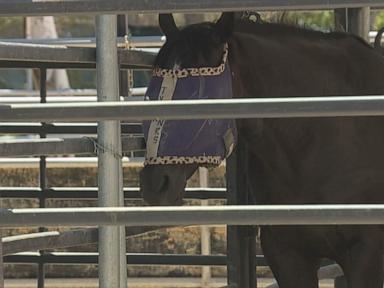
High-value equine events operate under a fragile operational paradigm: millions of dollars in biological assets are housed in temporary, highly accessible environments, reliant on decentralized oversight. The recent security breach at the National Barrel Horse Association (NBHA) Professional’s Choice Vegas Super Show—where a teenage competitor allegedly gained nocturnal access to stabling areas and used a sharp weapon to compromise three horses—exposes systematic failures in the modern equestrian competition model.
When an asset worth tens or hundreds of thousands of dollars can be decommissioned by an insider threat with a basic edged weapon, the industry is forcing owners to bear catastrophic systemic risk. This operational failure can be mapped across three distinct vectors: infrastructure vulnerability, ineffective risk-escalation protocols, and the severe cascading economic losses associated with equine incapacitation.
The Three Vectors of Stabling Vulnerability
Commercial equestrian events depend on temporary or semi-permanent stabling facilities to manage high volumes of animal traffic. This setup introduces structural security deficits that are easily exploited by bad actors, particularly insider threats who possess authorized credentials.
1. The Perceived-Trust Infrastructure Deficit
Equestrian venues rely heavily on "perceived trust" rather than hard security perimetrics. Stall assignments are publicly accessible, barn doors are frequently left unlatched to facilitate ventilation and rapid emergency response (such as fire evacuation), and perimeter fencing is designed to contain loose animals rather than exclude malicious humans. At the South Point Equestrian Center, the suspect possessed baseline access to the barn area as a registered competitor. The infrastructure failed because it lacked secondary authentication protocols—such as biometric access or localized biometric logging—to verify authorization during off-peak operational hours, specifically the 2:00 a.m. window when the attack occurred.
2. Disconnected Surveillance and Human Patrols
While large casino-attached event centers maintain sophisticated security networks, these systems focus primarily on gaming floors and public pedestrian zones. The stabling area represents a blind spot where continuous, real-time video analytics are rarely deployed. The absence of automated motion alerts or dedicated night guards within specific barn aisles creates a low-risk window for deliberate asset destruction. In this instance, the breach was discovered after the injuries were inflicted, proving that the venue's security model is purely reactive rather than preventative.
3. Flawed Escalation Protocols Following Competitor Removal
Reports indicate the incident occurred after event organizers disqualified a competitor for a prior horse mistreatment infraction. This sequence reveals a critical breakdown in risk mitigation. A disciplinary action introduces an immediate retributive risk vector.
Standard corporate risk management dictates that when an employee or participant is terminated or disqualified under volatile circumstances, their physical access privileges must be revoked instantly, and security personnel must be actively deployed to monitor potential retaliatory targets. The NBHA and venue management failed to implement an immediate threat-mitigation protocol following the disqualification, leaving the stabling area exposed to a predictable retaliatory strike.
The Economic Cost Function of Equine Incapacitation
The financial impact of animal cruelty within a competitive context extends far beyond immediate veterinary invoicing. For a professional barrel racer or sports horse owner, the destruction of an equine asset triggers a multi-layered financial contraction.
The total financial damage function can be expressed as:
$$C_{total} = V_{med} + L_{rev} + \Delta V_{asset} + C_{opp}$$
Where:
- $V_{med}$: Immediate and long-term veterinary clinical costs.
- $L_{rev}$: Sunk event registration, travel, and operational logistics revenue losses.
- $\Delta V_{asset}$: The permanent depreciation of the animal’s market value due to scar tissue, psychological trauma, or altered biomechanics.
- $C_{opp}$: Lost opportunity costs from missed future qualifications and championship points.
The Las Vegas Metropolitan Police Department booked the suspect on three counts of felony malicious destruction of property exceeding $5,000, reflecting the baseline statutory value threshold. However, the real-world asset valuation of competitive barrel horses frequently ranges from $30,000 to well over $100,000 per animal.
Even though the injuries inflicted were non-life-threatening, the physical trauma to the musculoskeletal system—compounded by the psychological impact of a violent assault—permanently alters the horse's performance metrics. Scar tissue limits skin elasticity and muscle extension, both of which are critical for the precise, high-velocity lateral movements required in barrel racing. Consequently, even if a horse clinically recovers, its competitive efficiency is permanently degraded, leading to a near-total loss of the initial capital investment.
Hardening the Equestrian Event Infrastructure
To mitigate insider threats and prevent retaliatory asset destruction, event organizers must transition from a trust-based operational model to a zero-trust security framework.
The first step requires strict access control segmentation. Competitor badges should be embedded with RFID technology, restricting barn access exclusively to the specific aisle where the handler's horses are stalled. Furthermore, all barns must enforce a hard lockdown period between 11:00 p.m. and 4:00 a.m., during which any entry requires secondary verification from a central security desk.
The second step involves establishing an automated, rapid-response escalation framework for disciplinary actions. The moment an official disqualifies a competitor for behavioral issues or animal welfare violations, an automated protocol must execute across the venue:
- The individual's RFID access credentials must be permanently deactivated.
- A dedicated security detail must be assigned to the competitor's assigned stall area to protect the assets remaining on site.
- The individual must be formally escorted off the property by law enforcement or armed security, establishing a clear legal boundary for trespassing if they return.
Relying on local police or venue security to investigate after an assault has occurred is a losing strategy for owners. Asset protection must be integrated directly into the infrastructure of the competition itself. Until organizers treat these venues with the same security rigor applied to high-value logistics hubs, owners remain exposed to catastrophic, uninsurable operational liabilities.